
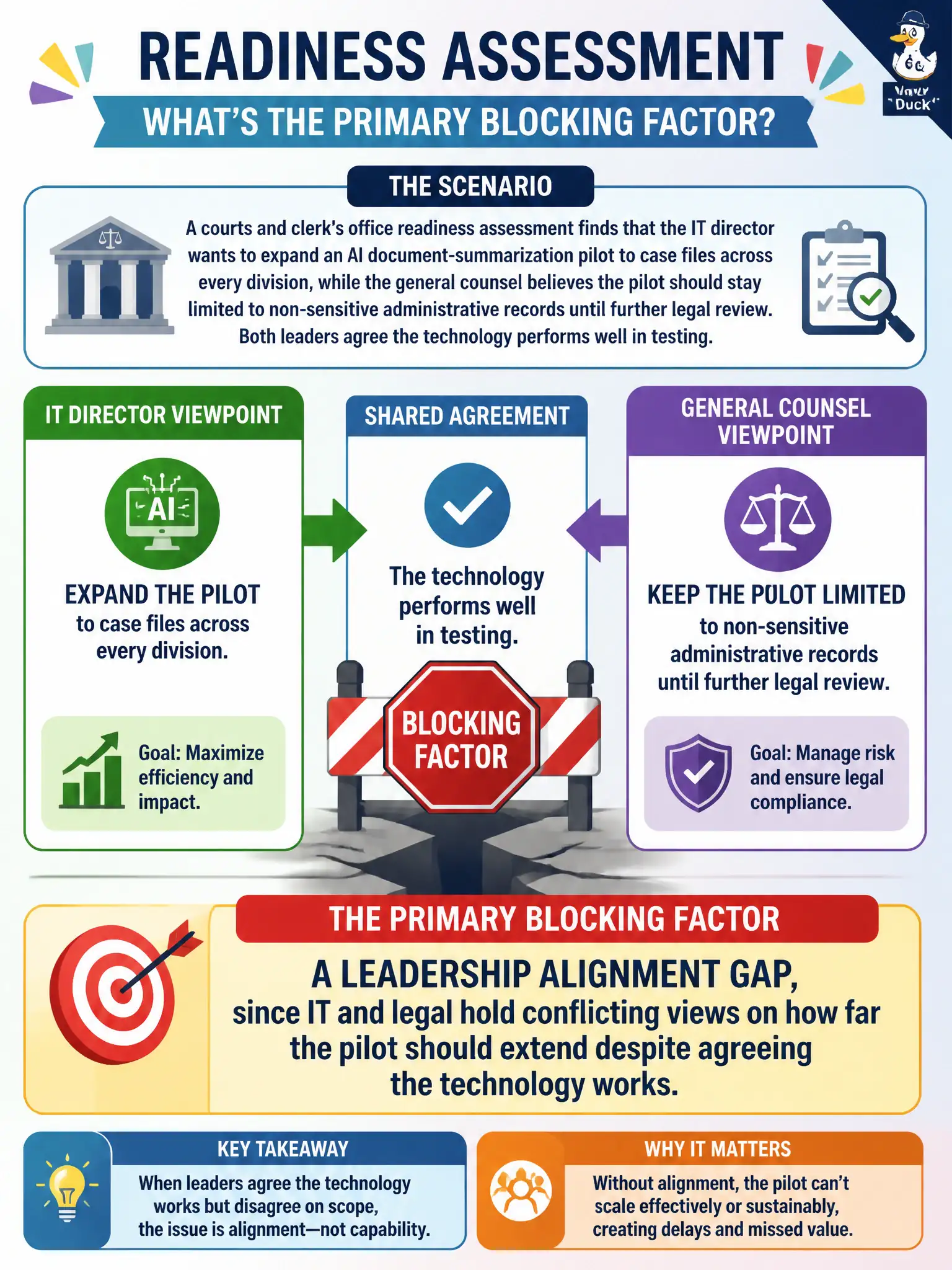
A courts and clerk's office readiness assessment finds that the IT director wants to expand an AI document-summarization pilot to case files across every division, while the general counsel believes the pilot should stay limited to non-sensitive administrative records until further legal review. Both leaders agree the technology performs well in testing. What does this assessment reveal as the primary blocking factor?
Select an answer to reveal the explanation.
Short Explanation
The tech is not the problem here, since both leaders already agree it performs well, so this is really a disagreement about scope and risk tolerance sitting at the top of the org chart. That's a leadership alignment gap, and no amount of retraining the model or adding headcount closes it. Picture two co-pilots who both trust the plane but can't agree on the flight plan.
Full Explanation
Readiness assessments look beyond technical performance because a working tool can still stall if the people responsible for approving its scope disagree. Here, the scenario explicitly states both leaders view the technology as performing well, which removes technical capability as the blocking factor. It also does not mention any funding shortfall or staffing shortage, so those options are not supported by the evidence given. What the scenario does establish clearly is a disagreement between the IT director, who wants to expand broadly, and the general counsel, who wants to limit scope pending legal review, over how far the pilot should extend into sensitive case files. That disagreement sits squarely in the leadership and governance dimension of readiness, not the technology dimension, and it needs to be resolved through structured discussion, a documented decision, or an escalation to a higher authority before the pilot can move forward in either direction. Treating this as a technical or resourcing problem would send the office chasing fixes that do not address the actual disagreement. A scope caveat: alignment does not require full agreement, only a clear, documented decision both leaders will follow. An operational check: confirm whether a documented decision-rights process exists for resolving exactly this kind of disagreement.