
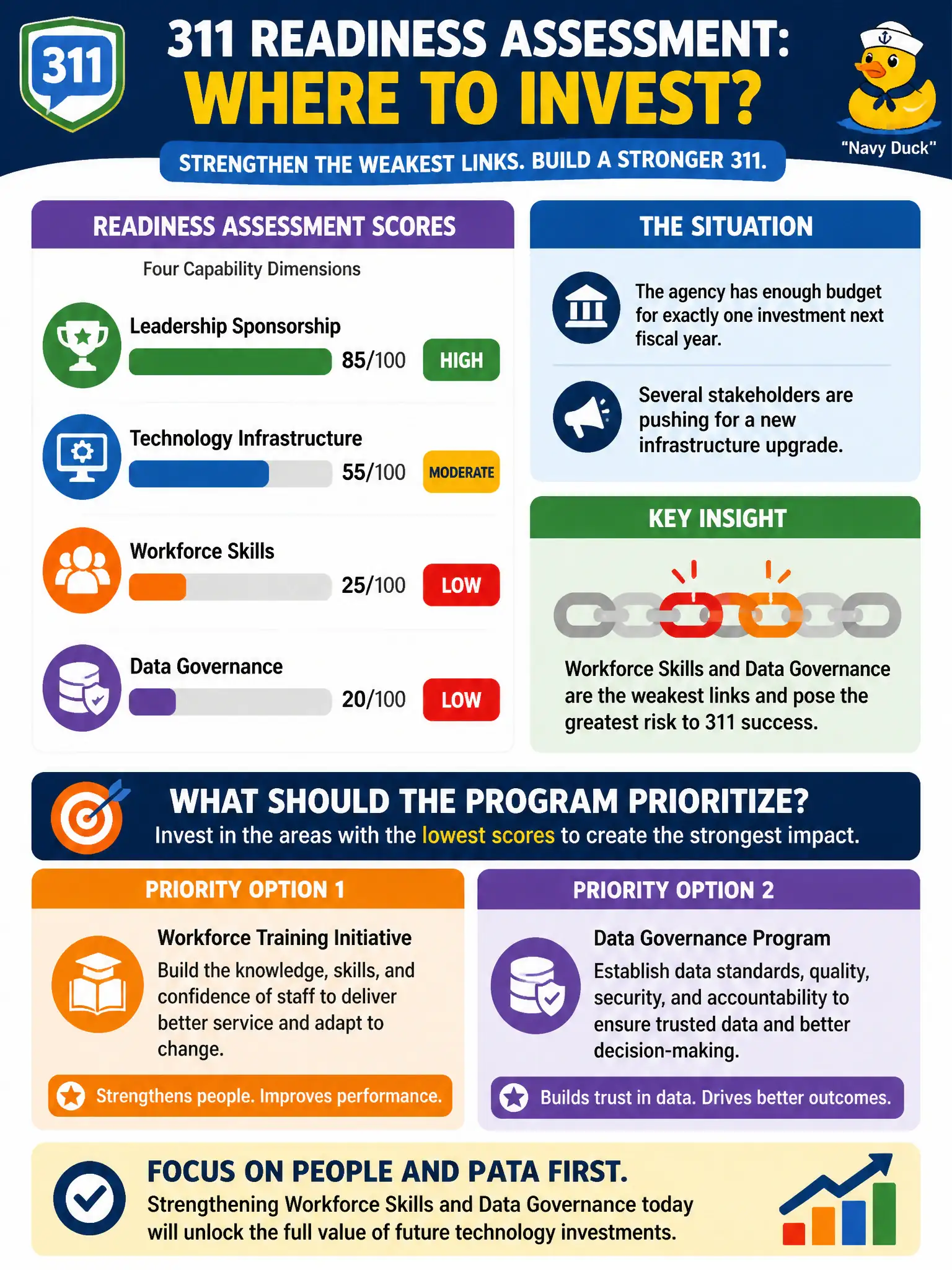
A regional 311 program completes a readiness assessment scoring four capability dimensions: leadership sponsorship scores high, technology infrastructure scores moderate, workforce skills score low, and data governance scores low. The agency has enough budget for exactly one investment next fiscal year, and several stakeholders are pushing for a new infrastructure upgrade. Based on the assessment scores, what should the program prioritize?
Select an answer to reveal the explanation.
Short Explanation
This one's a bit of a trap: the assessment data points to workforce skills and data governance as the weakest links, but the stakeholders are lobbying for infrastructure anyway. A good readiness recommendation follows the scores, not the loudest voice in the room, so the honest answer here is to fund whichever dimension is actually holding the program back. Data should win the argument, even when it's the less popular pick.
Full Explanation
Prioritization exercises in a readiness assessment exist to convert scored evidence into a single, defensible investment decision, especially when budget allows only one choice. In this scenario, leadership sponsorship is already strong and technology infrastructure sits at a moderate score, so neither is the constraint holding the program back. The two lowest scores, workforce skills and data governance, represent the dimensions most likely to limit what the program can safely and effectively do with any AI capability it deploys, which makes one of them the defensible next investment. Choosing the infrastructure upgrade simply because stakeholders are requesting it ignores that infrastructure did not score as the weakest dimension, so funding it would leave the actual gaps unaddressed while appearing responsive to pressure. A new sponsorship campaign misreads the data entirely, since sponsorship already scored high and does not need reinforcement. Deferring to stakeholder preference over the assessment's own scores defeats the purpose of running an assessment in the first place, since the tool exists specifically to counter gut-feel prioritization with evidence. A scope caveat: when two dimensions tie for lowest, a secondary factor such as dependency or urgency can break the tie. An operational check: revisit the assessment a year after the chosen investment to confirm the targeted score actually improved.