
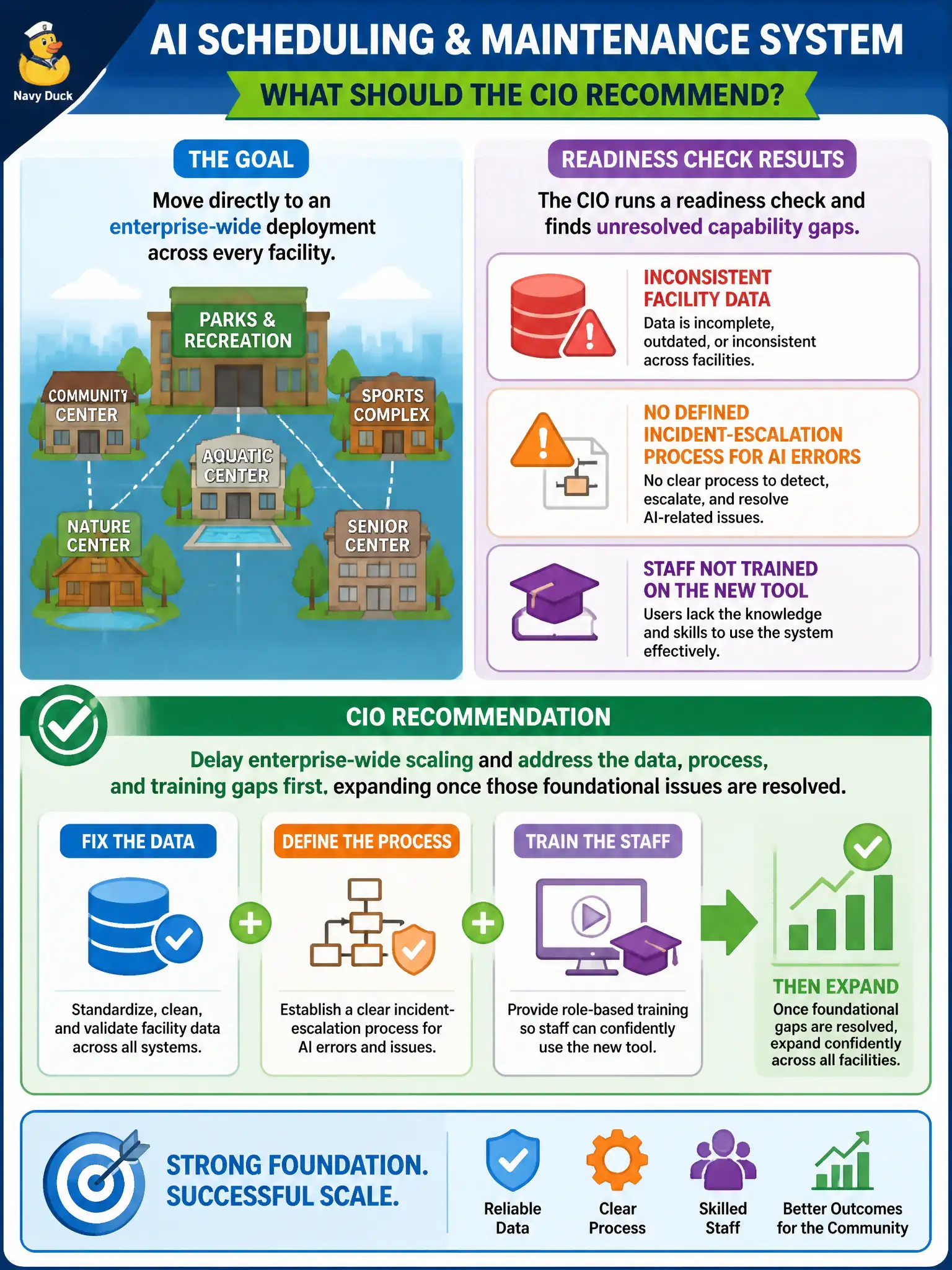
A parks and recreation department wants to move directly to an enterprise-wide deployment of an AI scheduling and maintenance system across every facility. Before approving the rollout, the CIO runs a readiness check and finds unresolved capability gaps: inconsistent facility data, no defined incident-escalation process for AI errors, and staff who have not been trained on the new tool. What should the CIO recommend?
Select an answer to reveal the explanation.
Short Explanation
Scaling something before it's ready just multiplies whatever is broken, so rolling this tool out to every facility right now would spread inconsistent data and untrained staff across the whole department instead of fixing them. The smarter move is to pump the brakes, patch the foundational gaps, and then scale once the tool actually has something solid to stand on. It's the difference between building on bedrock and building on sand and hoping nobody notices.
Full Explanation
A readiness check exists precisely to catch situations like this: enthusiasm for scale outrunning the foundation needed to support it. The scenario names three concrete gaps, inconsistent facility data, no error-escalation process, and untrained staff, each of which would be amplified, not contained, by an enterprise-wide rollout. Proceeding on schedule and hoping vendor support fills the gaps after go-live inverts the correct order of operations, since production incidents are a costly way to discover process gaps that could have been closed beforehand. Limiting the rollout to the largest facilities still exposes the department's highest-traffic sites to the same unresolved issues, so it reduces the footprint of the risk without addressing its cause. Assigning one staff member to monitor every facility for errors treats a structural gap as a staffing workaround, which does not scale and leaves the underlying data and training problems untouched. The defensible recommendation is to pause enterprise scaling, resolve the data quality, escalation process, and training gaps at a manageable pace, and then expand once those foundations hold. A scope caveat: a small, contained pilot to validate fixes is reasonable, but that is different from enterprise-wide deployment. An operational check: confirm whether an escalation path exists and has been tested before any facility count increases.