
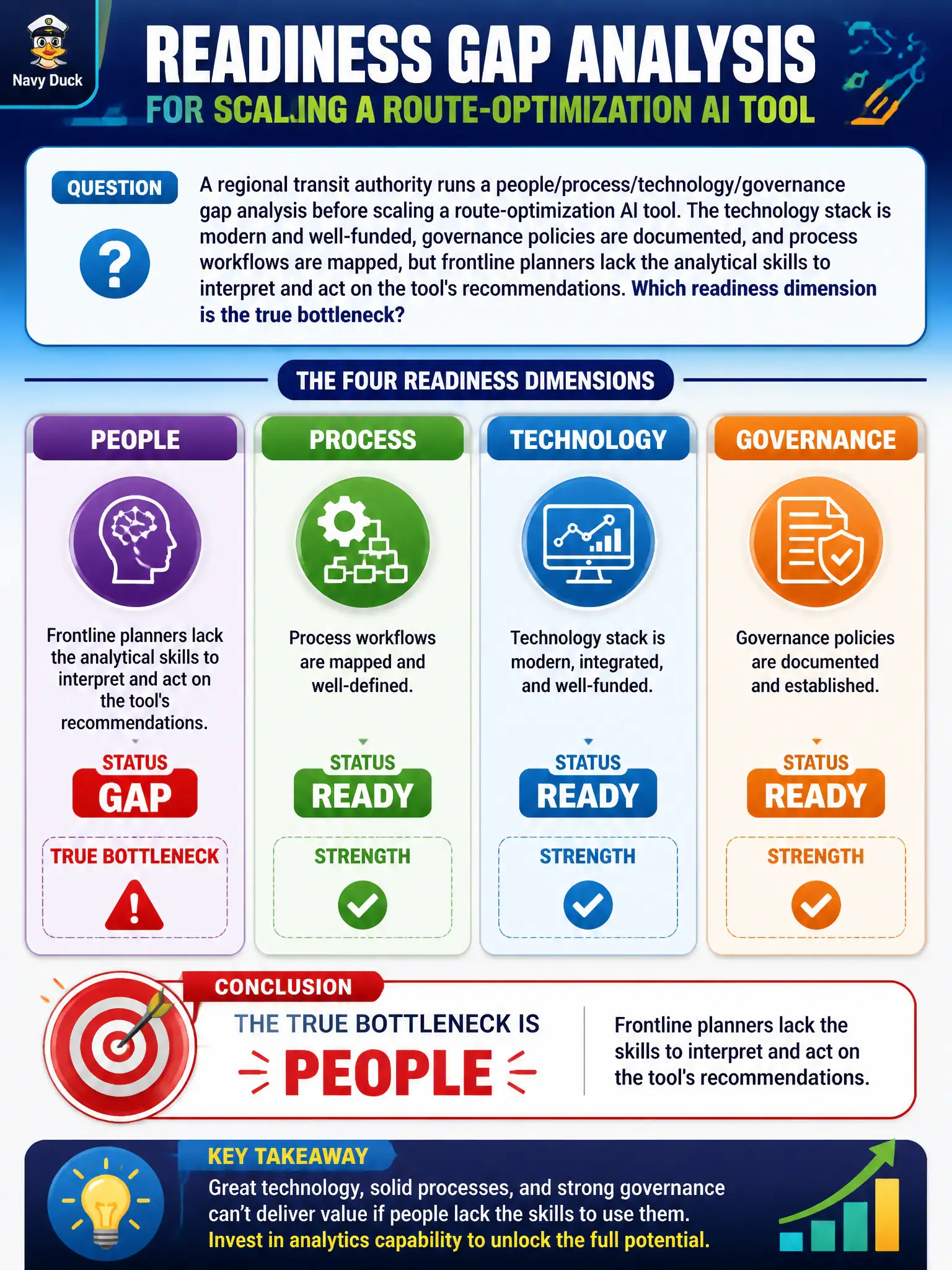
A regional transit authority runs a people/process/technology/governance gap analysis before scaling a route-optimization AI tool. The technology stack is modern and well-funded, governance policies are documented, and process workflows are mapped, but frontline planners lack the analytical skills to interpret and act on the tool's recommendations. Which readiness dimension is the true bottleneck?
Select an answer to reveal the explanation.
Short Explanation
A tool can hand a planner a perfect recommendation, but if nobody on the floor can read what it's saying, the output just sits there unused. Technology, governance, and process all sound solid here; the honest bottleneck is the people dimension, the skills gap standing between a good recommendation and a decision anyone acts on.
Full Explanation
A gap analysis across people, process, technology, and governance exists precisely because strength in three dimensions can mask a real weakness in the fourth, and readiness is bounded by the weakest dimension, not the average. Here the stack is modern, policies are documented, and workflows are mapped, so those three dimensions are not limiting factors; the evidence explicitly points to frontline planners lacking the analytical skills to interpret and act on recommendations, which is a workforce capability gap. Naming technology as the bottleneck misreads the evidence, since the scenario states the infrastructure is already modern and funded, with no described technical shortfall. Governance ratification is a real process step in some organizations, but nothing in the evidence suggests the documented policies are stalled in approval; the described gap sits with the planners, not the policy. Framing the process dimension as needing automation ignores that workflows are already mapped, which is the process deliverable readiness assessments look for. Scope note: a skills gap can sometimes signal an underlying change-management or trust issue rather than raw ability, so root-causing matters before designing training. Operational check: observe a sample of planners applying the tool's recommendations to confirm whether the barrier is skill, trust, or something else entirely.