
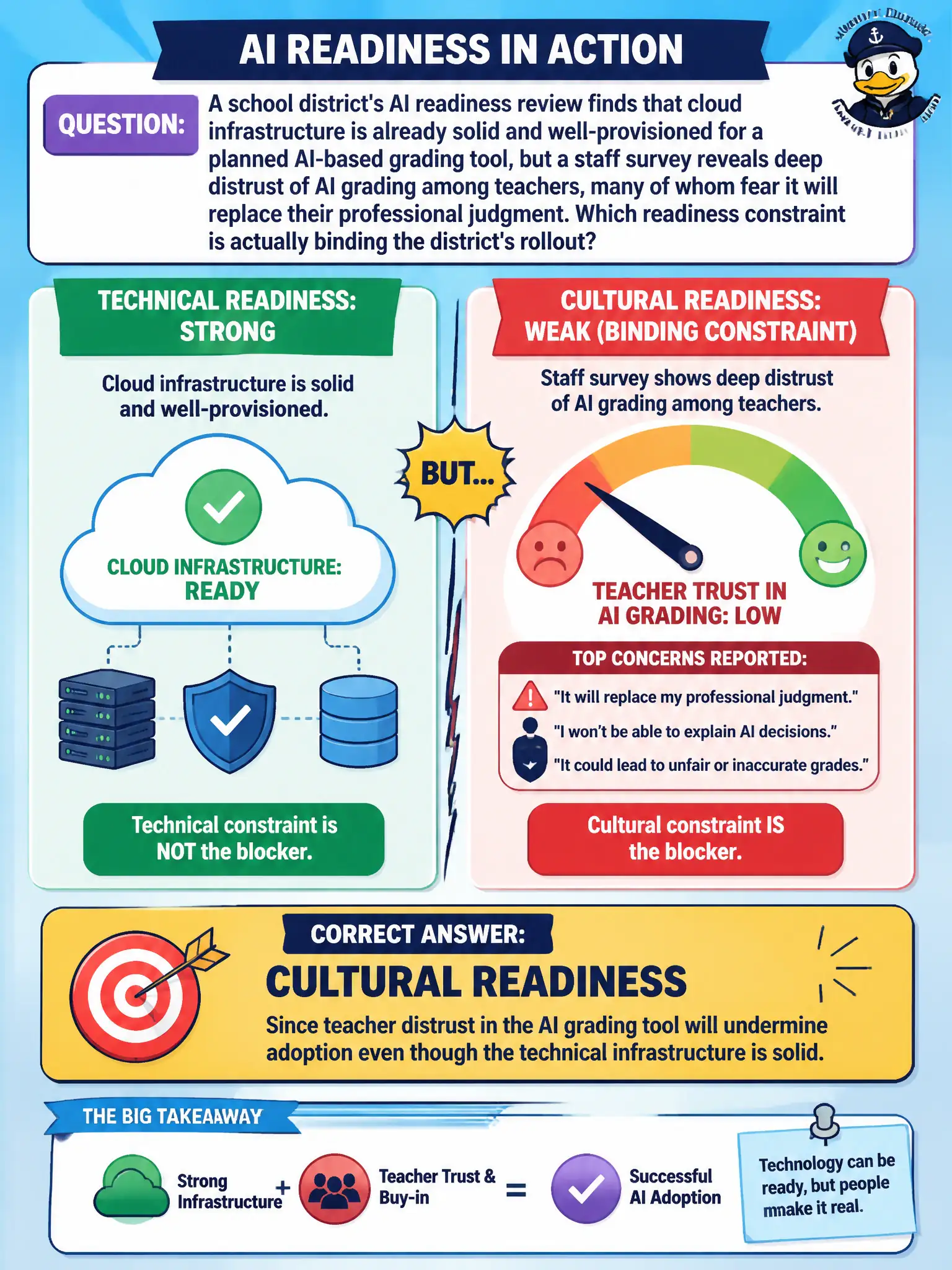
A school district's AI readiness review finds that cloud infrastructure is already solid and well-provisioned for a planned AI-based grading tool, but a staff survey reveals deep distrust of AI grading among teachers, many of whom fear it will replace their professional judgment. Which readiness constraint is actually binding the district's rollout?
Select an answer to reveal the explanation.
Short Explanation
Cloud servers don't grade papers, teachers do, or in this case decide whether to trust a tool that grades papers for them. The infrastructure being ready doesn't matter much when the people expected to use it don't believe in it yet; that trust gap is the cultural readiness constraint actually holding this rollout back.
Full Explanation
Readiness assessments cover multiple dimensions because a strong score in one area does not guarantee a successful rollout if another dimension lags behind. Here the technology dimension is explicitly solid, so the binding constraint must lie elsewhere, and the survey evidence points directly at cultural readiness: teachers who distrust the tool and fear it will replace their professional judgment are unlikely to adopt it faithfully, no matter how well the servers perform. Calling this a technical readiness gap misreads the evidence, since the scenario states infrastructure is already well-provisioned, with no described shortfall there. Framing it as a financial gap invents a budget concern the scenario never raises, and licensing cost has no bearing on whether teachers trust the tool once it is available. Citing regulatory approval as the blocker also introduces information not present in the scenario, and even an approved tool can fail to gain traction if the people using it distrust it. Scope note: cultural resistance sometimes signals a legitimate concern about accuracy or fairness rather than plain discomfort with change, so leadership should investigate the root of the distrust. Operational check: run a listening session or a volunteer pilot and measure whether transparency about how the tool works shifts trust before a district-wide rollout.