
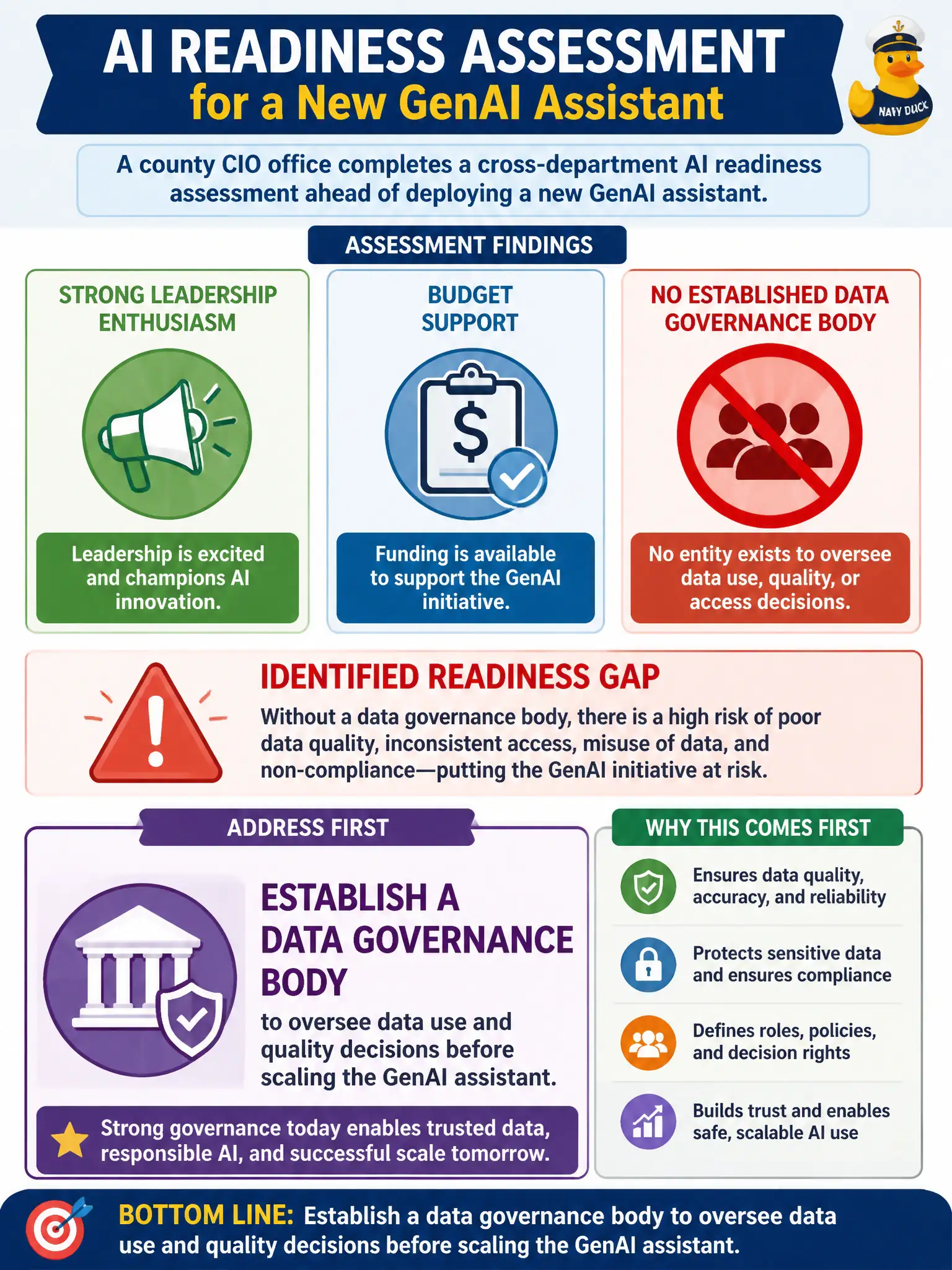
A county CIO office completes a cross-department AI readiness assessment ahead of deploying a new GenAI assistant. The findings show strong leadership enthusiasm and budget support, but no established data governance body exists to oversee data use, quality, or access decisions. Which readiness gap should the office address first?
Select an answer to reveal the explanation.
Short Explanation
Leadership enthusiasm is like a green light at an intersection with no traffic signal installed yet: exciting, but it doesn't mean it's safe to go. Data governance is the signal that decides who touches what data and how, and skipping it just moves the risk downstream to the pilot itself. Get that body standing before you accelerate, not after.
Full Explanation
Enthusiasm and budget are necessary but not sufficient conditions for responsible AI deployment; they create momentum, but momentum without governance means decisions about data access, quality standards, and appropriate use get made ad hoc or not at all. A data governance body is the structure that answers foundational questions, such as which datasets can feed the assistant, who approves changes, and how quality or bias issues get escalated, before those questions surface as incidents in production. Establishing it first converts enthusiasm into a program with guardrails, rather than a fast start that outruns its own controls. Launching the pilot on enthusiasm alone treats governance as something to retrofit later, but retrofitting oversight after an assistant is already touching county data is far harder than building it in from the start. Hiring more engineers addresses development capacity, not the absence of decision-making structure, and more engineers building on ungoverned data just produces the same problem faster. Expanding end-user training improves adoption and comfort but does nothing about how data feeding the assistant is sourced, validated, or controlled. Scope note: a lightweight interim governance charter can suffice if a full body takes time to convene. Operational check: confirm a named governance owner and a documented data-approval process exist before the pilot touches live county data.