
A school district competing for enrollment against nearby open-enrollment options is deciding how to position its AI-personalized learning program to prospective families. Which approach best uses the program as a competitive differentiator?
Select an answer to reveal the explanation.
Short Explanation
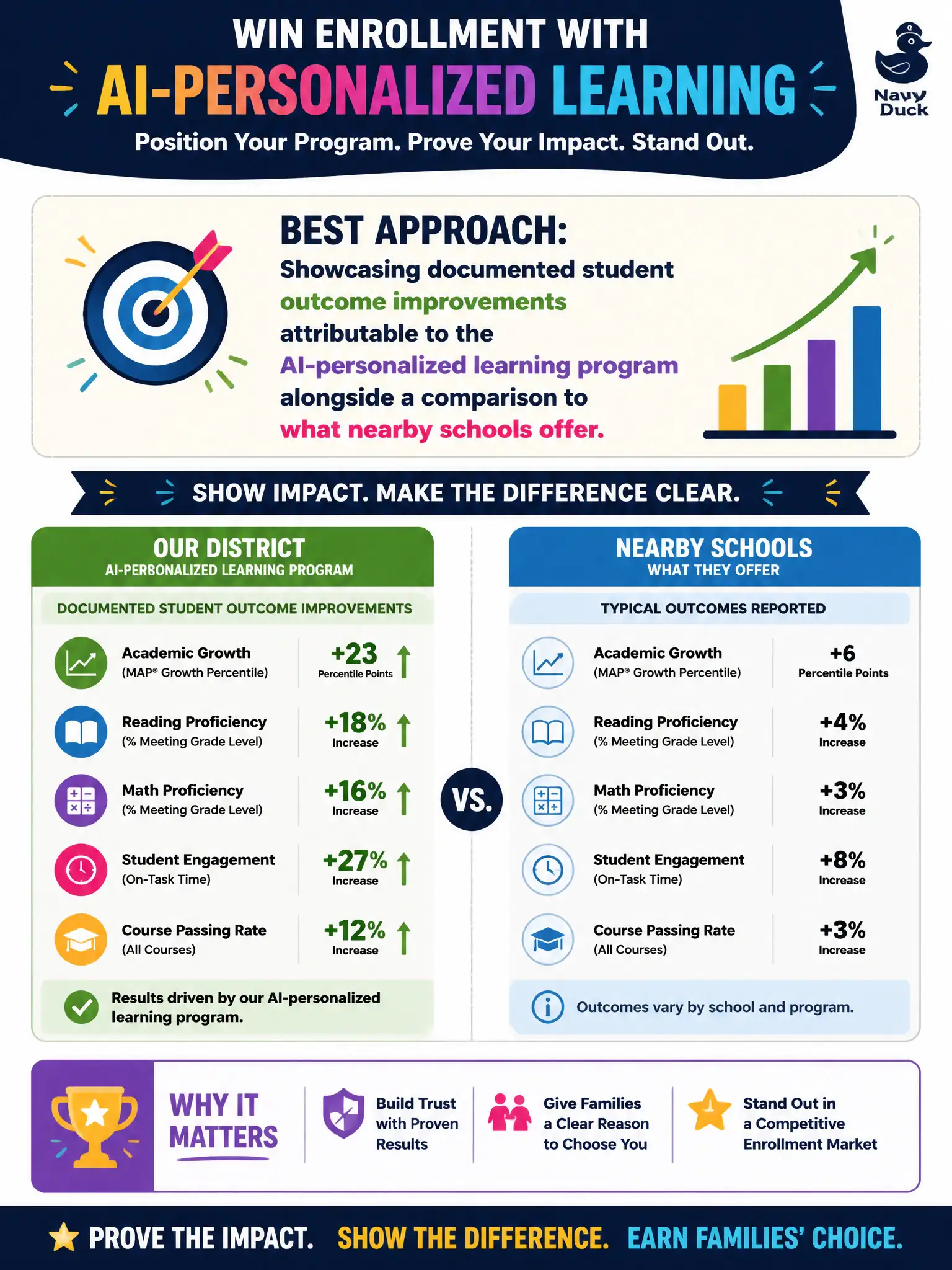
Think of it like choosing a summer camp for your kid: you care whether campers actually learn to swim, not which pool-filtration company the camp hired. Families choosing schools respond to outcomes their kids will experience, so the winning pitch here is real learning gains stacked up against what the school down the road offers. Vendor names and budget lines just don't move a parent's decision the way results do.
Full Explanation
Positioning a program as a competitive differentiator for enrollment-driven decisions works best when it speaks to the outcome families actually care about: whether their child will learn more effectively. Showcasing documented student outcome improvements, framed against what nearby open-enrollment schools offer, gives prospective families a concrete, comparable reason to choose the district, which is the core purpose of competitive positioning in this context. Emphasizing vendor counts describes the district's procurement footprint, not anything a parent can use to judge educational quality. Leading with technical architecture targets a technical audience, not the families making enrollment decisions, so it fails to connect capability to a benefit they can evaluate. Highlighting reduced technology spending describes internal efficiency, and lower spending is not inherently persuasive to a family and could even read as under-investment. One caveat for the exam: outcome claims need a credible evaluation method behind them, so a strategist should verify the improvement is measured against a comparable baseline, such as a prior cohort or similar schools, before using it in enrollment marketing.