
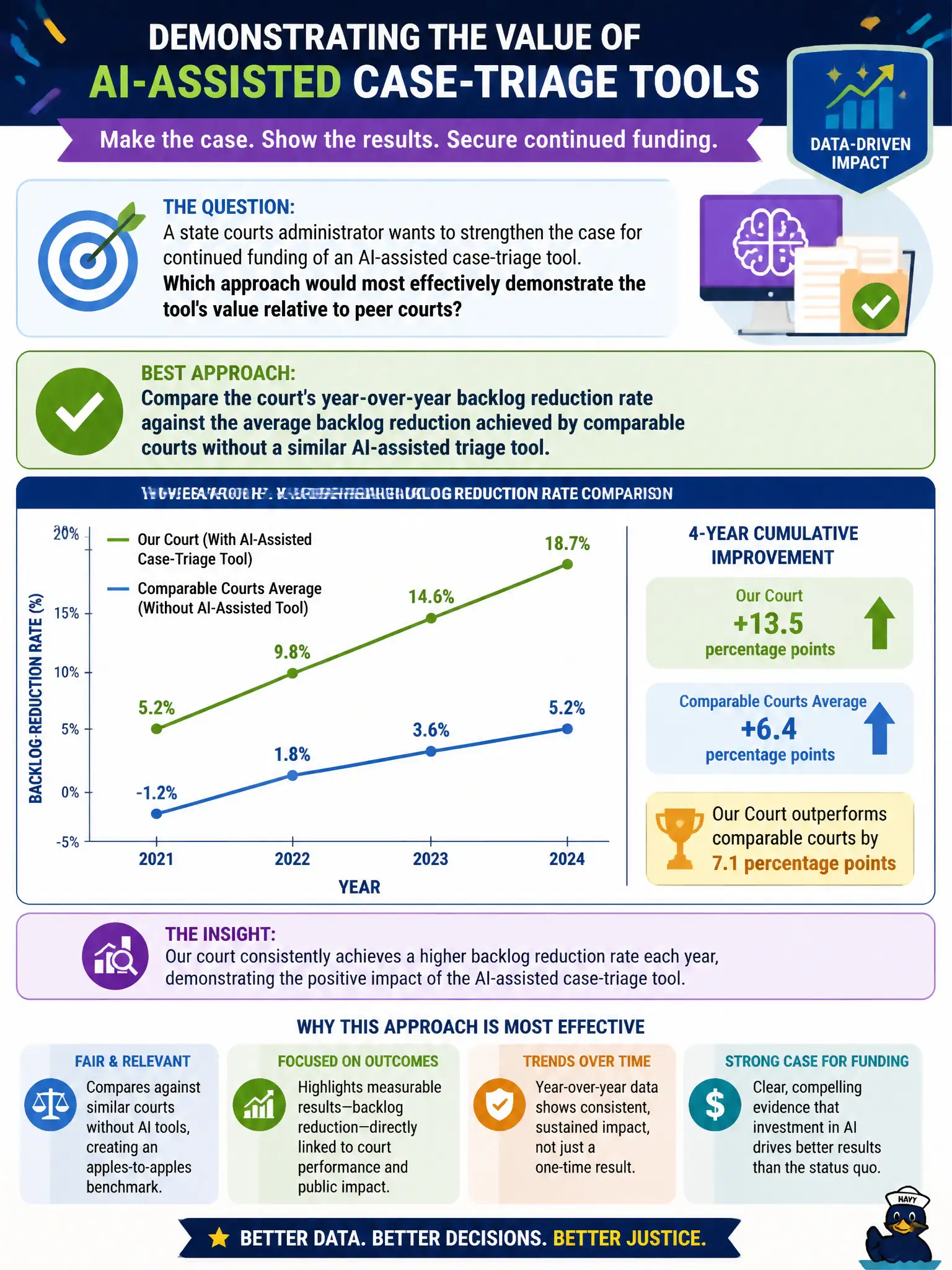
A state courts administrator wants to strengthen the case for continued funding of an AI-assisted case-triage tool. Which approach would most effectively demonstrate the tool's value relative to peer courts?
Select an answer to reveal the explanation.
Short Explanation
Think of it like a school showing off test-score gains compared to similar schools, not just bragging about how many new textbooks it bought. Funding decisions respond to proof that a program moved the needle faster than the alternative, so the strongest case here is backlog reduction measured against peer courts, not spending totals or headcounts. That's the number that answers the only question that matters: is this actually working better than doing it the old way?
Full Explanation
A funding case is strongest when it shows a measurable operational outcome improving faster than a credible baseline, and comparing backlog reduction rates against peer courts without similar AI-assisted triage does exactly that. It isolates the tool's contribution by holding the comparison group roughly constant, which lets funders see that the improvement is plausibly attributable to the technology rather than to unrelated factors like staffing changes. Counting integrated algorithms describes technical complexity, not outcomes, and a funder cannot tell from that number whether the backlog moved at all. Citing total vendor spending describes cost, and higher spending alone does not demonstrate value; it can just as easily raise questions about return on investment. Staff satisfaction surveys capture a useful but secondary signal about usability and change management, but they don't quantify the operational result funders care about most. One caveat for the exam: peer comparisons need roughly similar caseloads and court types to be credible, so a strategist should confirm the comparison group is a reasonable match before presenting the figures to a funding body.