
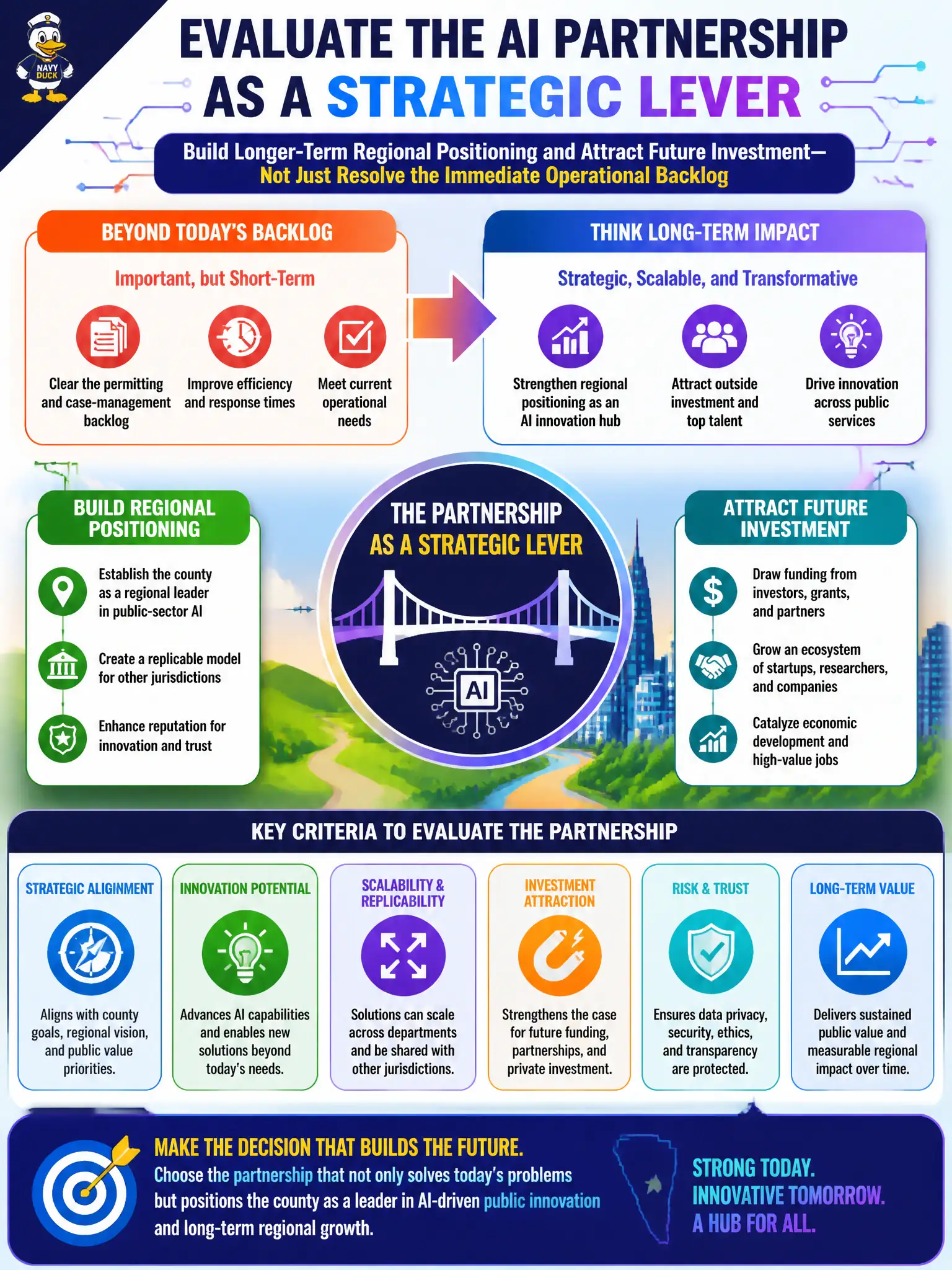
A county government is considering a formal partnership with a private AI research lab. Beyond solving its current backlog of permitting and case-management requests, county leaders want the partnership to establish the county as a regional hub for public-sector AI innovation and draw further outside investment. How should leadership evaluate this partnership decision?
Select an answer to reveal the explanation.
Short Explanation
Think of it like a small town landing a university research campus: the point isn't just filling potholes faster, it's becoming the place other people want to build next. Leadership should weigh the partnership as a long-term positioning play, not just a fix for this year's backlog.
Full Explanation
Strategic partnerships can serve two purposes at once: solving an immediate operational problem and building durable positioning that compounds over time, such as attracting additional investment, talent, or follow-on collaborations once the county is known as a regional AI hub. Evaluating the decision only against the current-year backlog treats a multi-year positioning opportunity as a narrow procurement question, which risks undervaluing the partnership or structuring it in a way that limits future upside. Insisting the lab fully operate the county's systems indefinitely trades away the internal capability-building that typically makes a partnership valuable beyond the initial engagement, and creates long-term dependency risk. Rejecting private collaboration outright ignores that many public-sector AI strategies rely on external partnerships precisely because building all capability internally is slower and costlier, especially for a county without conventional access to top identical private-sector talent. A caveat: positioning value is real but harder to quantify than backlog metrics, so leadership should pair the qualitative reputational goal with a few tangible tracked indicators. A useful operational check is whether the partnership agreement includes explicit terms for knowledge transfer, co-branding, or follow-on opportunities, not just a service-delivery scope.