
An emergency-management agency deployed an AI-assisted dispatch system that consistently cuts response coordination time during regional mutual-aid events, outperforming neighboring jurisdictions still using manual dispatch coordination. How should agency leadership frame this capability when engaging regional partners and elected officials?
Select an answer to reveal the explanation.
Short Explanation
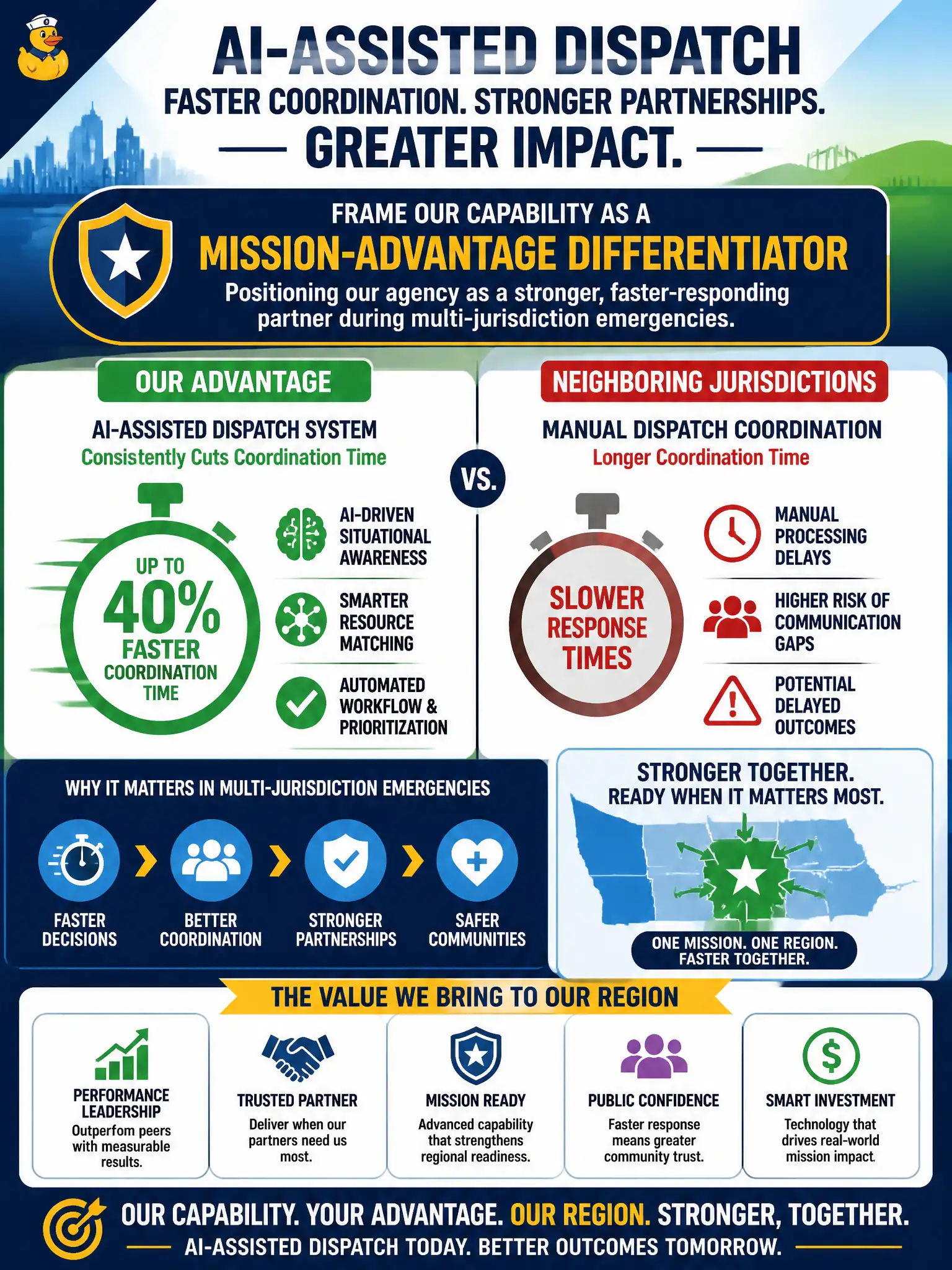
Think of it like a fire crew known for arriving faster than the next town over. That reputation for speed is worth talking about. Leadership should frame the faster dispatch as a mission-advantage that makes the agency the partner other jurisdictions want leading a mutual-aid response.
Full Explanation
In a public-safety context, competitive positioning isn't about market share, it's about mission performance: being demonstrably faster and more reliable during shared emergencies builds the agency's standing as a lead coordinator in regional mutual-aid networks. Framing the capability as a mission-advantage differentiator communicates concrete value to elected officials and partner agencies in terms that matter to them, response effectiveness and public safety outcomes, not internal IT metrics. Describing it as routine maintenance undersells a capability that measurably outperforms peer jurisdictions and could inform regional planning or resource allocation. Framing it primarily as staffing cost reduction misdirects the narrative toward efficiency at the expense of the outcome that actually matters operationally, faster coordinated response. Withholding discussion until every neighbor catches up forfeits an opportunity to build regional trust and influence, and mutual-aid networks generally benefit from transparency about which partner brings which capability. A caveat: claims of faster response should be backed by consistent, audited performance data across multiple actual events, not a single favorable incident. Before making this the public narrative, confirm the response-time improvement holds up across a representative sample of mutual-aid activations, not just the best cases.