
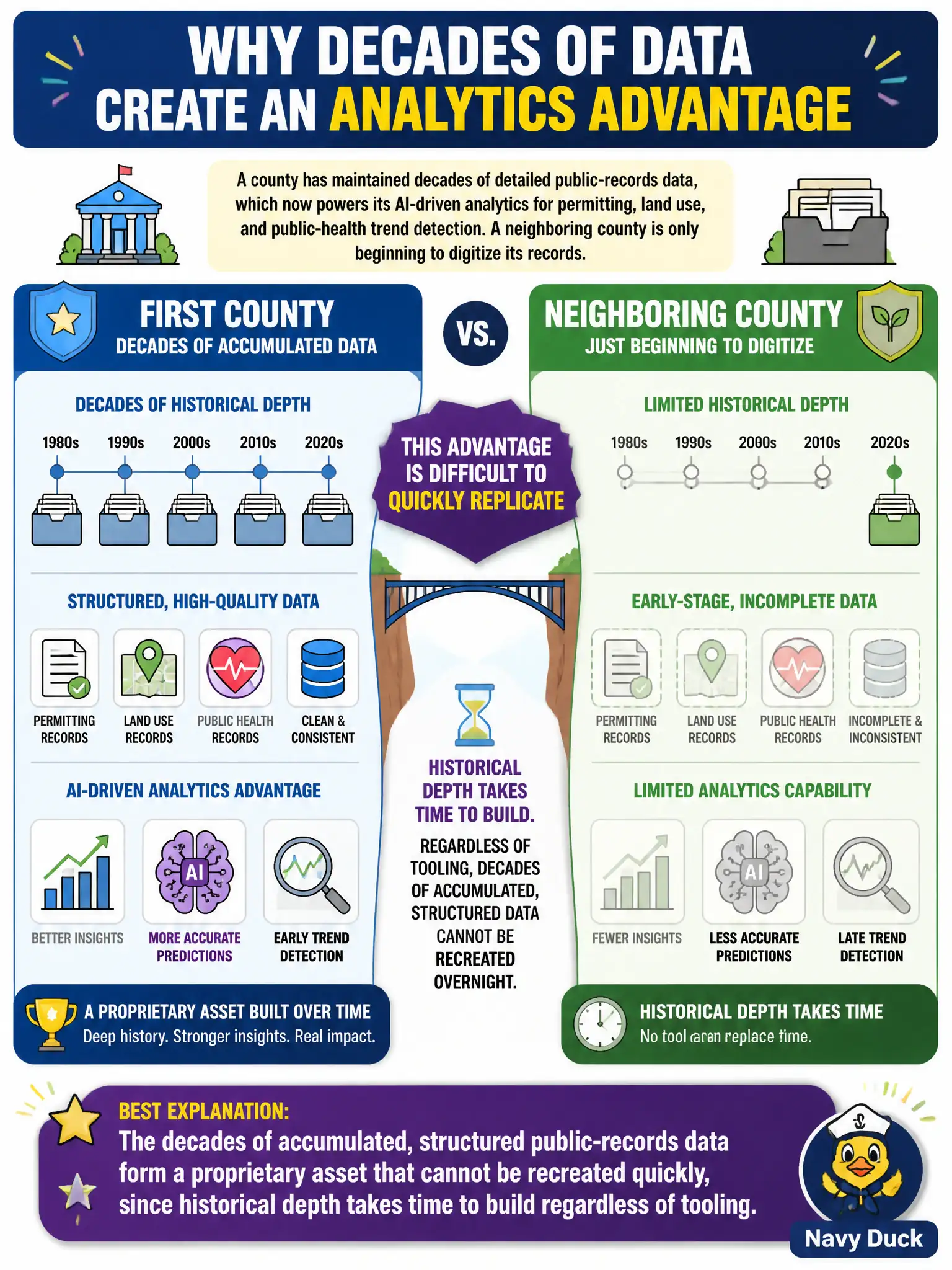
A county has maintained decades of detailed public-records data, which now powers its AI-driven analytics for permitting, land use, and public-health trend detection. A neighboring county is only beginning to digitize its records. What best explains why the first county's analytics advantage is difficult for its neighbor to quickly replicate?
Select an answer to reveal the explanation.
Short Explanation
Think of it like a library that's been collecting local records for fifty years versus one just opening its doors. The data, not the AI model, is the hard-to-copy asset here, because history can't be digitized overnight.
Full Explanation
A durable competitive or mission advantage in AI often comes from proprietary data assets rather than access to a particular model, since most organizations can eventually license comparable AI capabilities but cannot instantly manufacture decades of accumulated, high-quality records. The first county's structured historical dataset lets its analytics detect long-run trends and patterns that a newly digitizing neighbor simply has no equivalent data to support, and that gap closes only as fast as new records accumulate. Attributing the difference to a superior model misplaces the advantage at the tooling layer, when the same model applied to a shallow dataset would produce far weaker results. Citing general staff computer familiarity treats a data-depth problem as a skills problem, which does not explain why analytics quality specifically depends on historical record depth. Assuming a budget gap will close automatically ignores that money can buy digitization capacity but cannot buy back the decades already elapsed. One caveat: data volume alone isn't sufficient if quality or consistency is poor, so the advantage depends on the records being reasonably structured and maintained. A good operational check is whether the analytics outputs degrade meaningfully when tested against a shorter historical window.