
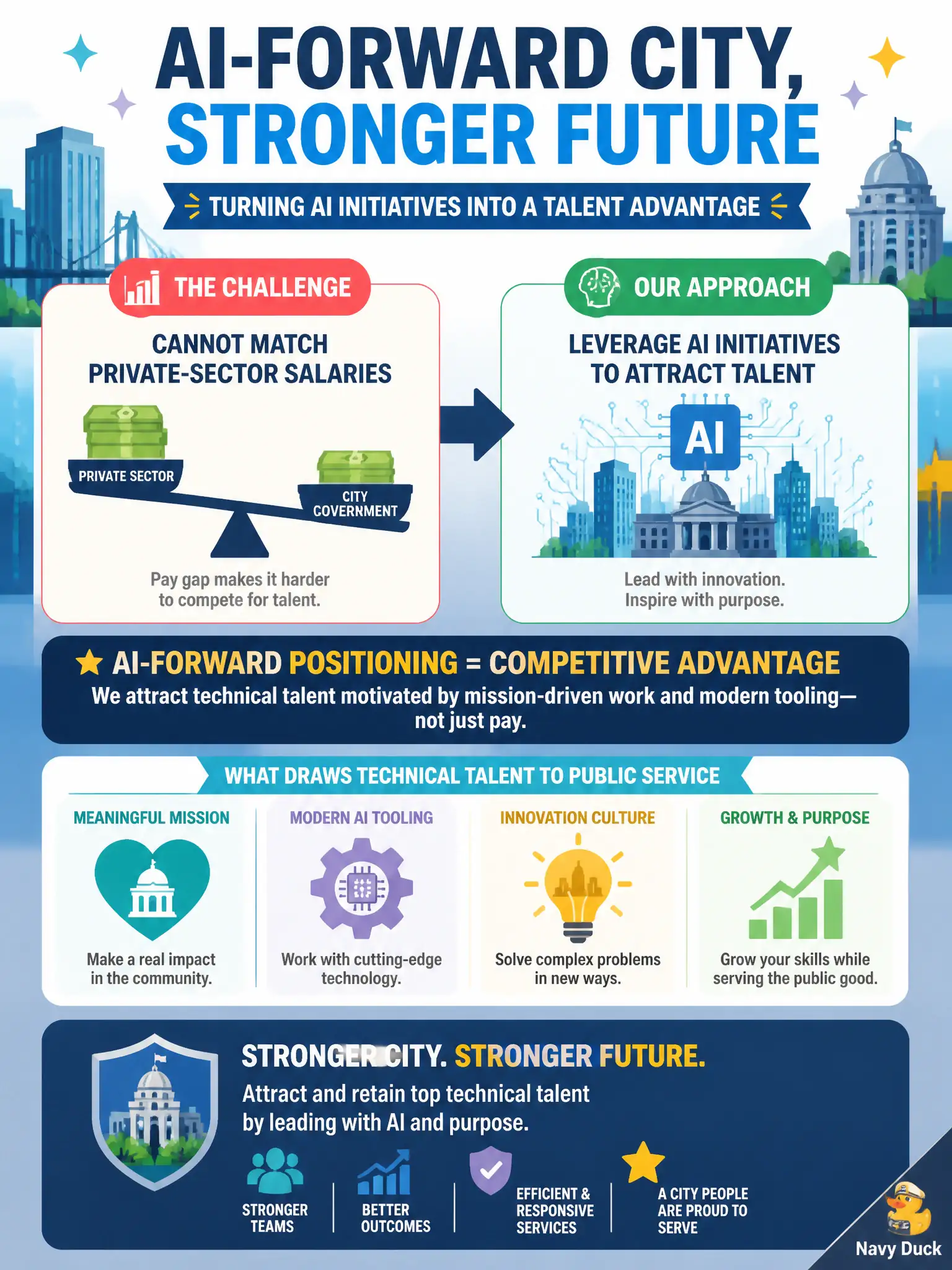
A city government cannot match private-sector salaries for data and AI roles, so it wants to use its AI initiatives to attract technical talent into public-service careers instead. Which framing best captures the strategic value of this approach?
Select an answer to reveal the explanation.
Short Explanation
Think of it like a nonprofit that can't out-pay a bank but wins talent with mission and interesting work. Being seen as an AI-forward employer is a competitive lever in the labor market, separate from what it costs to actually run the tools.
Full Explanation
Talent attraction is one of several distinct value levers AI adoption can create for an organization, alongside cost savings, service quality, and risk reduction, and it operates through a different mechanism than any of those. When a city can't compete on salary, offering technical staff the chance to work with modern AI tooling on mission-driven public problems becomes a differentiator in recruiting, functioning much like an employer brand strategy in the private sector. Treating this as a payroll-reduction play conflates workforce positioning with automation-driven cost cutting, which is a separate value category with its own tradeoffs around service continuity. Calling the hiring effect incidental undersells that talent scarcity in public-sector technical roles is a known strategic constraint, so deliberately leveraging AI initiatives to address it is a planned strategy, not a side effect. Treating it as a compliance exercise misreads the driver entirely, since attraction value comes from voluntary appeal to candidates, not a mandated reporting obligation. A caveat: talent-attraction value should still be tracked with a real metric, such as technical-role applicant volume or retention, rather than treated as self-evident. Check whether the agency's workforce plan cites AI initiatives as a recruiting differentiator.