
A county's AI value-tracking dashboard reports metrics quarterly, but the steering committee is struggling to catch performance drift or emerging bias issues before they compound across several deployed AI systems. What should the office do to better align reporting cadence with the committee's oversight needs?
Select an answer to reveal the explanation.
Short Explanation
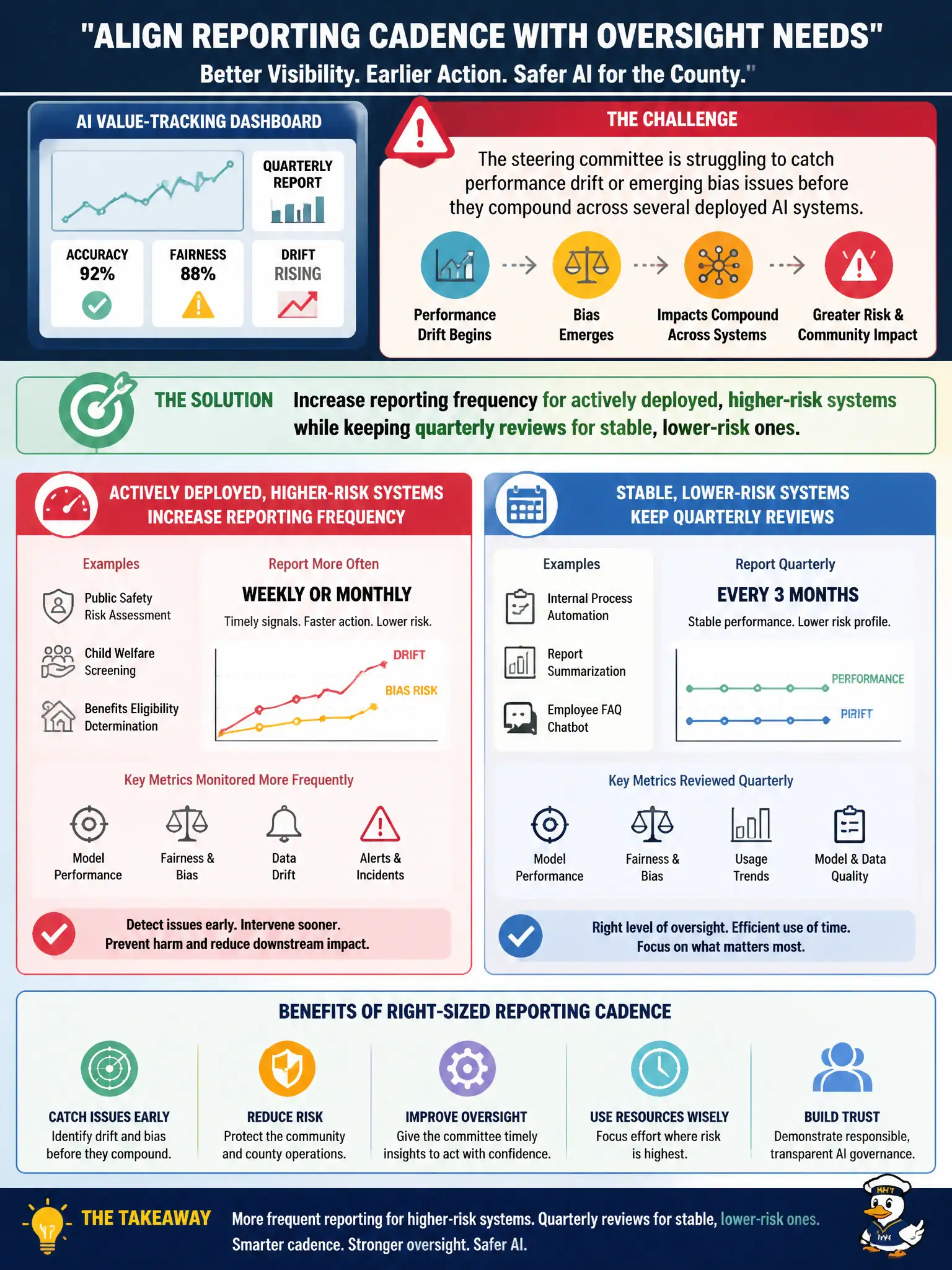
Think of it like a car dashboard: you don't need the oil-pressure light updating once a quarter if the engine is under strain right now. High-risk, actively running systems need faster cadence so problems surface while they're still small and cheap to fix; stable systems can stay on the slower quarterly rhythm.
Full Explanation
Oversight cadence should be risk-proportional, not uniform. Systems that are newly deployed, touch vulnerable populations, or have shown volatility need shorter feedback loops so drift, bias, or degraded outcomes are caught before they compound into larger harms or costly rework. Stable, well-understood systems with a track record of consistent performance can reasonably stay on a slower review cycle, since more frequent reporting there adds overhead without adding much insight. Simply adding more metrics to the same quarterly cycle doesn't fix the underlying problem, because the issue is timing, not data volume. Stretching to annual reporting moves in the wrong direction entirely, widening the blind spot the committee is already worried about. Removing the topic from steering-committee review conflates operational monitoring with governance accountability; the committee still needs visibility even if technical staff do the detailed monitoring. One caveat for the exam: cadence changes should be documented in the governance charter so accountability stays traceable. A practical check is to ask, for each deployed system, how long it could silently underperform before real harm accrues, and set that system's reporting interval shorter than that window.