
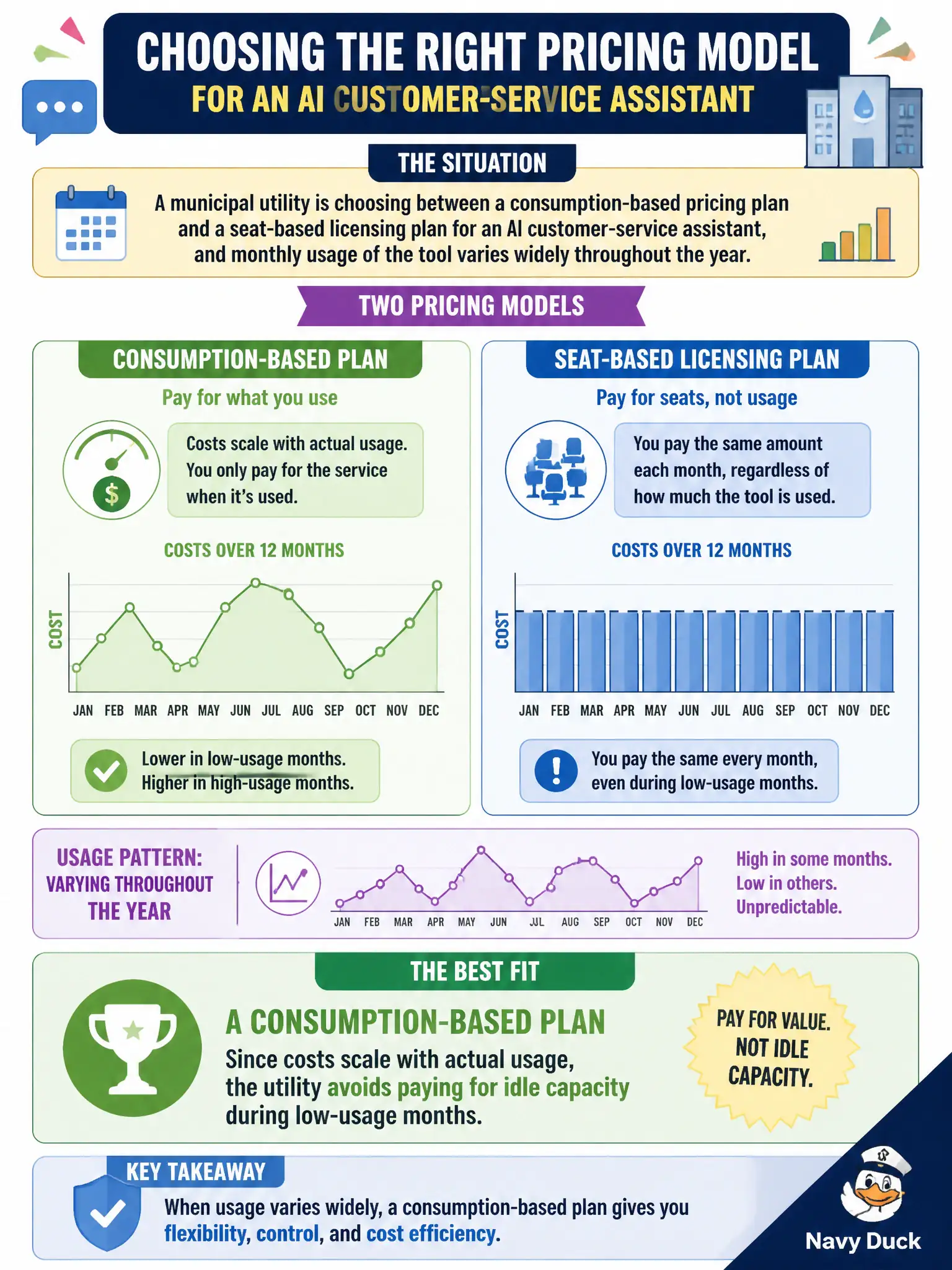
A municipal utility is choosing between a consumption-based pricing plan and a seat-based licensing plan for an AI customer-service assistant, and monthly usage of the tool varies widely throughout the year. Which pricing model best fits this usage pattern?
Select an answer to reveal the explanation.
Short Explanation
Think of it like paying for a taxi instead of leasing a car you barely drive most months: when usage swings a lot, consumption-based pricing keeps your bill tied to what you actually use instead of what you signed up for.
Full Explanation
Consumption-based pricing charges for the AI assistant in proportion to actual usage, so cost contracts during slow months and expands during high-demand periods like storm-related outage spikes. Seat-based licensing instead charges a fixed amount regardless of how much the tool is used, so the utility pays the same rate whether usage is high or nearly idle, creating a mismatch between cost and value when demand swings widely. Favoring seat-based pricing for administrative simplicity trades away cost efficiency for convenience, a weaker fit when usage swings are large enough to matter financially. Framing usage-driven costs as an obstacle to capital budgeting misreads the situation, since consumption pricing can still be forecast using a reasonable usage range; seat-based costs aren't inherently better suited to multi-year planning. A hybrid plan that stacks full seat fees on top of consumption overages doesn't blend the advantages of both models, it just adds a second cost layer on top of the fixed one. An operational check is to model the utility's actual monthly usage against both pricing structures over a full year to compare total cost, not just cost in an average month. The caveat: extremely stable, high-volume usage tends to favor seat-based or committed pricing instead, so this recommendation is specific to genuinely variable demand.