
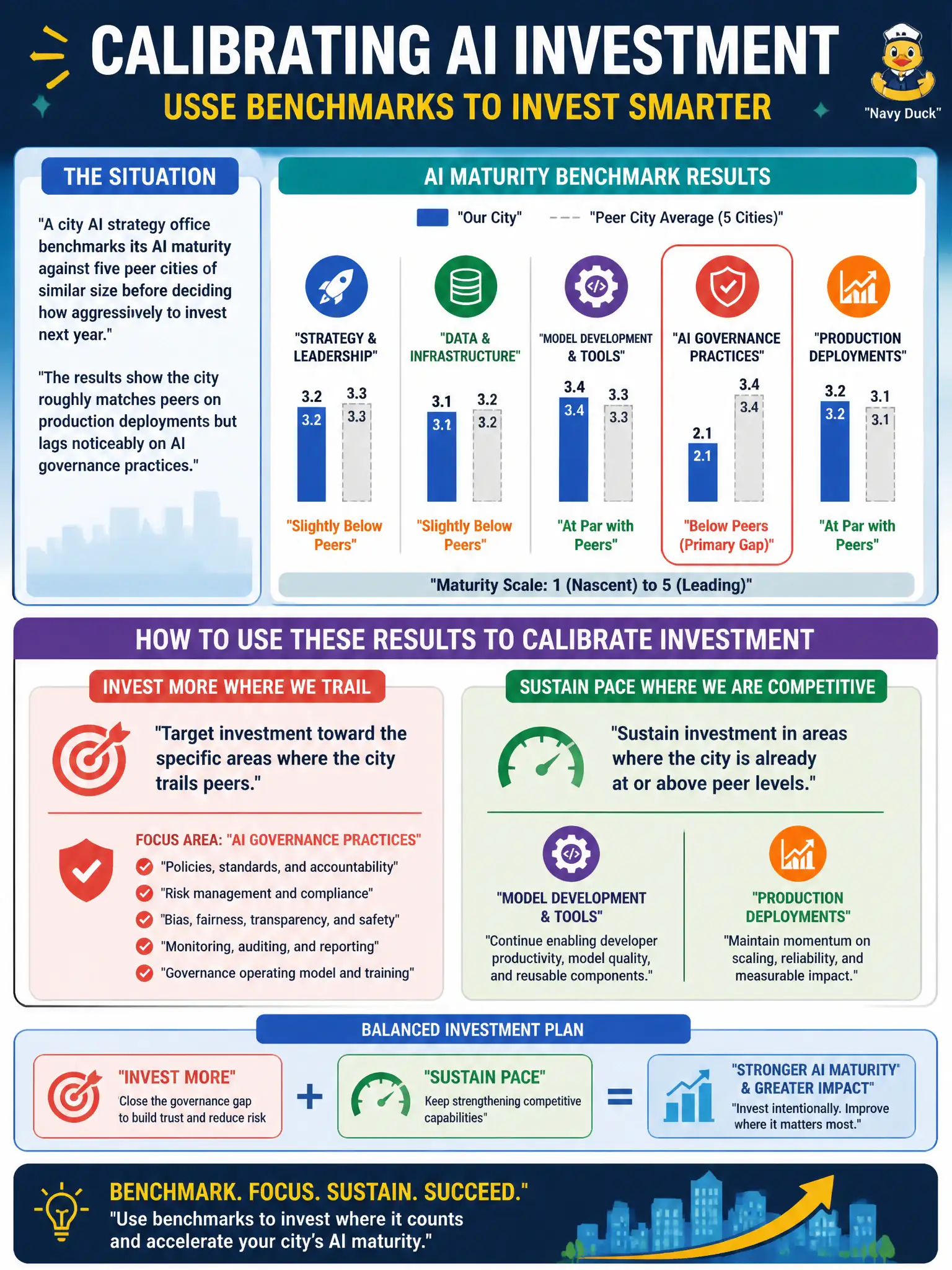
A city AI strategy office benchmarks its AI maturity against five peer cities of similar size before deciding how aggressively to invest next year. The results show the city roughly matches peers on production deployments but lags noticeably on AI governance practices. How should the office use these results to calibrate its investment plan?
Select an answer to reveal the explanation.
Short Explanation
Think of it like triage: you don't spend the whole budget fixing the parts that already work fine. Peer benchmarking tells you where the real gaps are, so investment should chase the gaps, in this case governance, rather than get spread evenly or maxed out everywhere.
Full Explanation
Peer benchmarking is only useful if its output changes where money goes. Once the assessment shows the city is competitive on deployment volume but behind on governance, the efficient move is to concentrate incremental investment on closing the governance gap while maintaining current momentum on deployments, because that's where the marginal dollar produces the most risk reduction and strategic catch-up. Investing at maximum intensity everywhere ignores the benchmark's actual finding and burns budget on areas that aren't underperforming. Waiting to match the single most advanced peer in every category turns a diagnostic tool into a paralysis trigger, and the city forgoes value it could be capturing today. Matching the peer average uniformly treats the benchmark as a target to mirror rather than a signal to interpret, and it ignores that the city's own gap profile is uneven. A relevant exam caveat: peer benchmarks describe relative position, not absolute sufficiency, so a city that ties its peers on governance could still be exposed if the whole peer group is behind best practice. A good operational check is to map each benchmark category to a specific gap-closing initiative with its own budget line before finalizing the investment plan.