
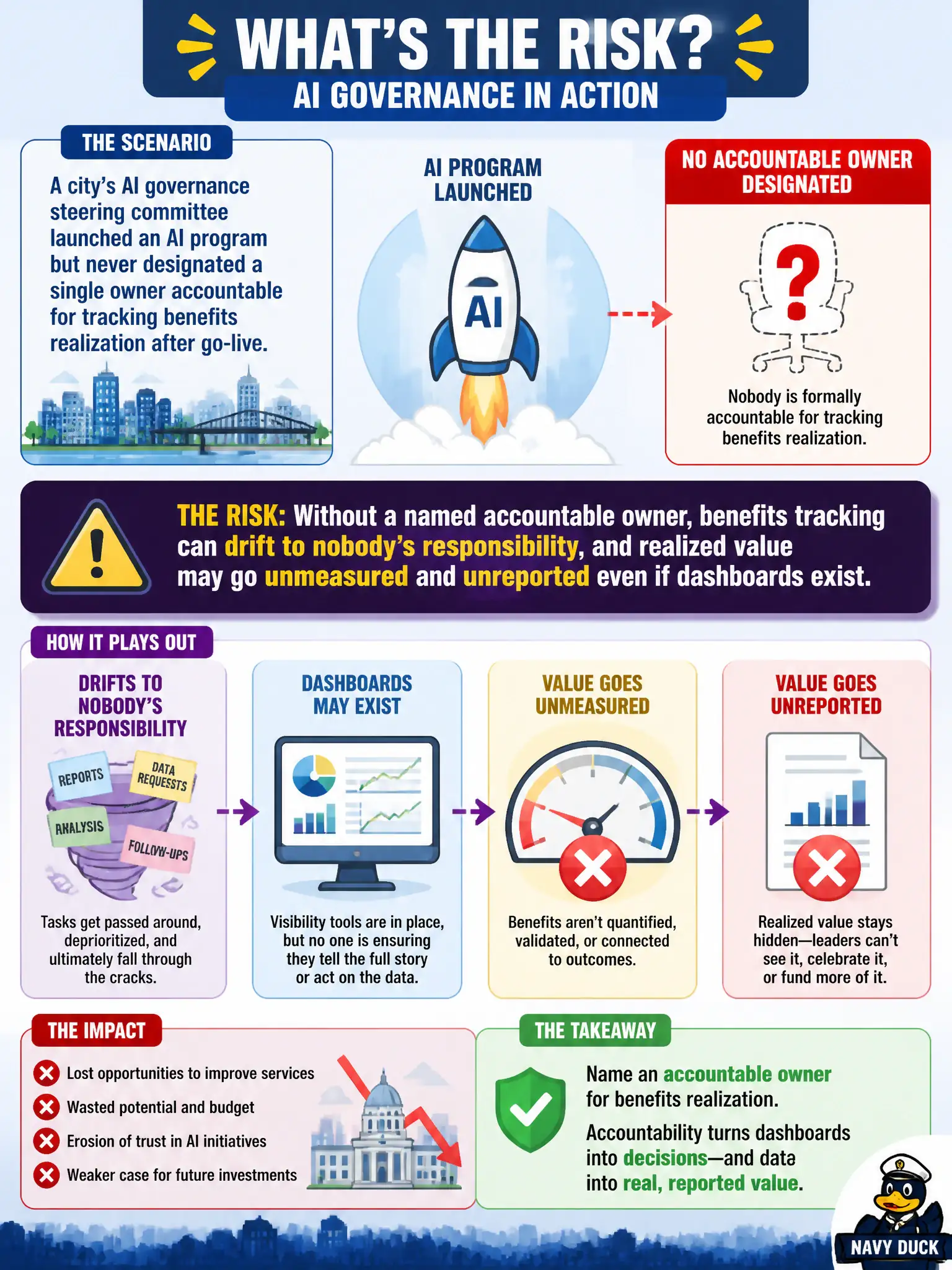
A city's AI governance steering committee launched an AI program but never designated a single owner accountable for tracking benefits realization after go-live. What risk does this create?
Select an answer to reveal the explanation.
Short Explanation
Think of it like a shared office plant nobody signed up to water: without a named owner, tracking benefits quietly stops happening even if the tools to do it are sitting right there. A dashboard doesn't chase down the numbers or act on them; a person has to.
Full Explanation
Benefits realization is an ongoing management activity, not a one-time reporting event, and it requires someone with explicit accountability to gather data, interpret it against the original business case, and escalate when results drift off track. When a steering committee omits this ownership assignment, the responsibility diffuses across the group, and diffuse responsibility in practice tends to mean nobody consistently does the work, a pattern well documented in program-governance failures. Assuming dashboards alone solve this confuses the existence of data with the accountability to act on it; a dashboard can display numbers, but it can't decide they're concerning, investigate root causes, or push corrective action through the organization. Assuming ownership matters only during the pilot phase misunderstands that benefits can erode over time as usage patterns, staffing, or process adherence shift after go-live, which is exactly when ongoing accountability matters most. Framing the risk as primarily technical conflates uptime, an operational availability metric, with realized value, which concerns whether the program is actually delivering the outcomes it was funded to deliver. A concrete governance check is to confirm the program charter names a specific role or individual as the benefits owner, with a defined reporting cadence back to the steering committee. The relevant caveat: this owner need not be technical staff, since benefits ownership is fundamentally a business accountability function, not an IT function.