
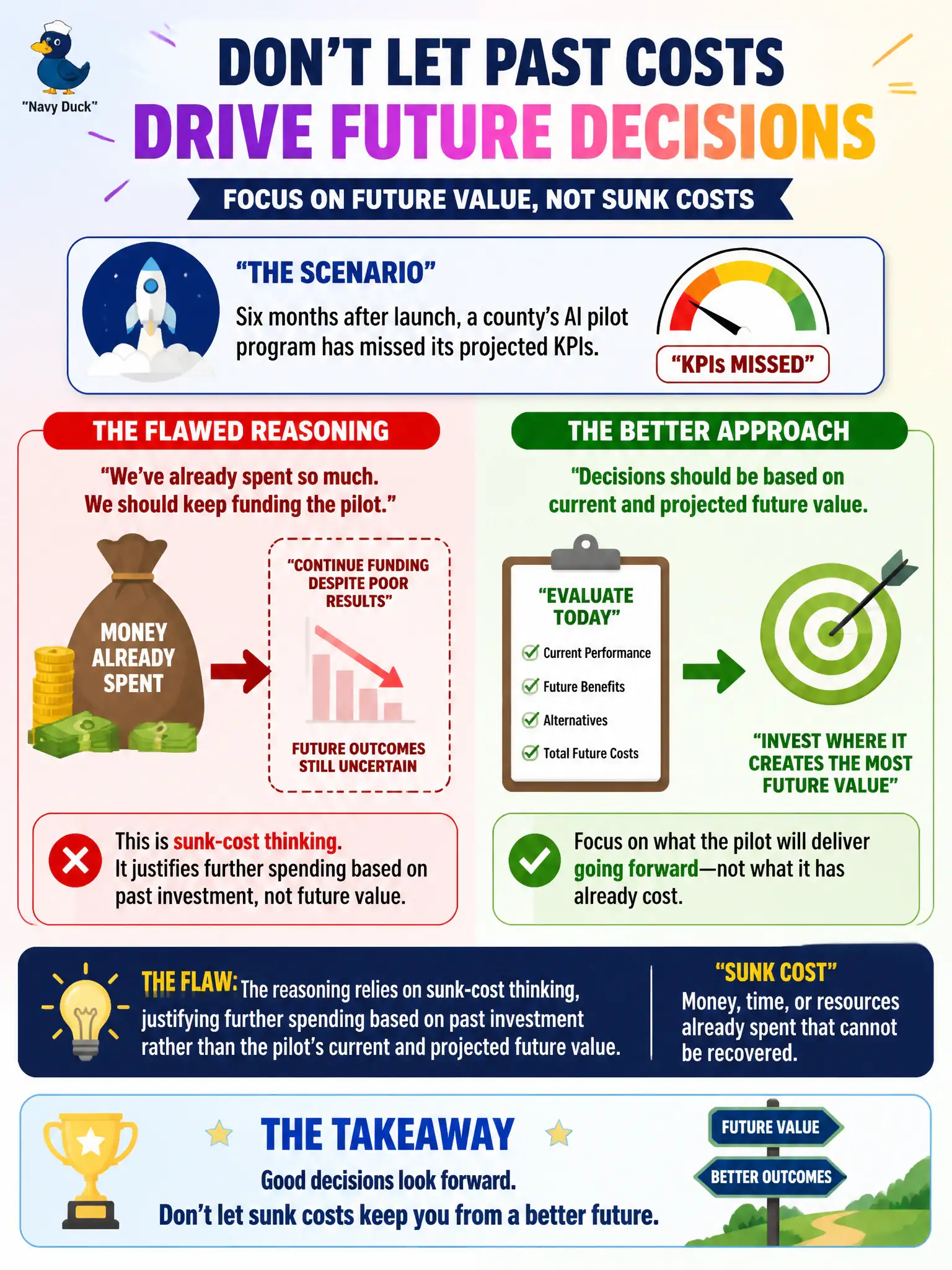
Six months after launch, a county's AI pilot program has missed its projected KPIs. Some stakeholders argue the county should keep funding the pilot because of how much has already been spent on it. What is the flaw in this reasoning?
Select an answer to reveal the explanation.
Short Explanation
Think of it like refusing to walk out of a bad movie because you already paid for the ticket: the money's gone either way. That's the sunk-cost fallacy, and it means past spending on the pilot shouldn't be the reason to keep funding it going forward.
Full Explanation
Sunk-cost reasoning treats money or effort already spent as a justification for future spending, even though those past costs are unrecoverable regardless of what the county decides next. A rational continue-or-cancel decision should weigh only forward-looking factors: the pilot's current trajectory, the likelihood it can be corrected, the cost of continuing versus stopping, and what alternative uses exist for the remaining budget. Claiming continuation preserves the investment gets the logic backwards, because the investment is already spent whether or not the pilot continues; only future outcomes are still in play. Arguing the evaluation window was too short may sometimes be a legitimate operational point, but it doesn't address the stakeholders' actual justification, which was spending-to-date rather than timeline adequacy. Pointing to overly aggressive KPI targets is a plausible root cause worth investigating separately, but again it's a different argument than the one being made, and using it to defend the sunk-cost logic doesn't fix the underlying reasoning error. A practical check here is to ask stakeholders to restate their case using only future-facing evidence, such as a revised forecast or corrective action plan, with all prior spending removed from the justification. One caveat for the exam: this doesn't mean underperforming pilots should always be canceled, only that continuation must be justified on projected value, not on money already gone.