
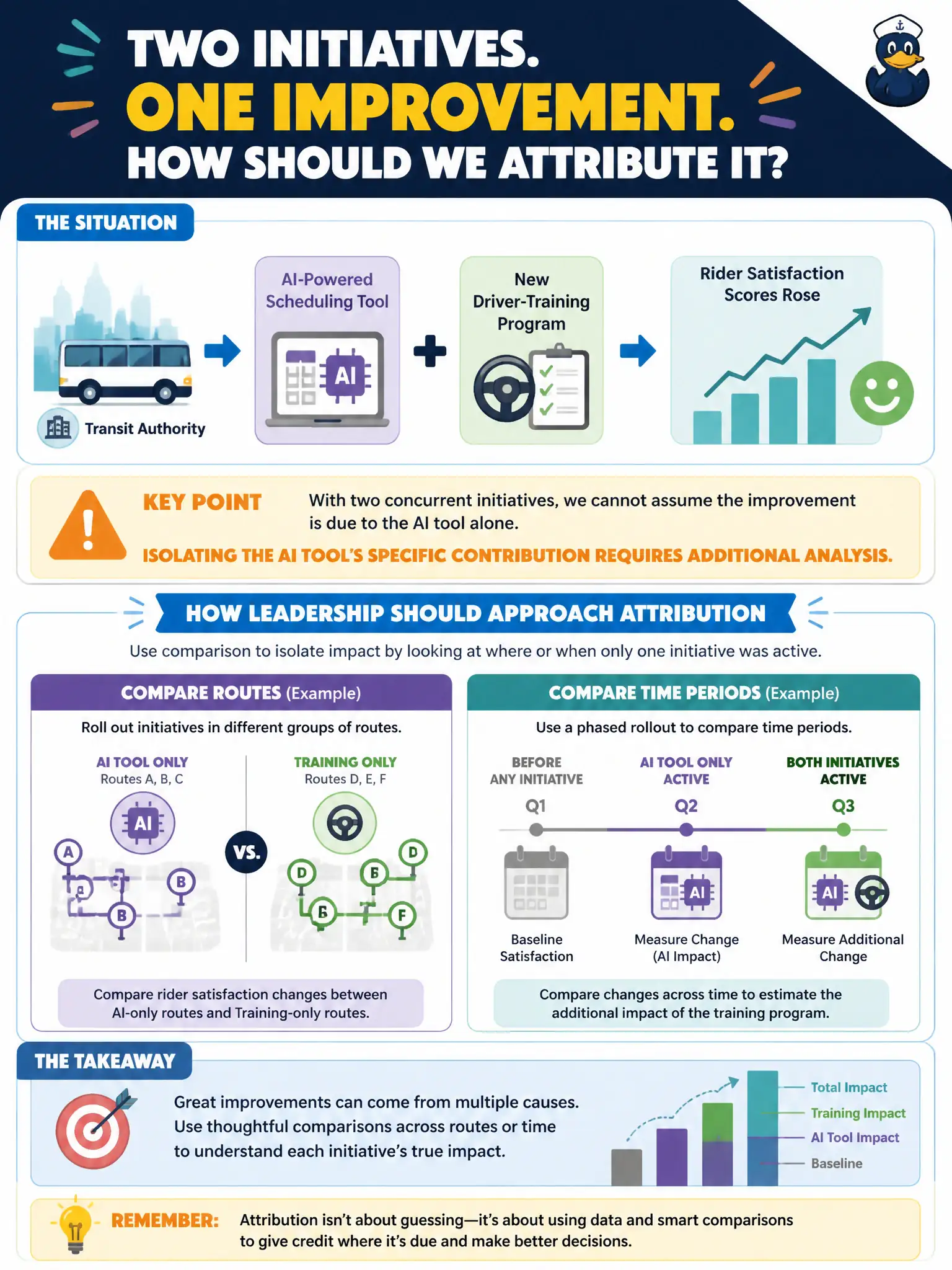
A transit authority launched an AI-powered scheduling tool and a new driver-training program in the same quarter, and rider satisfaction scores rose afterward. How should leadership approach attributing this improvement to the AI tool?
Select an answer to reveal the explanation.
Short Explanation
Think of it like two sales promotions running at once: if revenue goes up, you can't just guess which one did it. When an AI tool launches alongside another change, you need to isolate its effect before you can honestly claim credit for the AI tool's value.
Full Explanation
Attribution is a core challenge in measuring AI business value: when multiple initiatives launch close together, a single outcome metric can't tell you on its own which initiative drove the change. Handing full credit to the AI tool because it's the newer or more technical initiative substitutes narrative appeal for evidence, and the same flaw applies in reverse when crediting the training program simply because it involves people. Splitting credit evenly is administratively tidy but arbitrary, since it assumes both initiatives contributed equally without any data supporting that split. The defensible approach is to design a comparison that isolates variables, such as looking at routes or shifts where only the scheduling tool was active, staggering rollout timing in future initiatives, or using pre/post analysis segmented by which drivers received training. This is the same logic behind controlled testing in any measurement discipline: you want variation in one factor while holding others as constant as possible. An operational check leadership can run immediately is to pull satisfaction data by route or garage location and see whether improvement correlates more strongly with scheduling-tool coverage or training-program coverage. The scope limit to keep in mind is that perfect isolation is rarely possible in real municipal operations, so leadership should treat any single-cause claim from concurrent rollouts with appropriate caution.