
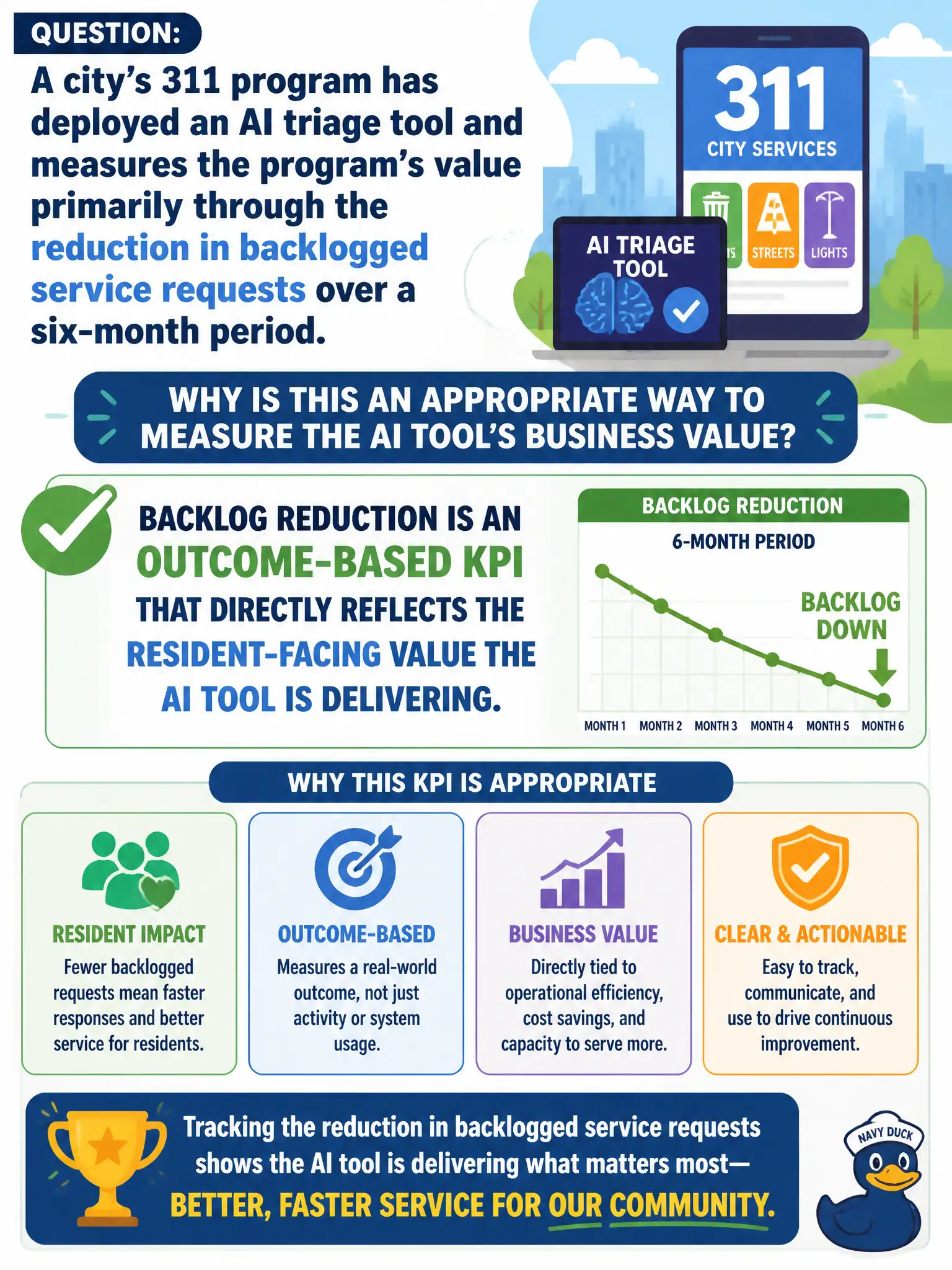
A city's 311 program has deployed an AI triage tool and measures the program's value primarily through the reduction in backlogged service requests over a six-month period. Why is this an appropriate way to measure the AI tool's business value?
Select an answer to reveal the explanation.
Short Explanation
Think of it like judging a snowplow crew by how many streets are actually cleared, not by how fast the trucks can drive. Backlog reduction tells you requests are actually getting resolved for residents, which is the outcome that matters.
Full Explanation
Backlog reduction is meaningful because it sits close to the actual mission of a 311 program: getting resident requests handled in a reasonable time. A drop in backlog over six months signals that the AI triage tool is genuinely helping staff process, route, and close requests faster, which is the kind of outcome elected officials and residents can recognize and value. Inference speed per request is a technical performance detail that says something about the model's engineering but nothing about whether requests are actually getting resolved faster in practice. Counting retraining cycles measures internal maintenance activity, not delivered value, and a program could retrain frequently while backlog stays flat or grows. Training dataset size describes an input to model development, not an output the program or its residents experience, so it has no direct bearing on whether the tool is working. The caveat: backlog reduction should be checked against request volume and staffing changes so the improvement isn't wrongly attributed to the AI tool alone. As an operational check, confirm the backlog trend holds even after controlling for seasonal request volume shifts over the same six months.