
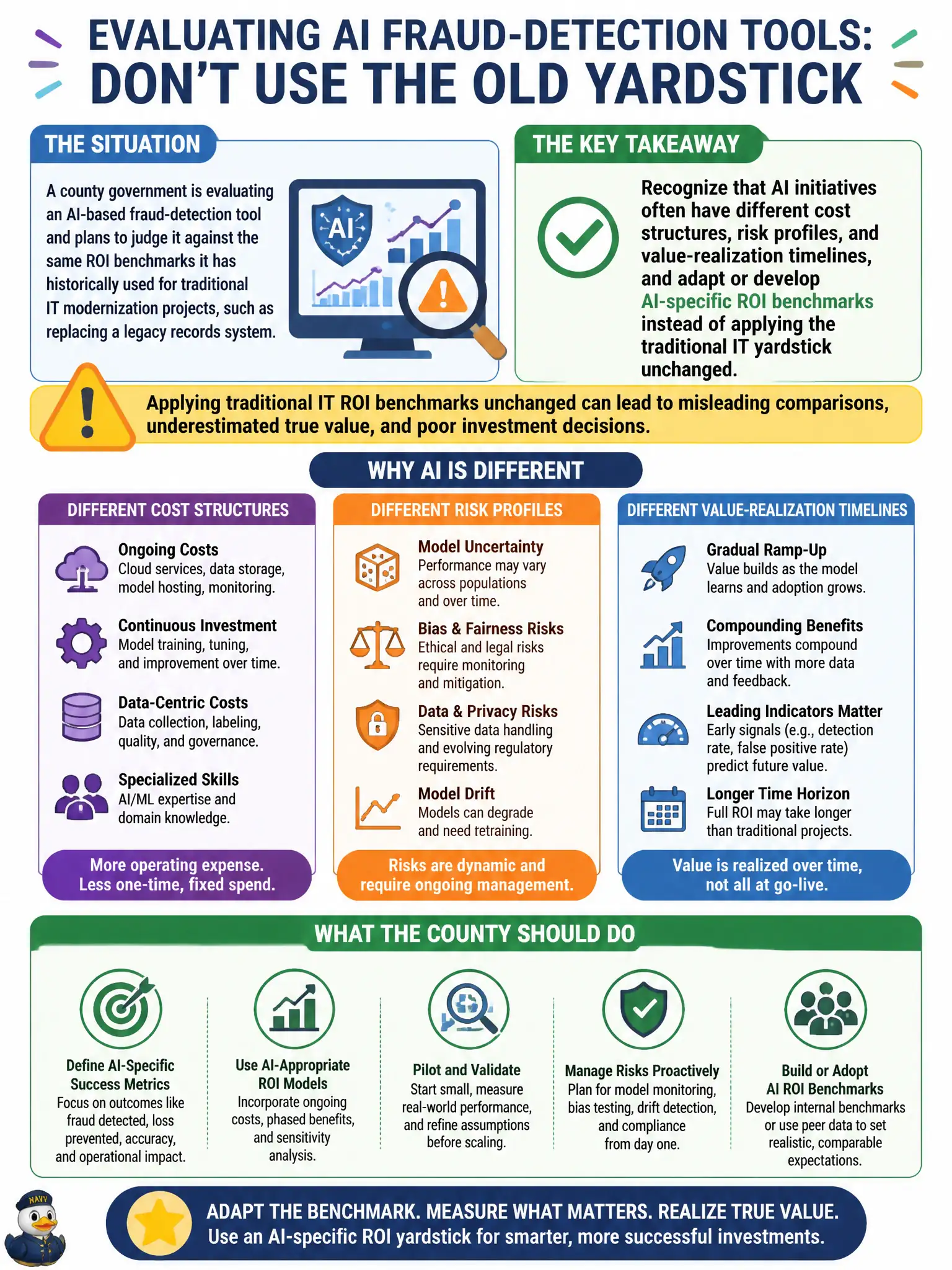
A county government is evaluating an AI-based fraud-detection tool and plans to judge it against the same ROI benchmarks it has historically used for traditional IT modernization projects, such as replacing a legacy records system. What should the county consider before applying those benchmarks unchanged?
Select an answer to reveal the explanation.
Short Explanation
Think of it like comparing a home appliance purchase to planting an orchard: both cost money upfront, but one pays back predictably next month and the other needs seasons of tending before the fruit shows up. Traditional IT ROI models expect the appliance pattern; AI often behaves like the orchard.
Full Explanation
Traditional IT modernization ROI models typically assume a defined implementation cost, a known go-live date, and fairly predictable ongoing savings, such as reduced paper handling or fewer manual records lookups. AI initiatives like fraud detection often carry ongoing data, monitoring, and model-tuning costs, benefits that compound or shift as the model learns, and risk factors like false positives or model drift that traditional IT ROI frameworks weren't built to capture. Applying the old benchmark unchanged can make a genuinely valuable AI investment look like it underperforms simply because its value curve doesn't match the old template. Rejecting the tool solely for a longer timeline conflates "different" with "worse" without examining whether the AI-specific value case still justifies the investment. Raising the benchmark for every future technology project overcorrects and would unfairly penalize traditional IT projects that legitimately follow the older, faster payback pattern. The caveat: this doesn't mean abandoning financial discipline, only adapting the framework's assumptions. A useful operational check is to map the fraud-detection tool's cost and benefit timeline against the old benchmark's assumptions line by line before deciding whether they still hold.