
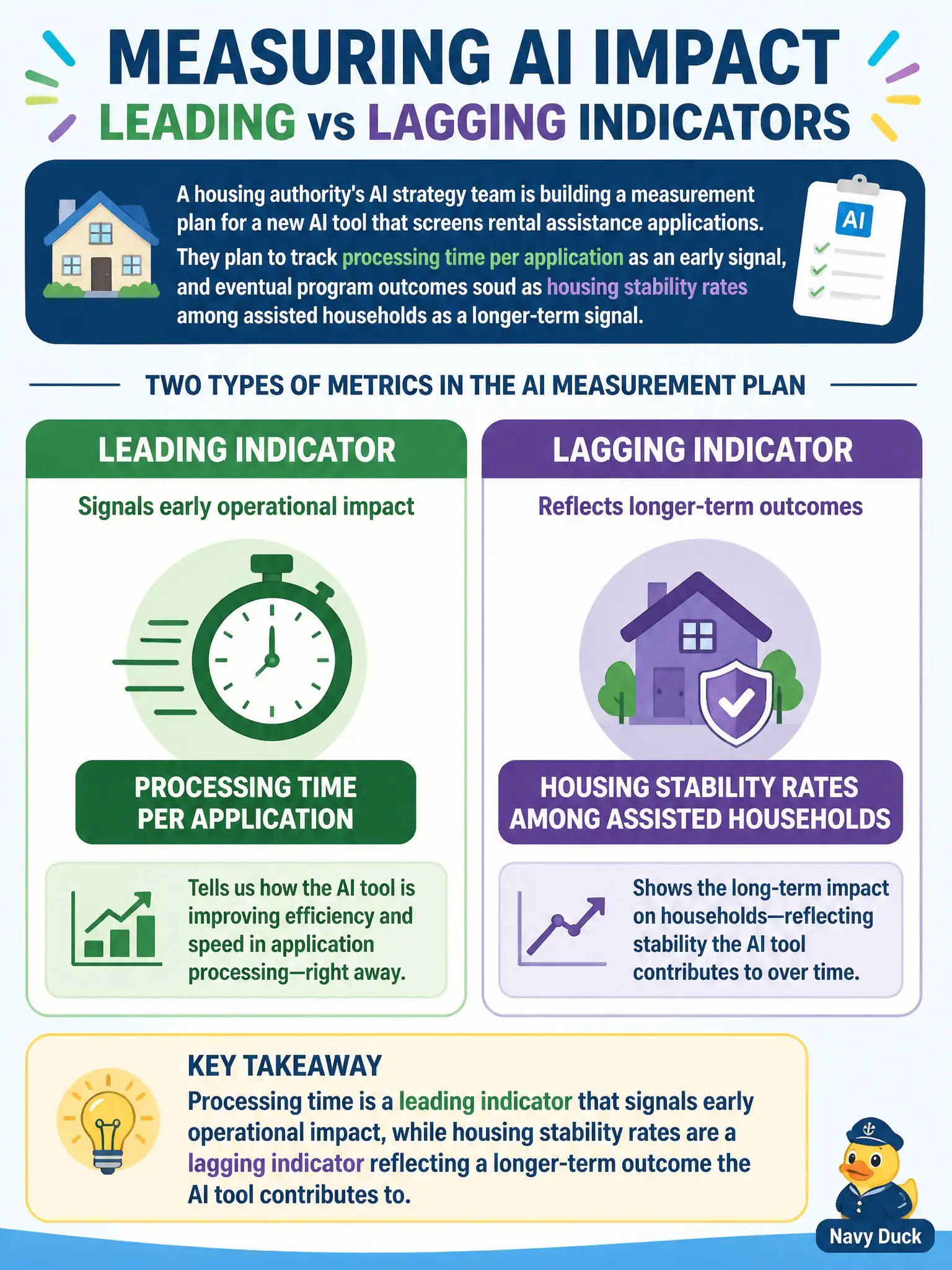
A housing authority's AI strategy team is building a measurement plan for a new AI tool that screens rental assistance applications. They plan to track processing time per application as an early signal, and eventual program outcomes such as housing stability rates among assisted households as a longer-term signal. How should the team categorize these two types of metrics?
Select an answer to reveal the explanation.
Short Explanation
Think about a road trip: your speedometer tells you something useful right now, but whether you actually arrive on time is the real test that shows up later. Processing time is that speedometer — a fast, early signal the tool is working operationally. Housing stability rates are the arrival — a slower, bigger-picture outcome that shows whether the tool actually helped in the way that matters.
Full Explanation
Leading indicators are near-term, observable signals that an initiative is functioning as intended and often predict eventual outcomes, while lagging indicators are longer-term results that confirm whether the initiative actually achieved its intended impact. Processing time per application is a leading indicator because it can be measured almost immediately after deployment and signals operational impact, while housing stability rates are a lagging indicator because they take months or years to materialize and reflect the deeper outcome the screening tool is ultimately meant to support. Calling both metrics lagging indicators ignores that processing time is available almost immediately, which is the defining trait of a leading indicator, not a lagging one. Calling both metrics leading indicators ignores that housing stability is exactly the kind of delayed, outcome-level result lagging indicators are built to capture — the fact that it isn't a single irreversible event doesn't change its long time horizon. Reversing the two, calling processing time lagging and stability leading, inverts the actual time horizons, since stability data takes far longer to accumulate than processing-time data. Caveat: a metric's leading-versus-lagging classification depends on the specific initiative's goals, not a fixed universal label. Operational check: confirm the measurement plan tracks both indicator types on separate reporting cadences matched to how quickly each becomes available.