
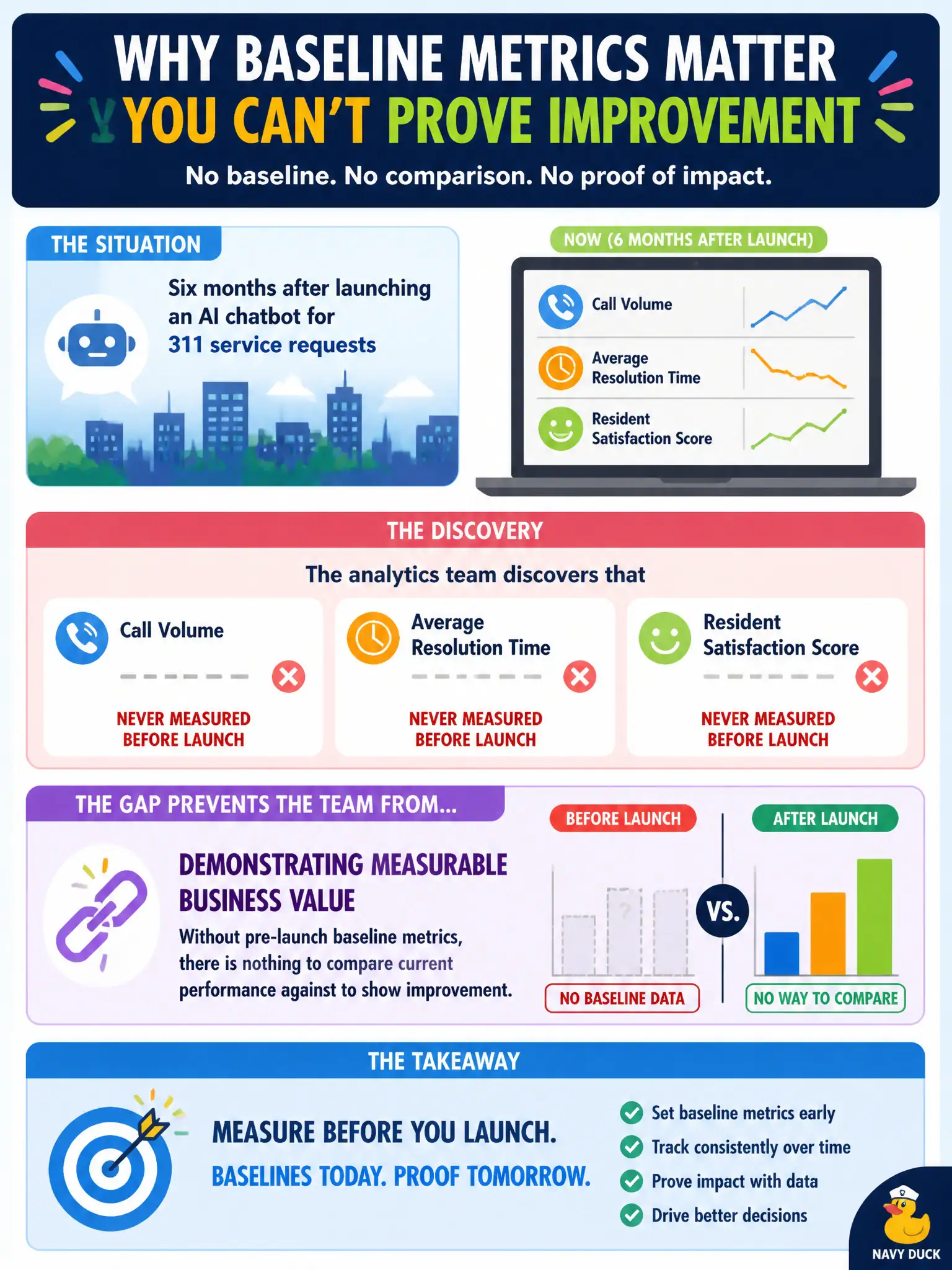
Six months after launching an AI chatbot for 311 service requests, a city's analytics team is asked to report whether the chatbot has improved resident service. The team discovers that call volume, average resolution time, and resident satisfaction scores were never measured before the chatbot launched. What does this gap prevent the team from doing?
Select an answer to reveal the explanation.
Short Explanation
Think about stepping on a scale for the first time after a diet, with no idea what you weighed before you started — you can see where you are, but you can't say whether anything actually changed. Without baseline call volume, resolution time, and satisfaction numbers from before the chatbot launched, the team has no fixed point to measure improvement against. Value has to be proven relative to something, and that something was never captured.
Full Explanation
Demonstrating AI business value requires a before-and-after comparison: baseline metrics captured prior to launch establish the starting point that post-launch performance is measured against, and without that starting point, even a genuinely improved resolution time or satisfaction score can't be attributed to the chatbot with any confidence. This is why baseline capture belongs at the start of a value-measurement plan, not six months in. Claiming the chatbot cannot continue operating without baseline metrics confuses a measurement gap with an operational or compliance requirement; the tool can keep functioning, it's the ability to prove its impact that's compromised. Claiming baseline metrics are training-data inputs the model needs misunderstands what baseline metrics are for — they're business performance indicators used for value reporting, not data used to train the chatbot's underlying model. Claiming vendor support is contingent on baseline metrics invents a contractual relationship that isn't implied by the scenario; vendor agreements are typically tied to service-level terms, not to whether the customer separately tracked its own performance baselines. Caveat: a retroactive comparison group or a delayed baseline period can partially substitute, though it's weaker evidence than a true pre-launch baseline. Operational check: confirm every future AI initiative has baseline metrics defined and captured before go-live, not after.