
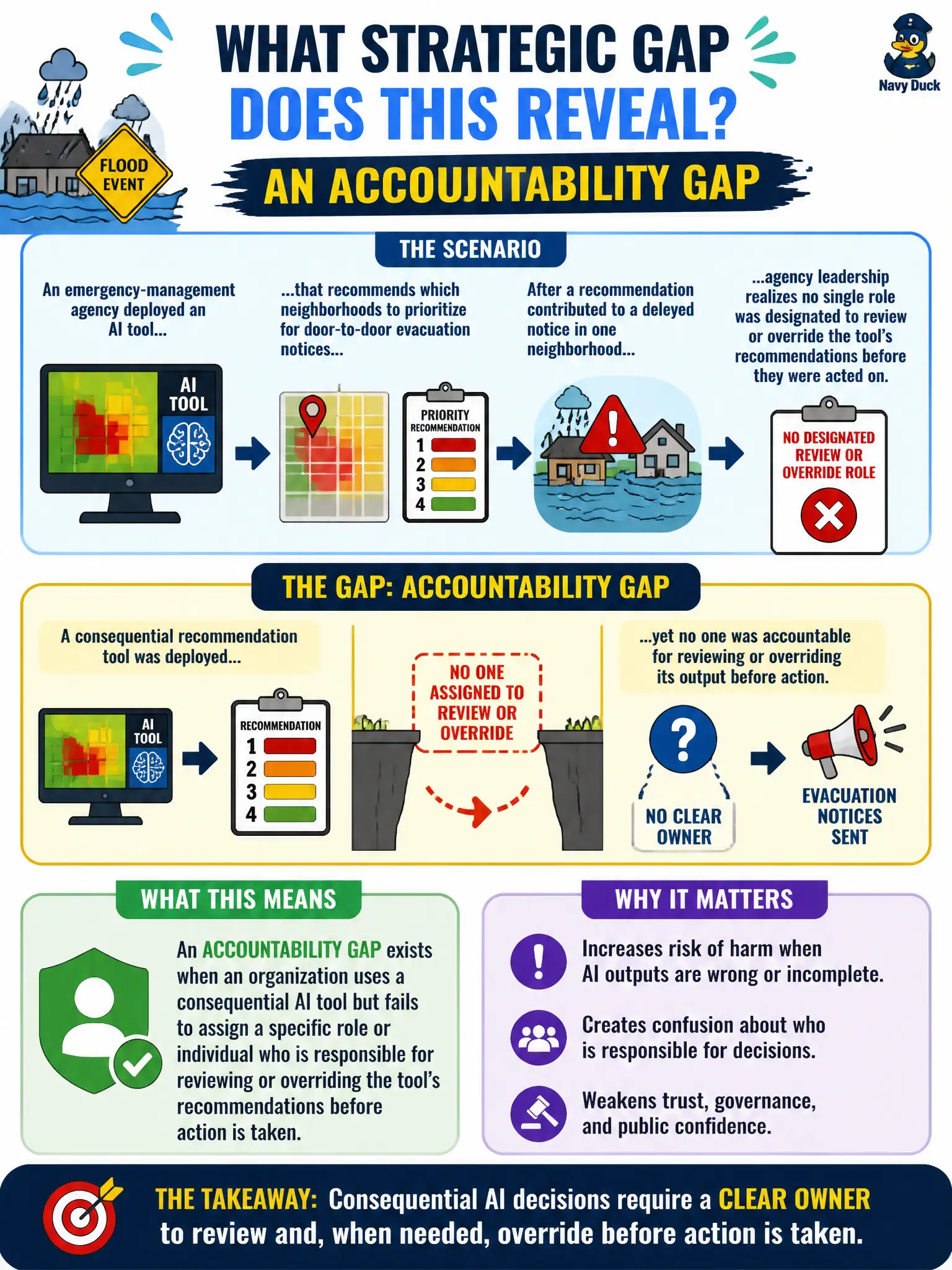
An emergency-management agency deployed an AI tool that recommends which neighborhoods to prioritize for door-to-door evacuation notices during a flood event. After a recommendation contributed to a delayed notice in one neighborhood, agency leadership realizes no single role was designated to review or override the tool's recommendations before they were acted on. What kind of strategic gap does this reveal?
Select an answer to reveal the explanation.
Short Explanation
Think about a car with no one assigned to hold the steering wheel — even a great engine doesn't help if nobody's positioned to correct course when it matters. The real problem here isn't the tool's accuracy or the data behind it; it's that no one was named to review its recommendations before they became real-world action. That's an accountability gap, and it's a governance fix, not a retraining fix.
Full Explanation
An accountability gap exists when an organization deploys a consequential AI recommendation without clearly assigning a role responsible for reviewing, approving, or overriding its output before that output drives action — in this case, evacuation notices went out based on a recommendation no one was designated to check. That gap is a structural governance failure independent of whether the tool itself performed well. Framing this as a data-quality gap assumes the training data was flawed, but the scenario doesn't establish that; the failure described is procedural, about missing human review, not about the data feeding the model. Framing it as a staffing shortage misattributes the cause to field capacity, but the scenario specifically points to the absence of a review-and-override role, not too few people to deliver notices. Framing it as a technology-performance gap assumes the algorithm itself needs improvement, but nothing indicates the recommendation was inaccurate — only that no one was positioned to catch or correct it in time. Caveat: an accountability gap can coexist with data or performance issues, but this scenario's stated failure point is the missing review role specifically. Operational check: confirm every AI-informed action in the emergency-response workflow names a specific accountable reviewer before deployment continues.