
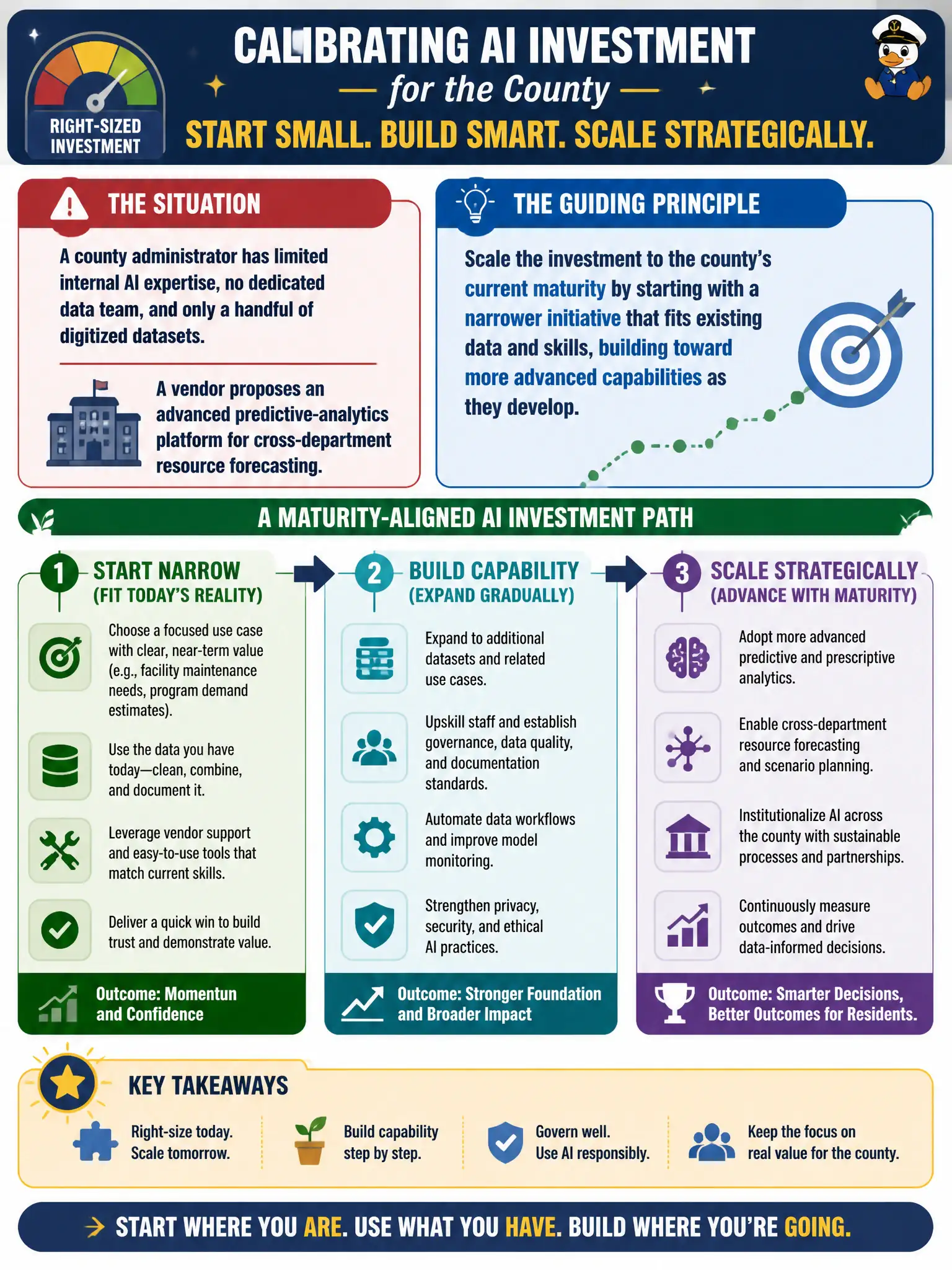
A county administrator has limited internal AI expertise, no dedicated data team, and only a handful of digitized datasets. A vendor proposes an advanced predictive-analytics platform for cross-department resource forecasting. How should the administrator calibrate the county's AI investment relative to this proposal?
Select an answer to reveal the explanation.
Short Explanation
Think about buying hiking boots before you've walked around the block — the right gear still depends on matching it to where you actually are, not where you hope to be. A county with thin data and no dedicated data team isn't ready for an advanced cross-department platform, no matter how capable the tool is. Calibrating the investment to current maturity, then growing it, is what actually gets the county to that more advanced future.
Full Explanation
Investment calibration means matching an AI initiative's sophistication to an organization's current data, skills, and process maturity, rather than to the most advanced tool a vendor happens to offer: starting with a narrower initiative that fits the county's existing digitized datasets and limited expertise produces usable results and builds internal capability, creating a realistic path toward more advanced forecasting later. Approving the advanced platform as proposed assumes the tool itself can substitute for missing expertise and data foundations, but a sophisticated platform typically requires more data quality and internal know-how to configure and interpret than a county in this position currently has. Rejecting all AI investment until a full internal data team exists overcorrects, treating team-building as a strict prerequisite when a well-scoped smaller initiative can proceed with current resources and build the case for future hiring. Approving the platform but handing oversight entirely to the vendor removes accountability precisely where it matters most, since a county with limited internal expertise still needs someone accountable for reviewing forecasts before they inform budget or staffing decisions. Caveat: 'narrower first' doesn't mean permanently narrow — the roadmap should specify growth triggers. Operational check: confirm the scaled-down initiative has an explicit graduation criterion for when to expand scope.