
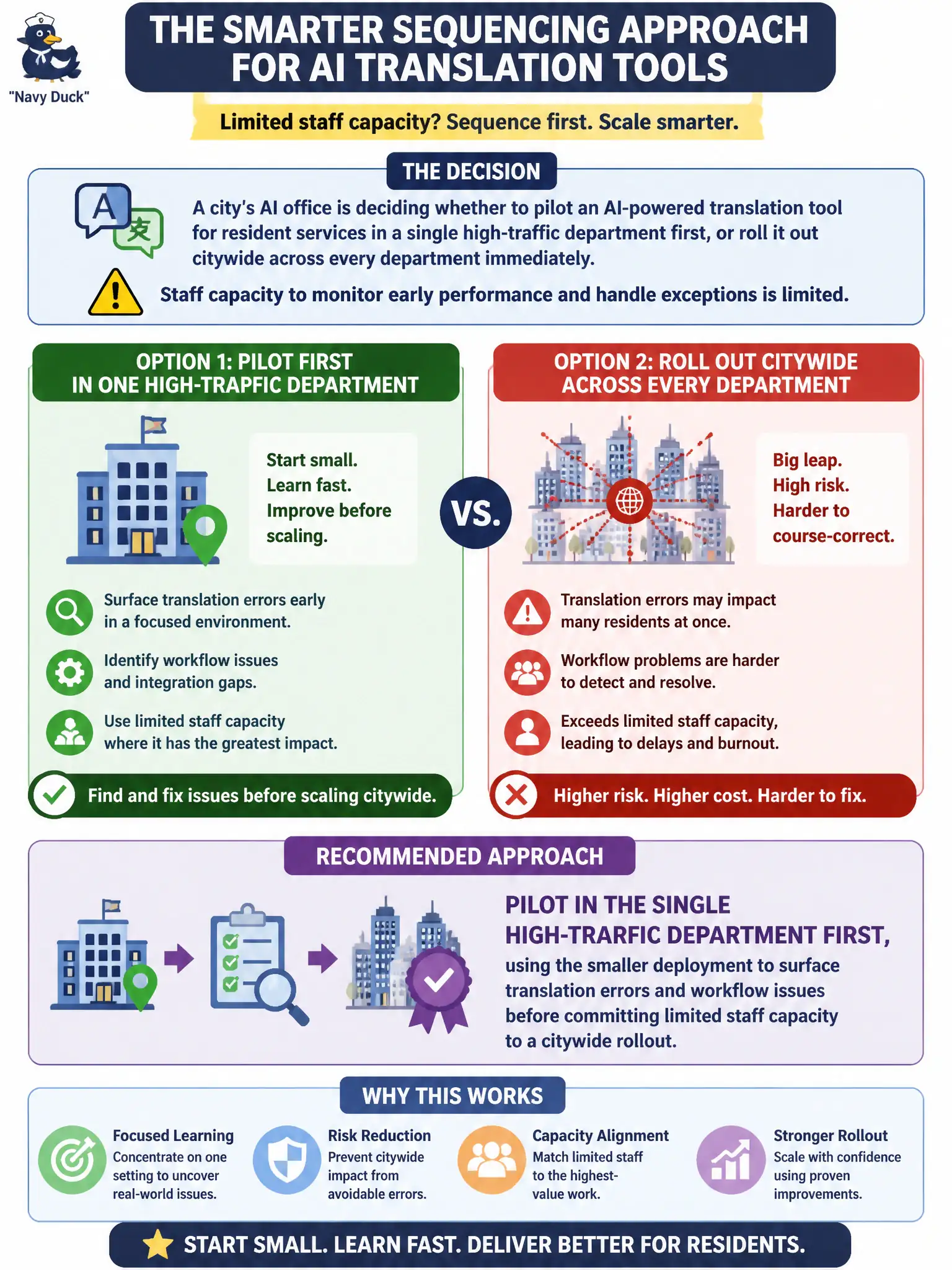
A city's AI office is deciding whether to pilot an AI-powered translation tool for resident services in a single high-traffic department first, or roll it out citywide across every department immediately. Staff capacity to monitor early performance and handle exceptions is limited. What sequencing approach best manages this constraint?
Select an answer to reveal the explanation.
Short Explanation
Think about testing a new recipe for two people before you cook it for the whole block party — small-batch problems are cheap to fix, and citywide ones aren't. Piloting the translation tool in one high-traffic department first lets limited staff catch and correct errors while the stakes are still manageable. That's a quick win that earns the right to scale, not a shortcut around scaling responsibly.
Full Explanation
Phased sequencing matches deployment scope to actual monitoring capacity: piloting in one high-traffic department first generates a meaningful volume of real translation requests, enough to surface errors and workflow gaps, while keeping the number of departments needing active staff attention small enough for a limited team to manage. That contained first phase produces the evidence needed to scale citywide with confidence rather than hope. Rolling out citywide because translation feels like a lower-risk category ignores that risk category and monitoring capacity are separate variables — even a safe-seeming tool can produce embarrassing mistranslations at volume, and limited staff can't catch those across every department at once. Limiting scope to written text only while still rolling out everywhere reduces functional scope but not the underlying capacity problem. Piloting in the lowest-traffic department produces less real-world signal, not cleaner signal, since a quiet department generates too few requests to meaningfully stress-test the tool. Caveat: 'high-traffic first' assumes that department can tolerate early hiccups without major resident harm. Operational check: define a clear error-rate threshold the pilot must meet before the citywide rollout decision is made.