
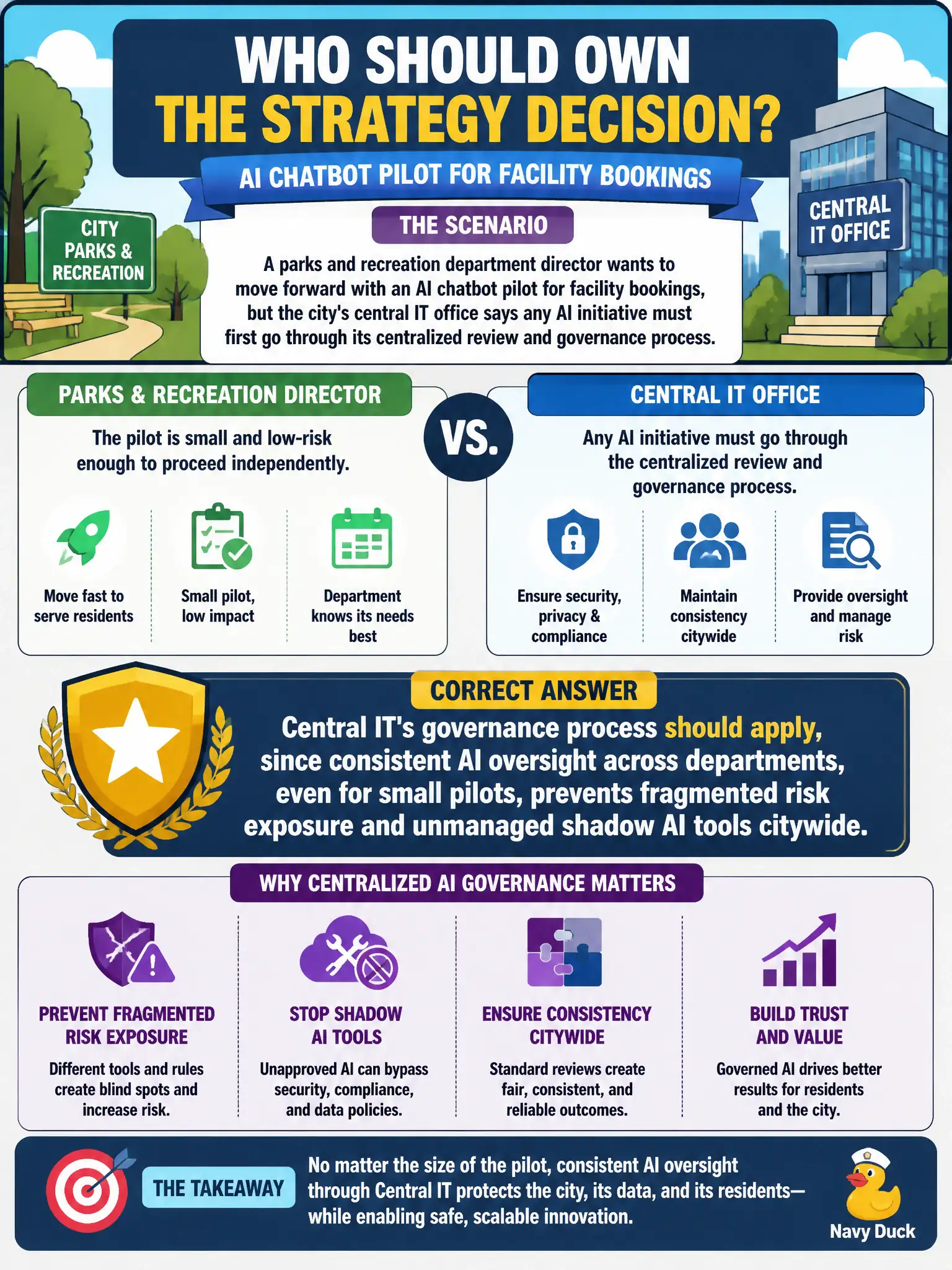
A parks and recreation department director wants to move forward with an AI chatbot pilot for facility bookings, but the city's central IT office says any AI initiative must first go through its centralized review and governance process. The department director argues the pilot is small and low-risk enough to proceed independently. Who should own the strategy decision?
Select an answer to reveal the explanation.
Short Explanation
Think about a building where every tenant installs their own wiring because it's 'just a small addition' — eventually nobody knows what's actually connected to the grid, and that's how you get a fire. Centralized AI governance exists so even a small pilot doesn't quietly become an ungoverned tool nobody's tracking. Low-risk is a judgment the governance process is supposed to make, not a reason to skip it.
Full Explanation
Consistent AI governance across departments matters precisely because 'small, low-risk pilot' is a self-assessment, not an outcome of review — a citywide governance process exists to catch data-handling, security, and accountability gaps a single department isn't positioned to evaluate on its own. Routing even a small chatbot pilot through central IT's process prevents the kind of unmanaged shadow AI sprawl that becomes far harder to inventory once many departments have each made their own call. Letting the department director have final say because parks and recreation understands facility bookings better conflates operational domain expertise with governance authority. Tying governance authority to whichever office secures outside grant funding lets a funding technicality override an oversight structure that should apply no matter how a project is paid for. Running two parallel pilots to compare governance models avoids resolving the actual ownership question and doubles the coordination and risk surface instead of reducing it. Caveat: centralized governance shouldn't mean a bottleneck — a well-designed process includes an expedited track for genuinely low-risk pilots. Operational check: confirm the city's AI governance policy documents an intake path for department-initiated pilots before assuming one doesn't exist.