
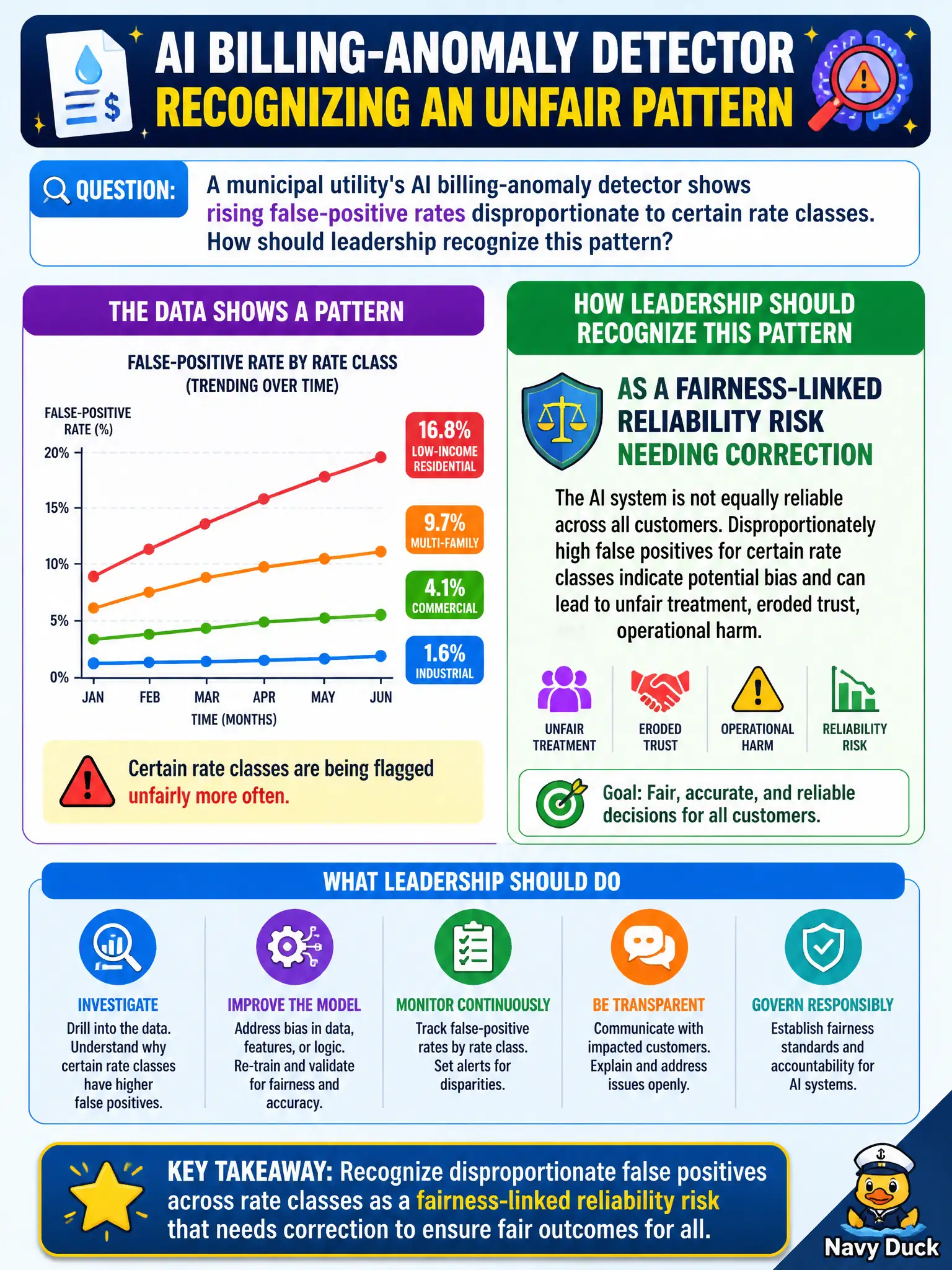
A municipal utility's AI billing-anomaly detector shows rising false-positive rates disproportionate to certain rate classes. How should leadership recognize this pattern?
Select an answer to reveal the explanation.
Short Explanation
When one group of customers gets flagged far more often than another, that's not a coincidence worth shrugging at. A false positive means the tool got it wrong, and when wrong calls pile up disproportionately on one rate class, that's a fairness problem wearing a technical disguise. It deserves a real look, not a shrug.
Full Explanation
A rising false-positive rate concentrated in specific rate classes signals that the anomaly detector is systematically over-flagging certain customer groups relative to others, which is both a reliability defect and a fairness concern, since customers in those classes are being subjected to unwarranted scrutiny or billing disputes at a higher rate. Recognizing this as a fairness-linked reliability risk means leadership treats it as something to correct, likely by examining whether training data or thresholds are miscalibrated for those particular usage patterns. Dismissing the pattern as an expected side effect ignores that a well-calibrated detector should not produce systematically skewed error rates across customer segments; if it does, that is a defect, not a normal cost of doing business. Interpreting the pattern as evidence that those rate classes are genuinely more anomaly-prone begs the question, since a false positive is by definition a case where no real anomaly existed, so a rising false-positive rate cannot itself prove the underlying customers are unusual. Attributing the pattern to billing-department staffing misdiagnoses a detection-tool defect as a human-resourcing problem, and adding staff would not correct a model that is miscalibrated for a particular rate class. A scope caveat: correction should be data-driven, since an aggressive threshold change to reduce false positives could increase missed true anomalies elsewhere. A concrete operational check is to compare false-positive rates by rate class against the utility's overall baseline on a recurring reporting cycle.