
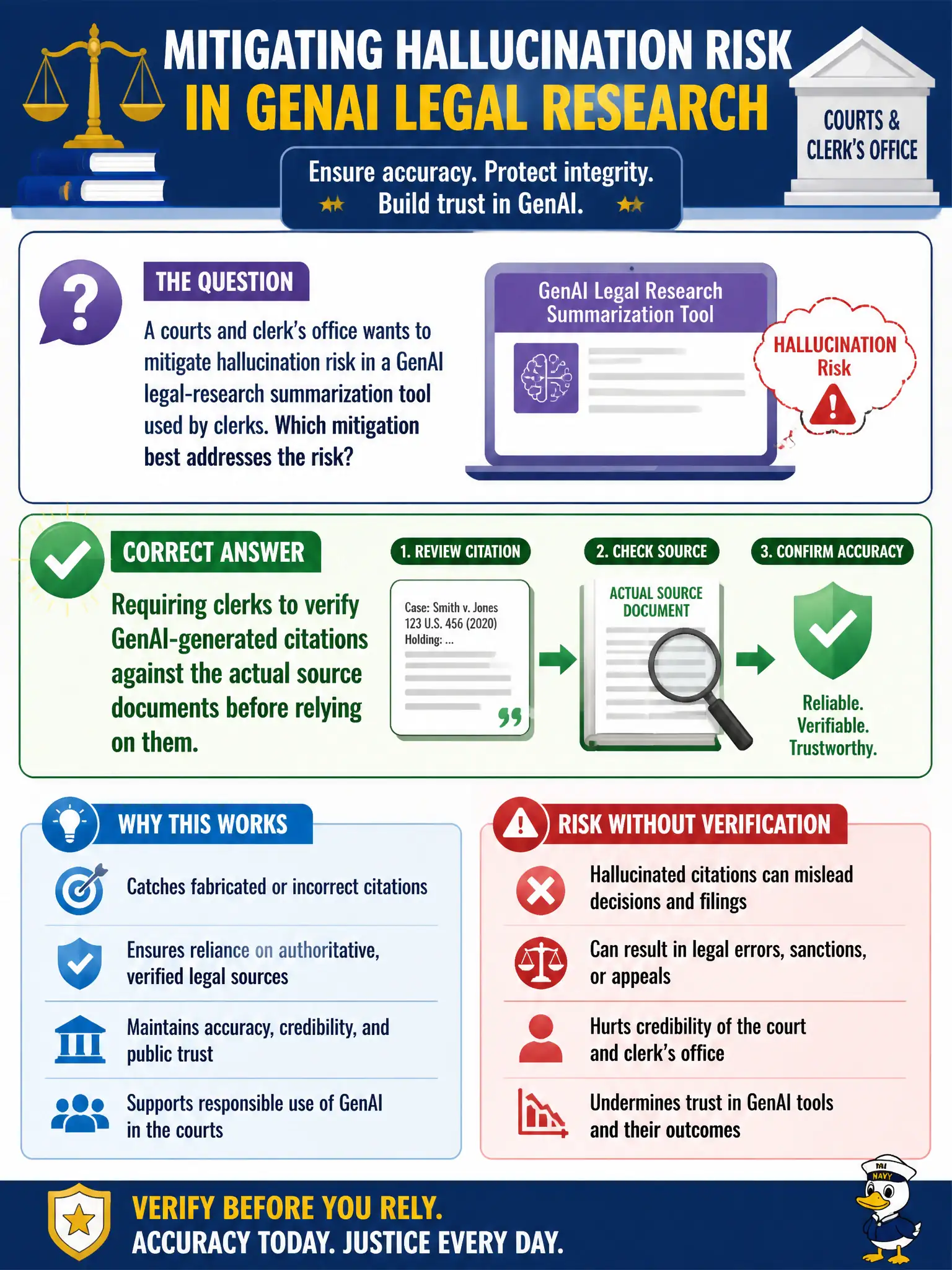
A courts and clerk's office wants to mitigate hallucination risk in a GenAI legal-research summarization tool used by clerks. Which mitigation best addresses the risk?
Select an answer to reveal the explanation.
Short Explanation
A GenAI tool can write a citation that sounds completely real and still be pointing at a case that doesn't exist. Fluent doesn't mean accurate. Having clerks actually verify citations against the real source is the check that catches a hallucination before it ends up in a filing.
Full Explanation
Hallucination in a GenAI tool refers to output that is fluent and plausible-sounding but not grounded in fact, and in a legal-research context that most often shows up as fabricated or misattributed citations. The correct mitigation targets that specific failure mode directly: requiring clerks to verify each generated citation against the actual source document before relying on it catches fabricated references before they influence a case-status decision or filing. Encouraging faster reading to review more cases moves in exactly the wrong direction, since hallucination detection requires more careful scrutiny of specific claims, not less time spent per document. Disabling spell-check has no relationship to hallucination at all; spelling errors and fabricated legal citations are unrelated failure modes, and unusual wording is not a reliable signal of a fabricated citation anyway. Increasing summary length gives the model more room to generate content but does nothing to ground that content in real source material, and a longer hallucinated summary is not safer than a short one. A scope caveat: citation verification addresses fabricated references specifically, but a full hallucination-mitigation approach should also address other unsupported factual claims within the summary text itself. A concrete operational check is to require a signed verification log entry each time a clerk confirms a generated citation traces to a real, correctly cited source.