
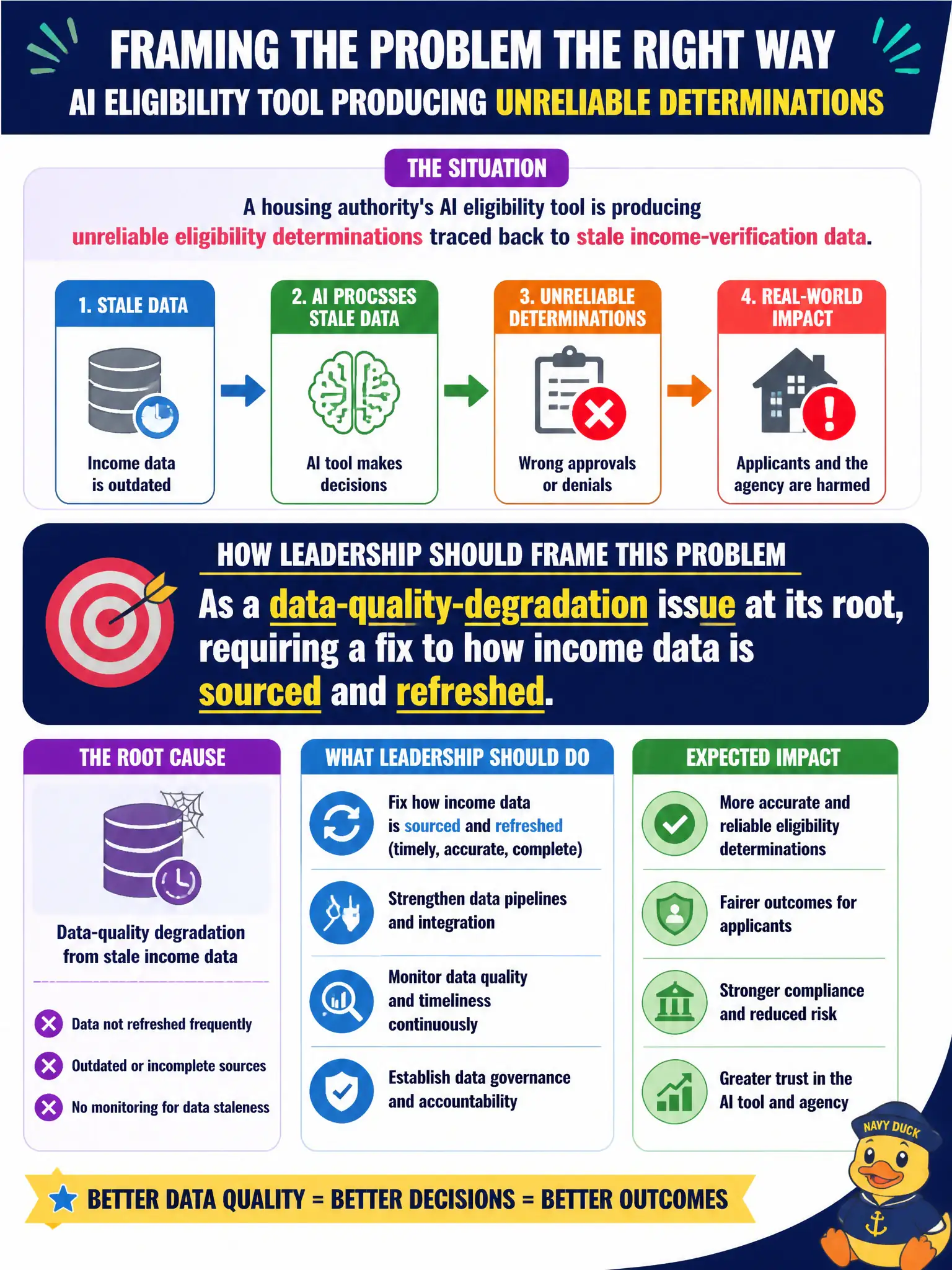
A housing authority's AI eligibility tool is producing unreliable eligibility determinations traced back to stale income-verification data. How should leadership frame this problem?
Select an answer to reveal the explanation.
Short Explanation
Feed a model stale numbers and it'll confidently hand back stale conclusions, no matter how good the algorithm underneath is. The real fix isn't a fancier model, it's fixing the data feeding it. Chase the wrong cause and the eligibility errors keep coming no matter what you swap out.
Full Explanation
Tracing a reliability failure to its actual root cause matters because different causes call for different fixes, and swapping in a more sophisticated model does nothing to correct income-verification data that is out of date before it ever reaches the model. Data-quality degradation describes exactly this situation: the model's determinations are unreliable not because its underlying logic is flawed, but because the inputs it depends on have decayed in accuracy over time. Framing this as a pure model-accuracy problem and chasing a better algorithm misdiagnoses the failure and would leave the actual defect, stale source data, completely unaddressed. Framing it as a staffing shortage confuses a data-pipeline problem with a human-capacity problem; adding caseworkers does not refresh the income-verification data the tool relies on. Treating it as an unavoidable cost of doing business abandons the agency's responsibility to correct a determinable, fixable defect that directly affects whether residents receive housing assistance they are entitled to. A scope caveat: fixing the data pipeline does not retroactively correct determinations already made on stale data, so past cases may need separate review. A concrete operational check is to audit the income-verification data refresh cycle and confirm it matches the cadence the eligibility tool assumes when scoring applicants.