
A public-health agency's AI outbreak-prediction tool starts producing degraded predictions after case-report data patterns change. What risk is most likely responsible?
Select an answer to reveal the explanation.
Short Explanation
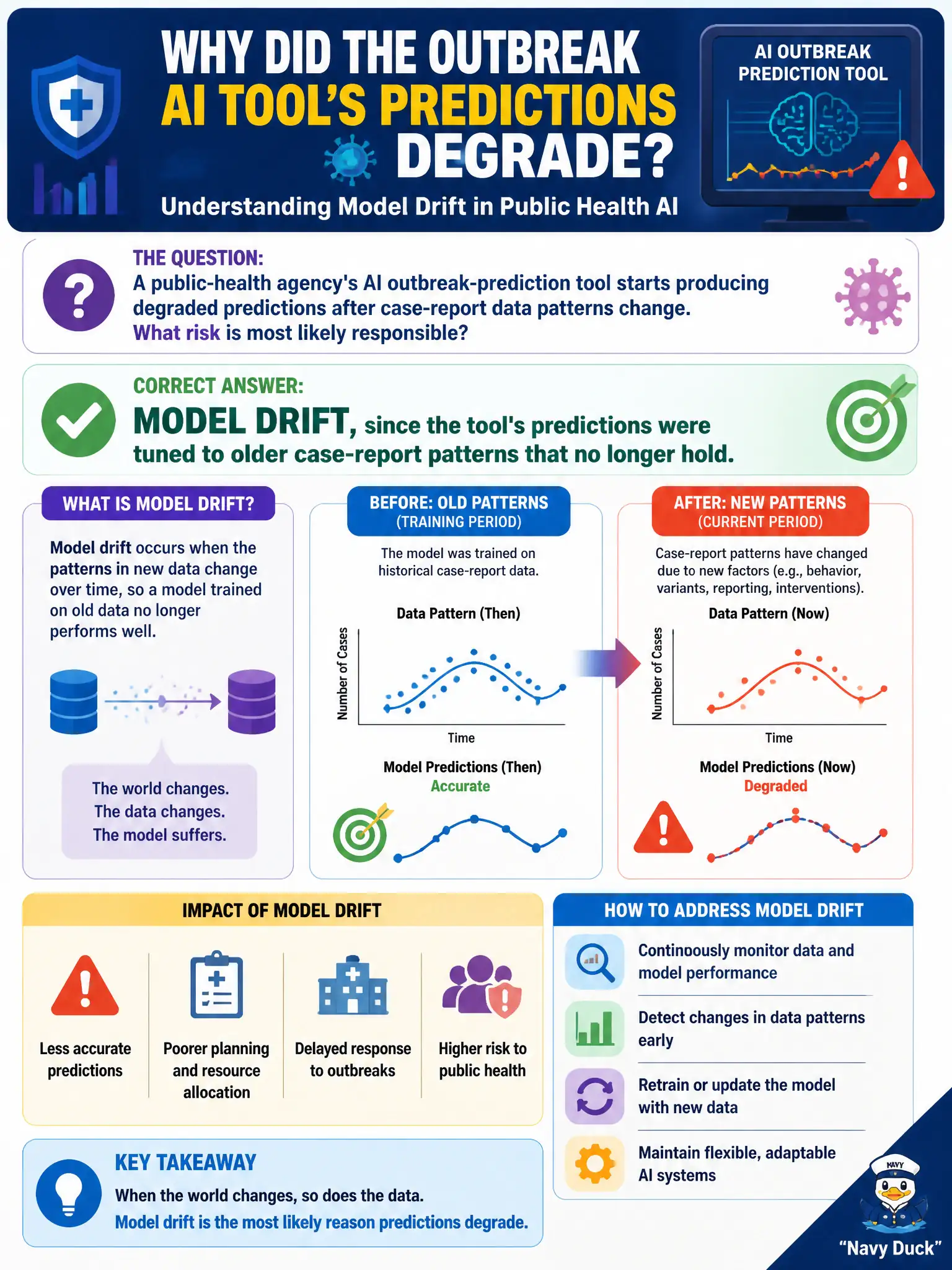
A prediction tool trained on yesterday's disease patterns doesn't automatically know today's changed. That gap between what a model learned and what's actually happening now is model drift, and it's a different animal from bias or a tool making things up. Naming the right problem is step one to fixing it.
Full Explanation
Model drift occurs when the statistical relationships a model learned from historical training data no longer match the patterns present in current real-world data, causing prediction quality to degrade even though the model itself has not changed. For an outbreak-prediction tool, a shift in how case-report data behaves, perhaps due to a new reporting method, a changed disease strain, or altered testing rates, means the model is applying old assumptions to a new reality, which is exactly what model drift describes. Hallucination refers to a generative model fabricating plausible-sounding but false content, which is a different failure mode than a prediction model whose accuracy is degrading due to a real change in underlying data patterns. Shadow AI describes unapproved tool use outside governance visibility, which has nothing to do with why an approved, monitored tool's predictions are declining. A bias issue describes systematically unequal treatment across groups, which is a distinct concern from an overall decline in predictive accuracy tied to a data-pattern shift. A scope caveat: drift and bias can sometimes co-occur, so ruling out bias entirely still requires a separate disaggregated check even once drift is confirmed as the primary cause. A concrete operational check is to compare the model's recent prediction accuracy against a rolling baseline and flag when it falls outside expected variance, which is the standard drift-detection signal.