
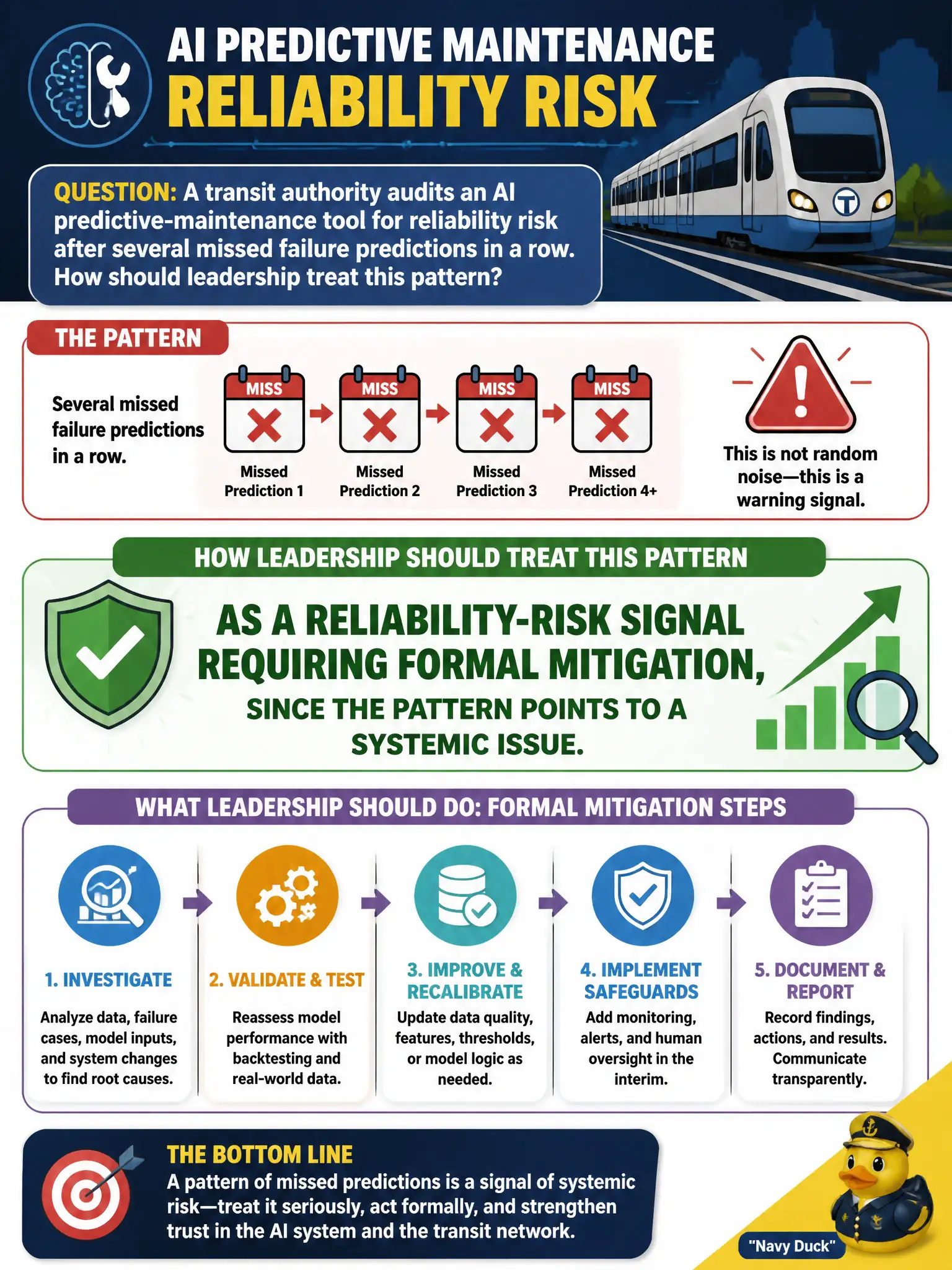
A transit authority audits an AI predictive-maintenance tool for reliability risk after several missed failure predictions in a row. How should leadership treat this pattern?
Select an answer to reveal the explanation.
Short Explanation
One missed prediction might be a fluke. Several in a row is a pattern, and patterns are what reliability risk actually looks like. Treating repeated misses as a signal worth mitigating formally, rather than shrugging them off one at a time, is what keeps a small crack from becoming a bigger failure down the line.
Full Explanation
Reliability risk in an AI system is identified through patterns of failure, not single events, and several consecutive missed failure predictions is exactly the kind of pattern that indicates a systemic issue with the model rather than random noise. Treating this as a formal reliability-risk signal means the transit authority investigates root causes, such as whether the training data no longer represents current equipment conditions, and applies a structured mitigation plan. Dismissing the pattern as isolated incidents ignores the statistical weight of repetition; a model that consistently misses is behaving differently than one that occasionally errs, and the distinction matters for asset safety. Abandoning predictive maintenance entirely in favor of manual inspection overcorrects by discarding a tool's value because of a fixable reliability gap, rather than diagnosing and repairing the specific failure mode. Leaving resolution entirely to the maintenance crew without governance involvement misassigns responsibility, since crew members can report what they observe but typically lack the authority or tooling to investigate or retrain the model itself. A scope caveat: not every missed prediction indicates the same root cause, so mitigation should be tailored to what the investigation actually finds, whether that is data quality, drift, or an edge case the model was never trained on. A concrete operational check is to log and review every missed prediction against actual maintenance outcomes on a recurring cadence, rather than only after a cluster becomes noticeable.