
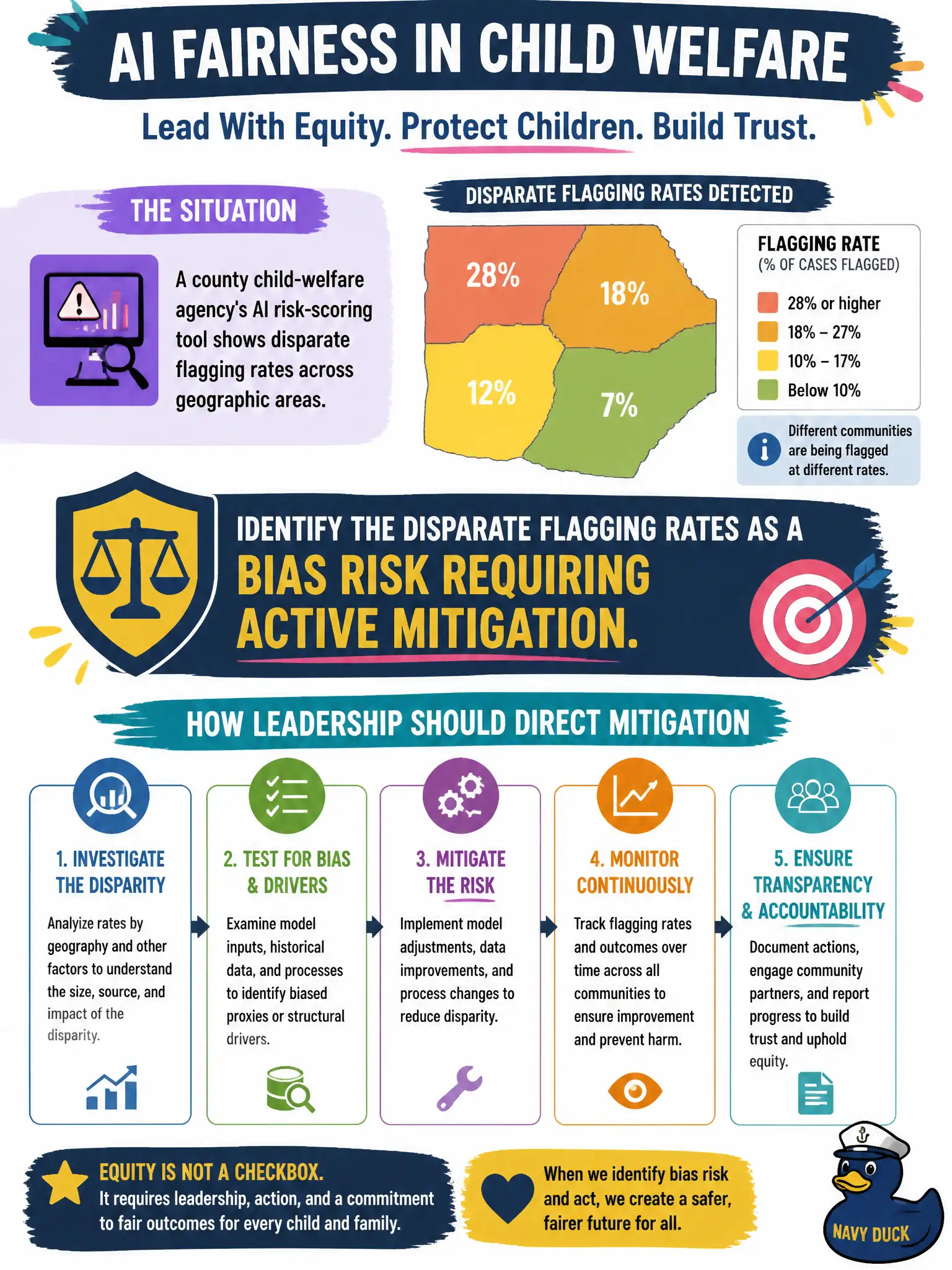
A county child-welfare agency's AI risk-scoring tool shows disparate flagging rates across geographic areas. How should the agency's leadership direct mitigation?
Select an answer to reveal the explanation.
Short Explanation
When a tool flags one neighborhood at a very different rate than another, that's not noise, it's a signal. Chalking it up to coincidence is how a fairness problem quietly becomes a lawsuit. Treating disparate rates as a bias risk that needs active mitigation is what actually protects the families the tool touches.
Full Explanation
Disparate outcome rates across demographic or geographic groups are a recognized signal of potential bias in an AI system, and responsible leadership treats that signal as a risk requiring investigation and mitigation rather than an anomaly to be waited out. In a child-welfare context, where flagging decisions carry serious consequences for families, dismissing disparate rates as a data artifact that will resolve with more volume ignores that bias often persists or worsens as more data accumulates if the underlying cause is never addressed. Publishing the raw rates without internal review confuses transparency with remediation; disclosing a problem is not the same as fixing it, and it can create public alarm without any corresponding action plan. Retraining caseworkers on the interface misdiagnoses the issue entirely, since a disparity in how the model scores cases is a property of the model and its training data, not of how staff click through a screen. A scope caveat: not every disparity is caused by bias in the model itself; some may reflect real underlying differences in reported case circumstances, so mitigation should start with a root-cause investigation rather than an assumption either way. A concrete operational check is to run a disaggregated audit comparing flagging rates against known case-severity indicators before deciding what corrective action to take.