
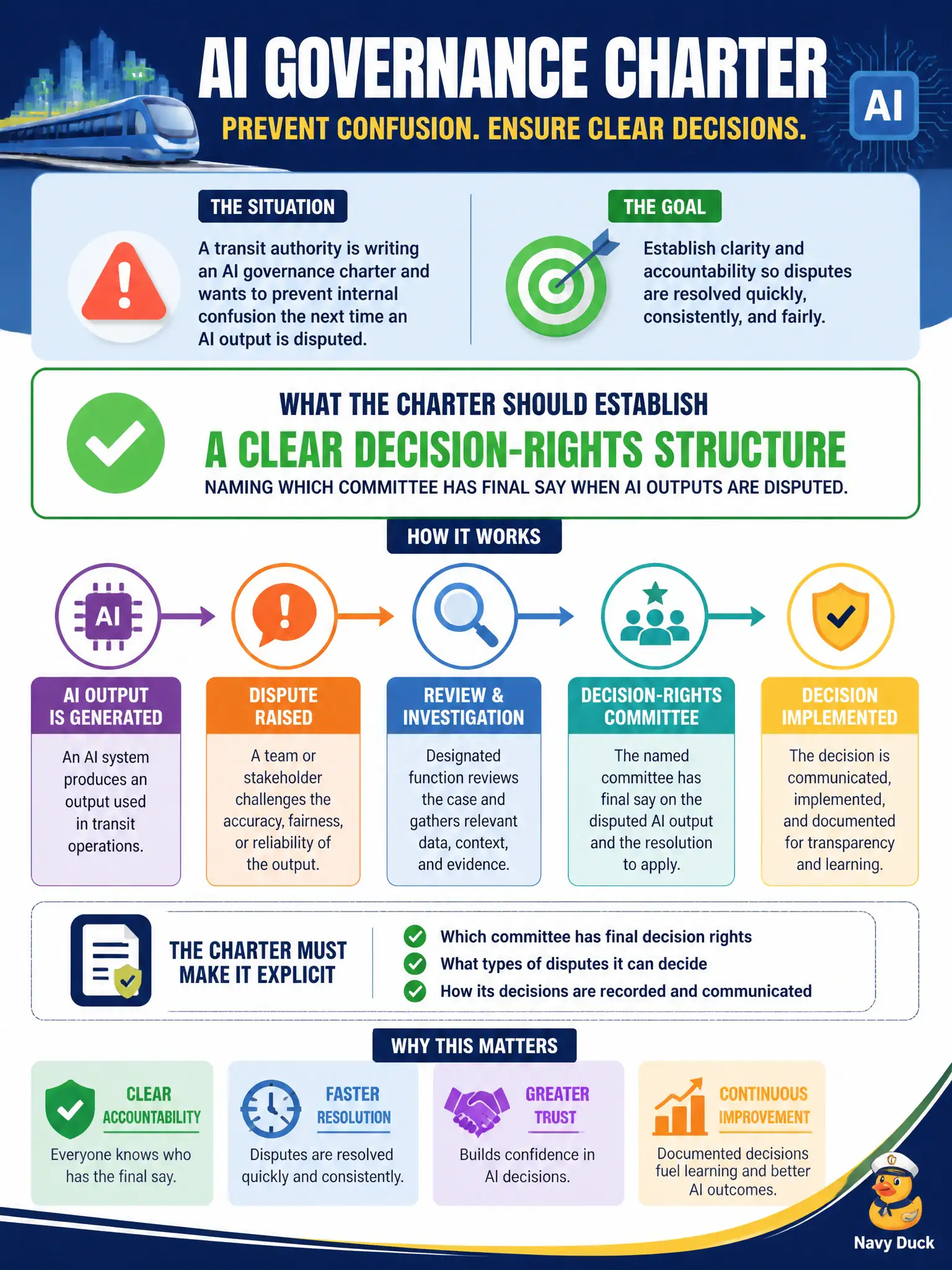
A transit authority is writing an AI governance charter and wants to prevent internal confusion the next time an AI output is disputed. What should the charter establish?
Select an answer to reveal the explanation.
Short Explanation
A charter without clear decision rights is like a sports league with no referee: everyone argues the call, but nobody's actually in charge of making it. Naming a committee with final say before the first dispute happens means the transit authority isn't inventing a process mid-argument. Clarity up front saves a lot of hallway debates later.
Full Explanation
A governance charter's job is to define decision rights in advance, so that when an AI output is challenged, everyone already knows who has the authority to resolve it and how. Naming a specific committee with final say gives the organization a repeatable, defensible process rather than an ad hoc scramble each time a dispute surfaces. Leaving resolution to informal discussion until a manager happens to weigh in produces inconsistent outcomes depending on who is in the room that day, and it offers no auditable trail for later review. Handing final authority to the tool's vendor puts a commercial party with its own interests in charge of judging its own product's correctness, which undermines the independence a dispute-resolution process needs. Simply discarding disputed outputs and reverting to manual work avoids the disagreement rather than resolving it, and it fails to build any institutional learning about why the output was questioned in the first place. A scope caveat: the committee's authority should be limited to interpreting and validating outputs, not silently overriding the underlying governance policies that produced them. A concrete operational check is to confirm the charter names the committee by role or title, not by a specific individual, so authority survives staff turnover.