
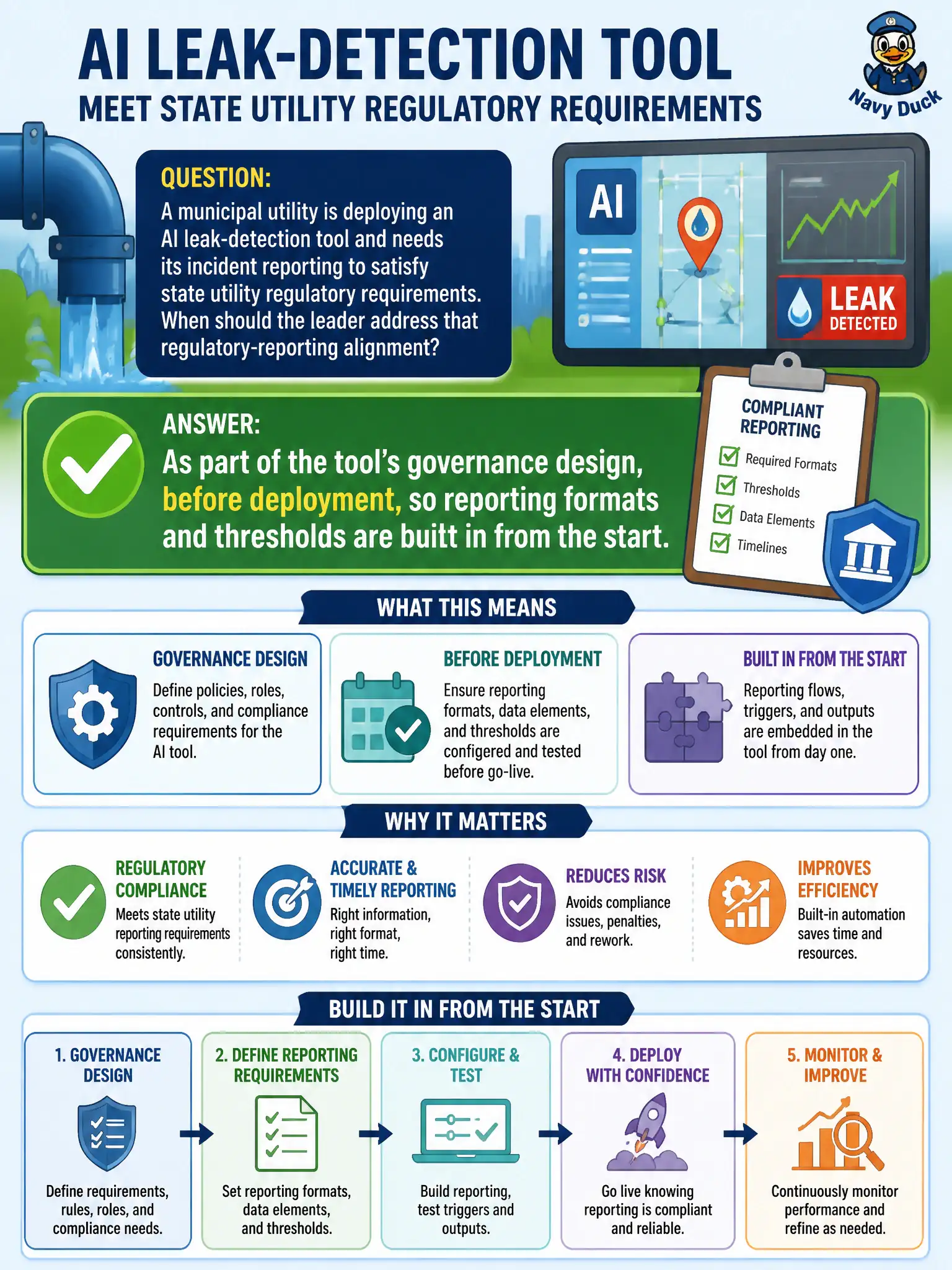
A municipal utility is deploying an AI leak-detection tool and needs its incident reporting to satisfy state utility regulatory requirements. When should the leader address that regulatory-reporting alignment?
Select an answer to reveal the explanation.
Short Explanation
Picture trying to retrofit seatbelts into a car after it's already on the highway. Waiting to bolt on regulatory-reporting rules after an AI tool is running means redesigning data flows the utility already depends on. Building the reporting requirement into governance from day one means the tool speaks the regulator's language from its very first alert.
Full Explanation
Governance-by-design means regulatory obligations are treated as functional requirements for the AI system itself, not paperwork layered on afterward. For a leak-detection tool, that means the categories, thresholds, and timing the state regulator expects in an incident report get built into how the tool logs and surfaces its findings before the tool ever goes live. Waiting for a full operating cycle risks the tool having captured data in a shape that cannot be reformatted into the regulator's required structure without rework or gaps. Treating reporting as something addressed only if a regulator opens an inquiry turns compliance into a reactive fire drill instead of a standing capability, and by then noncompliant history may already exist. Tying it to whenever an annual audit happens to look at AI systems leaves a compliance blind spot for months at a time, since audits are periodic checks, not real-time controls. A scope caveat worth noting: exact reporting formats vary by state, so the specific fields required should come from the utility's own regulatory counsel rather than being assumed uniform. A concrete operational check is to have the compliance office sign off on the tool's reporting schema before go-live, confirming it maps directly to the state's required incident-report fields.