
A courts and clerk's office is rolling out an AI tool that drafts public-facing case-status summaries for the clerk's website. Which body should own final approval of the tool before it goes live?
Select an answer to reveal the explanation.
Short Explanation
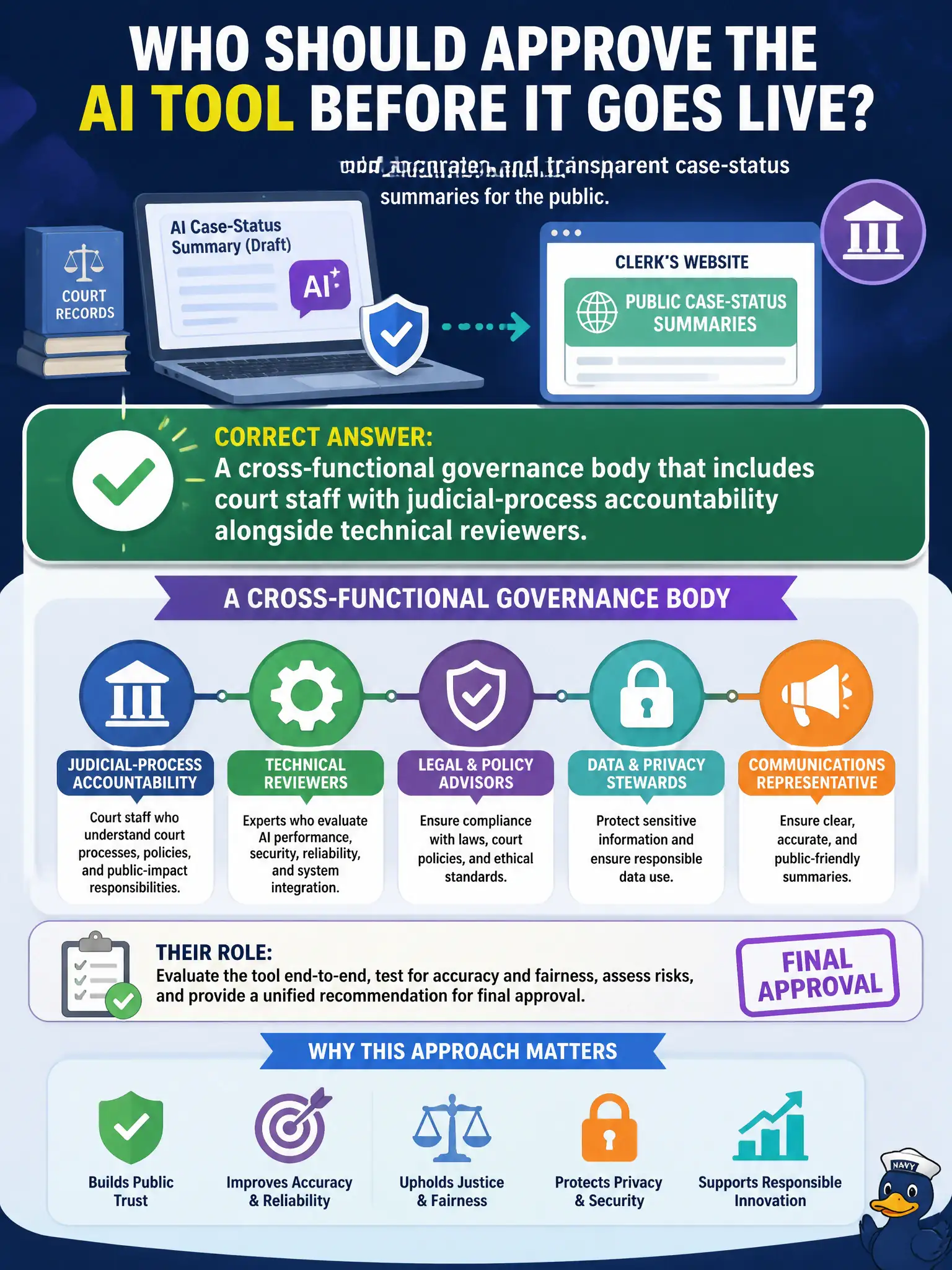
Think of approving this tool like signing off on a courtroom procedure change, not a server upgrade. IT can confirm the servers hum along fine, but only someone who understands judicial-process accountability can judge whether a case-status summary is fair, accurate, and appropriate to publish. Ownership needs both hats in the room, not one department deciding alone.
Full Explanation
A courts and clerk's office is a mission environment where public-facing outputs carry procedural and legal weight, so approval authority has to combine two kinds of accountability: technical soundness and judicial-process correctness. A cross-functional governance body, drawing court staff who understand case handling together with technical reviewers who understand the model's behavior, is positioned to catch both a broken integration and a summary that misstates a case's status. Routing approval through IT alone tests only whether the system runs, not whether its output is procedurally sound, which is the actual risk in a courts setting. Leaving the decision to a vendor representative hands external sales interests a role that belongs to the accountable public agency, and a vendor has no stake in judicial correctness. A single clerk, however knowledgeable, lacks the enterprise view needed to weigh risk across the whole office, and facilities management has no domain connection to case-status content at all. The caveat here is scope: this approval structure applies to the initial go-live decision, not to routine day-to-day content generation once the tool is live and monitored. A concrete operational check is to require documented sign-off from both a court-operations representative and a technical reviewer, filed before the tool's first public deployment, so the approval trail itself proves shared accountability.