
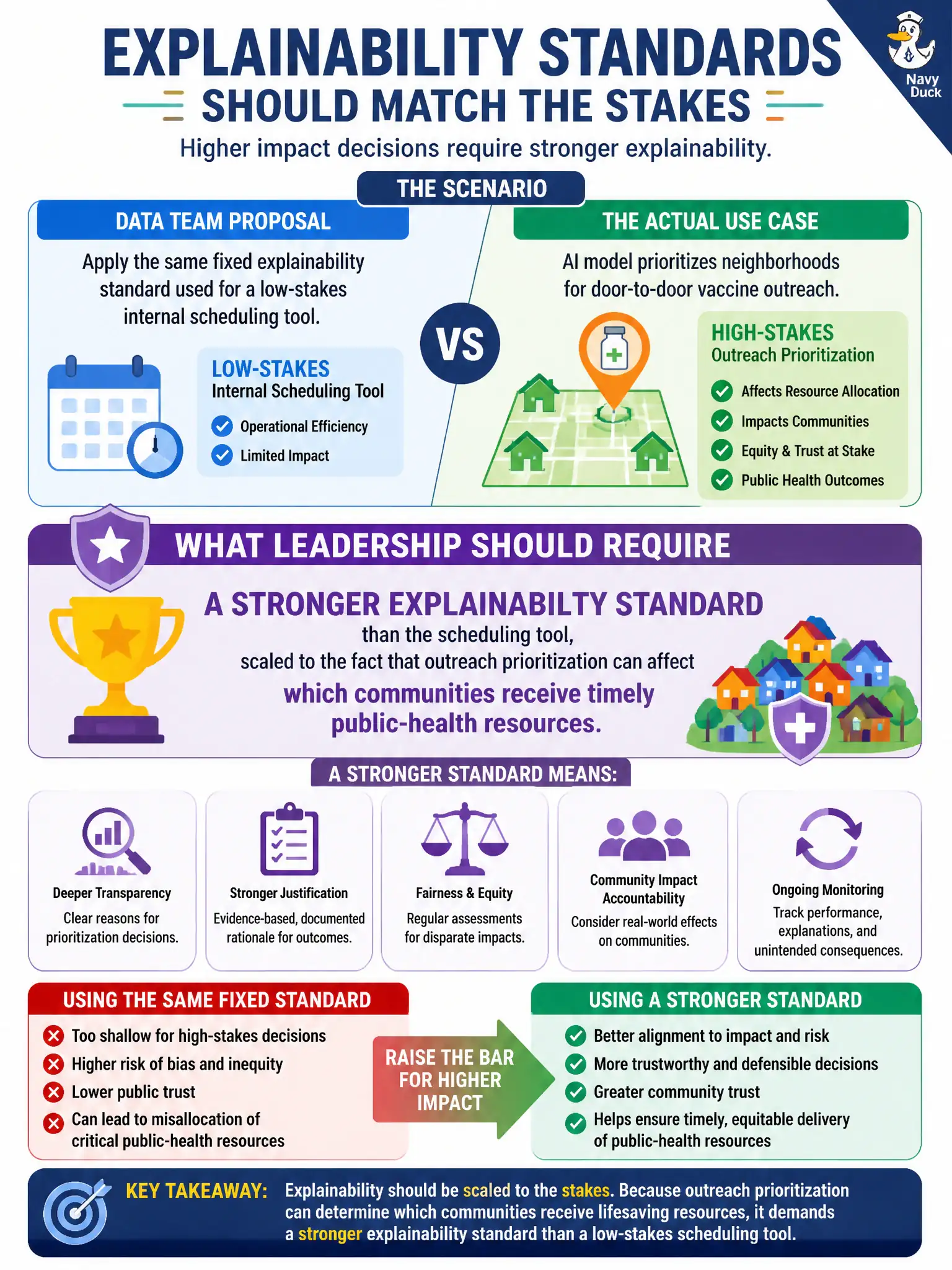
A public-health agency is setting explainability requirements for an AI model that prioritizes which neighborhoods receive door-to-door vaccine outreach. A data team proposes applying the same fixed explainability standard the agency uses for a low-stakes internal scheduling tool. What should the agency's leadership require instead?
Select an answer to reveal the explanation.
Short Explanation
Think about it like requiring a detailed inspection report before approving a bridge, but a quick checklist before approving a bike rack: both get looked at, but the stakes decide how deep you go. A model deciding which neighborhoods get vaccine outreach carries real public-health consequences, so it needs a deeper explanation of its reasoning than a tool that's just shuffling staff schedules.
Full Explanation
Responsible AI leadership means calibrating explainability depth to the stakes of the decision the model informs, rather than applying one fixed technical checkbox across every internal system regardless of consequence. A model that ranks neighborhoods for vaccine outreach directly shapes which communities receive timely public-health resources, so leadership needs to understand and be able to justify why certain neighborhoods were prioritized, in case of community pushback, equity review, or an unexpected disease outbreak pattern the model missed. Skipping explainability documentation because the model doesn't individually deny anyone a service ignores that prioritization decisions still have real distributive consequences at the community level, even without a single denied applicant. Treating the decision as purely operational logistics understates its public-health stakes and would justify under-scrutinizing a model that shapes health-equity outcomes. Applying the identical standard used for a low-stakes scheduling tool undervalues explainability where it matters most and potentially over-invests it where it doesn't, wasting scrutiny that should scale with impact. A relevant scope caveat: higher explainability requirements often mean added documentation burden and possibly slower deployment timelines, which leadership should plan for rather than treat as a late surprise. A concrete check: require the model to produce a rank-ordered justification for its top-priority neighborhoods that a non-technical health director could review and challenge before outreach begins.