
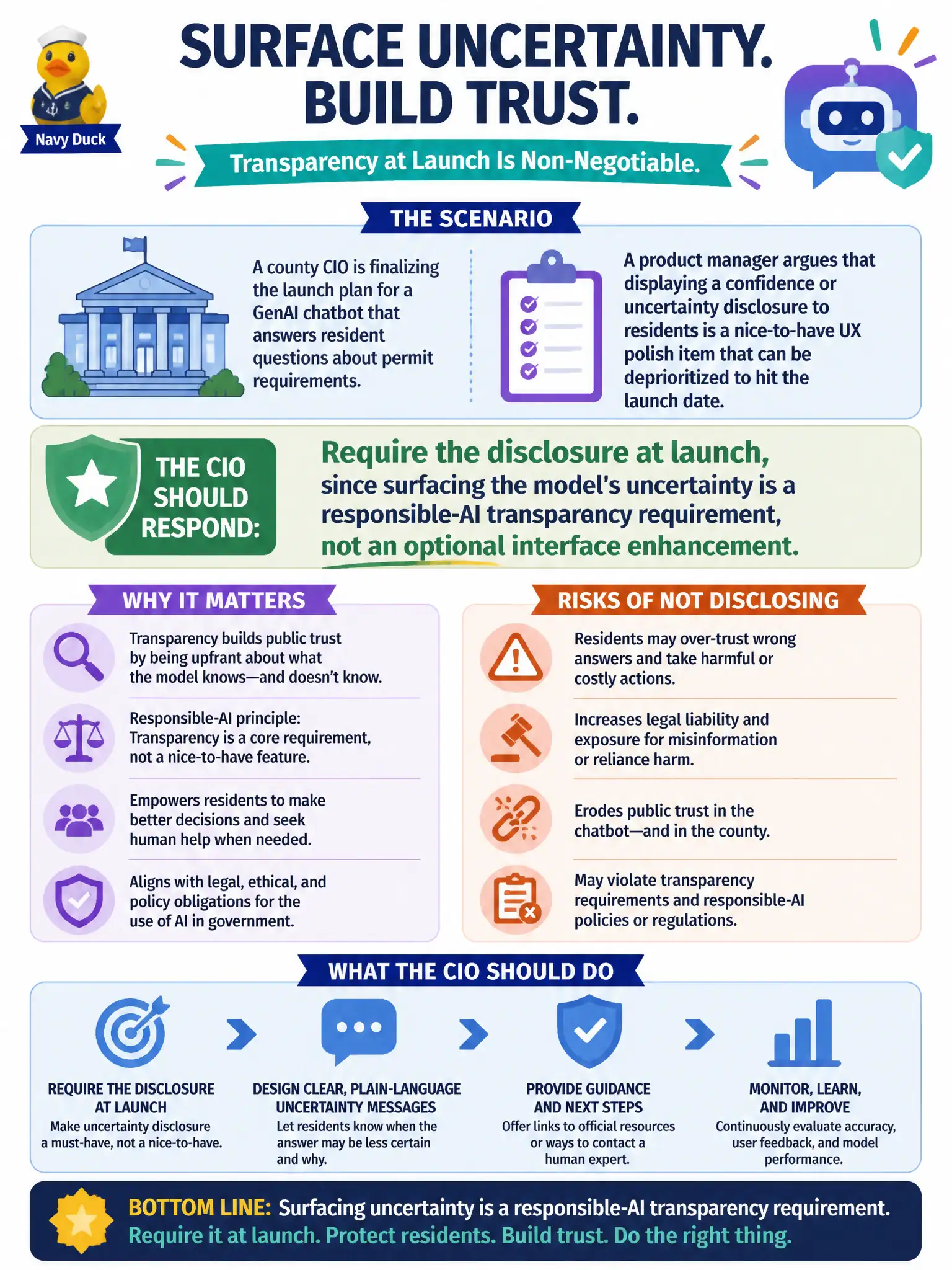
A county CIO is finalizing the launch plan for a GenAI chatbot that answers resident questions about permit requirements. A product manager argues that displaying a confidence or uncertainty disclosure to residents is a nice-to-have UX polish item that can be deprioritized to hit the launch date. How should the CIO respond?
Select an answer to reveal the explanation.
Short Explanation
Think about a weather app that shows '70% chance of rain' instead of just 'it will rain': the confidence number is what lets you decide how much to trust the forecast. A permit chatbot that states its answer with no signal of uncertainty leaves residents unable to tell a solid answer from a guess, so surfacing that uncertainty isn't decoration, it's part of being honest about what the tool actually knows.
Full Explanation
Transparency about an AI system's limitations is a core responsible-AI principle, not a cosmetic UX choice, because residents relying on a chatbot's answer to understand permit requirements need a signal for when that answer might be unreliable. Treating the disclosure as visual polish that can be cut under deadline pressure misunderstands its function: without it, residents have no way to distinguish a well-grounded answer from one generated with low confidence, which increases the risk of residents acting on bad information about legal requirements. Deferring the decision to the vendor conflates transparency policy, which is a governance responsibility of the county, with technical implementation, which the vendor can execute but should not decide unilaterally. Relocating the disclosure into buried terms-of-service language technically preserves some disclosure but defeats its purpose, since transparency has to reach the resident at the point of use, in the conversation itself, not in a document nobody reads before asking a question. A scope caveat worth flagging: the appropriate level of confidence signaling can scale with stakes, a simple hours-of-operation question may need less than a nuanced eligibility interpretation, but some signal should exist across the board. A concrete check: before launch, confirm the chat interface visibly flags lower-confidence responses or ambiguous permit scenarios rather than presenting every answer with uniform certainty.