
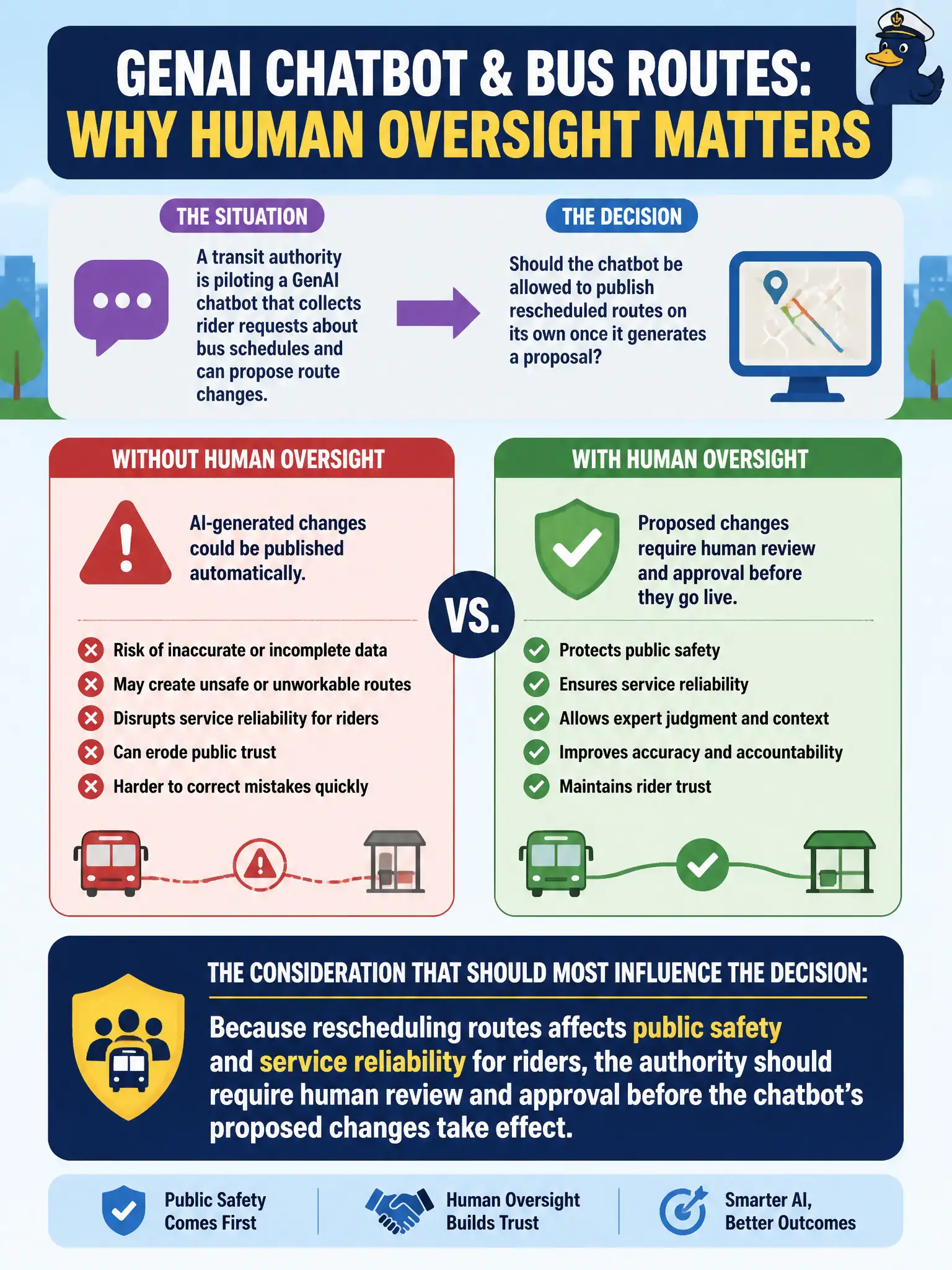
A transit authority is piloting a GenAI chatbot that collects rider requests about bus schedules and can propose route changes. Leadership is deciding whether the chatbot should be allowed to publish rescheduled routes on its own once it generates a proposal. Which consideration should most influence the decision to require human oversight before any change takes effect?
Select an answer to reveal the explanation.
Short Explanation
Think about the difference between a chatbot drafting a memo and a chatbot actually rerouting the bus riders depend on to get to work: one is low stakes, the other affects real people's commutes and safety. When the downside of a wrong call is that big, you keep a human in the loop before anything goes live, not after.
Full Explanation
The right level of human oversight scales with the consequence of the agent acting incorrectly, and rescheduling public transit routes carries real safety and reliability stakes for riders who depend on predictable service, which is exactly the kind of high-consequence action that calls for review and approval before it takes effect rather than after. Treating the interaction channel, text messaging, as the deciding factor confuses how riders reach the chatbot with what the chatbot is authorized to do once it has their input, and the channel has little bearing on the risk of the underlying action. Tying the oversight requirement to whether the model was fine-tuned in-house versus offered as a managed service mixes up how a model was built with what it is allowed to do unsupervised, which are independent questions; a managed model given autonomous publishing rights carries the same operational risk as a custom one. Relying on a quarterly audit of already-published changes accepts the harm of a bad reroute before anyone catches it, and reversibility does not undo the missed trips or stranded riders that already happened in the meantime. A reasonable scope caveat is that low-stakes chatbot functions, like answering a rider's question about the next arrival time, may not need the same approval gate as a change that alters a published schedule. An operational check worth running is confirming that no proposed route change reaches riders without a named staff member's sign-off logged against it.