
A county IT office is designing the architecture for a resident-services program that spans permitting, tax collection, and library services, each governed by different rules and data sources. The office is weighing a multi-agent orchestration approach, where a separate specialized agent handles each department, against a single monolithic chatbot that tries to cover all three. Which factor most supports choosing multi-agent orchestration for this program?
Select an answer to reveal the explanation.
Short Explanation
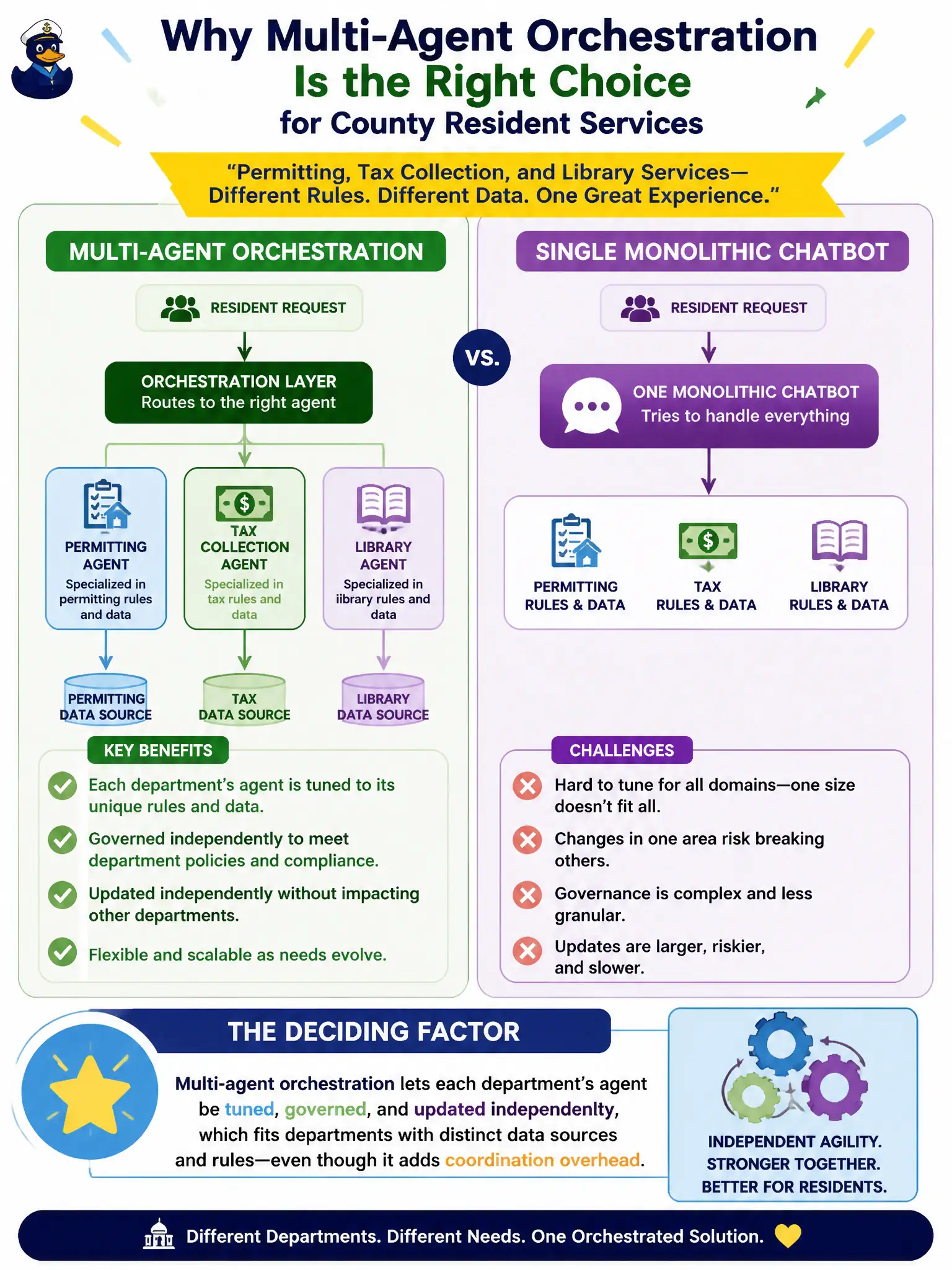
Picture three department specialists at a shared front desk instead of one generalist trying to know permitting, taxes, and library rules all at once. Each specialist can be trained, updated, and held accountable for their own rules without stepping on the others, and that's the real case for multi-agent orchestration when departments genuinely differ.
Full Explanation
Multi-agent orchestration assigns each domain, permitting, tax collection, library services, to its own specialized agent, so each one can be updated, governed, and tuned against that department's own rules and data without a change to permitting logic risking a break in the tax-collection agent's behavior. This independence becomes valuable precisely when departments have meaningfully different data sources and compliance requirements, as described here, even though coordinating handoffs between agents adds real design and operational complexity the county has to manage. Assuming a single chatbot is inherently easier to govern gets the tradeoff backward for this scenario, since forcing one model to absorb three departments' worth of shifting rules concentrates risk rather than isolating it, and a change meant for one department can unintentionally affect how the model answers for another. Framing the choice around cloud compute cost misses the point of the architecture decision, since orchestration overhead can just as easily raise costs as lower them, and the real driver here is governance and data separation, not raw compute spend. Believing a single chatbot removes the need for human review confuses architecture with oversight; both approaches still need review policies regardless of how many agents are involved. A reasonable scope caveat is that multi-agent orchestration is not worth the added complexity for a program where departments share nearly identical rules and data. A useful check is mapping each department's data-access boundaries before deciding how many agents the design actually needs.