
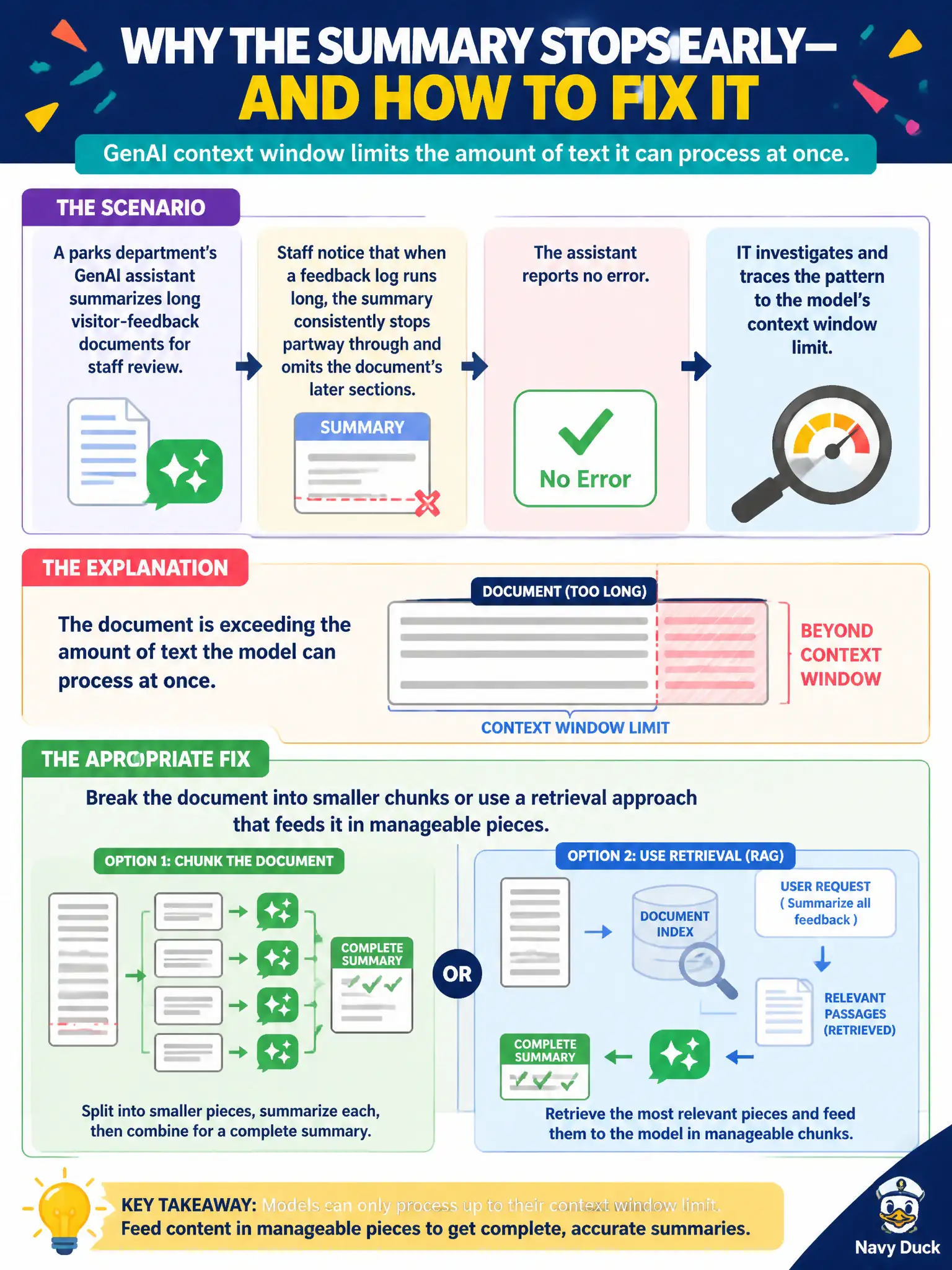
A parks department's GenAI assistant summarizes long visitor-feedback documents for staff review. Staff notice that when a feedback log runs long, the summary consistently stops partway through and omits the document's later sections, even though the assistant reports no error. After investigating, the department's IT lead traces the pattern to the model's context window limit. Which explanation best accounts for the truncation and points to an appropriate fix?
Select an answer to reveal the explanation.
Short Explanation
Picture trying to read an entire novel out loud in one breath: at some point you just run out of air, not because you forgot how to read, but because there's a limit to how much you can hold at once. A model's context window works the same way, so once a feedback log outgrows it, the fix is feeding the document in smaller pieces, not blaming the model's training or its guardrails.
Full Explanation
Every GenAI model has a fixed context window, the maximum amount of text it can take in and reason over for a single request, and once an input document exceeds that limit, the model simply cannot see or summarize the parts that spill past the boundary, even though it returns a normal-looking answer. This differs from model drift, which describes output quality degrading over time as real-world patterns shift away from what the model was trained on, a problem addressed by monitoring and retraining, not by adjusting input length. It also differs from guardrail filtering, which deliberately blocks or redacts specific categories of content for safety or policy reasons rather than cutting text purely because of its position in a long document. And it has nothing to do with seat-based licensing, which governs how many named users can access the tool, not how much text any single request can contain. The practical fix is to break the long feedback log into smaller sections the assistant can process one at a time, or to adopt a retrieval approach that pulls only the most relevant passages into each request instead of feeding the entire document at once. One caveat: chunking changes how summaries are structured, so the department should also decide whether it needs a rolled-up summary of summaries. A quick operational check is comparing the length of a truncated document against the assistant's documented context-window limit to confirm the two line up.