
A library system's leadership is evaluating Amazon Quick as an AI-powered business assistant for staff questions, weighing it strategically rather than as a technical rollout. Which framing correctly positions this kind of tool for the library's leadership?
Select an answer to reveal the explanation.
Short Explanation
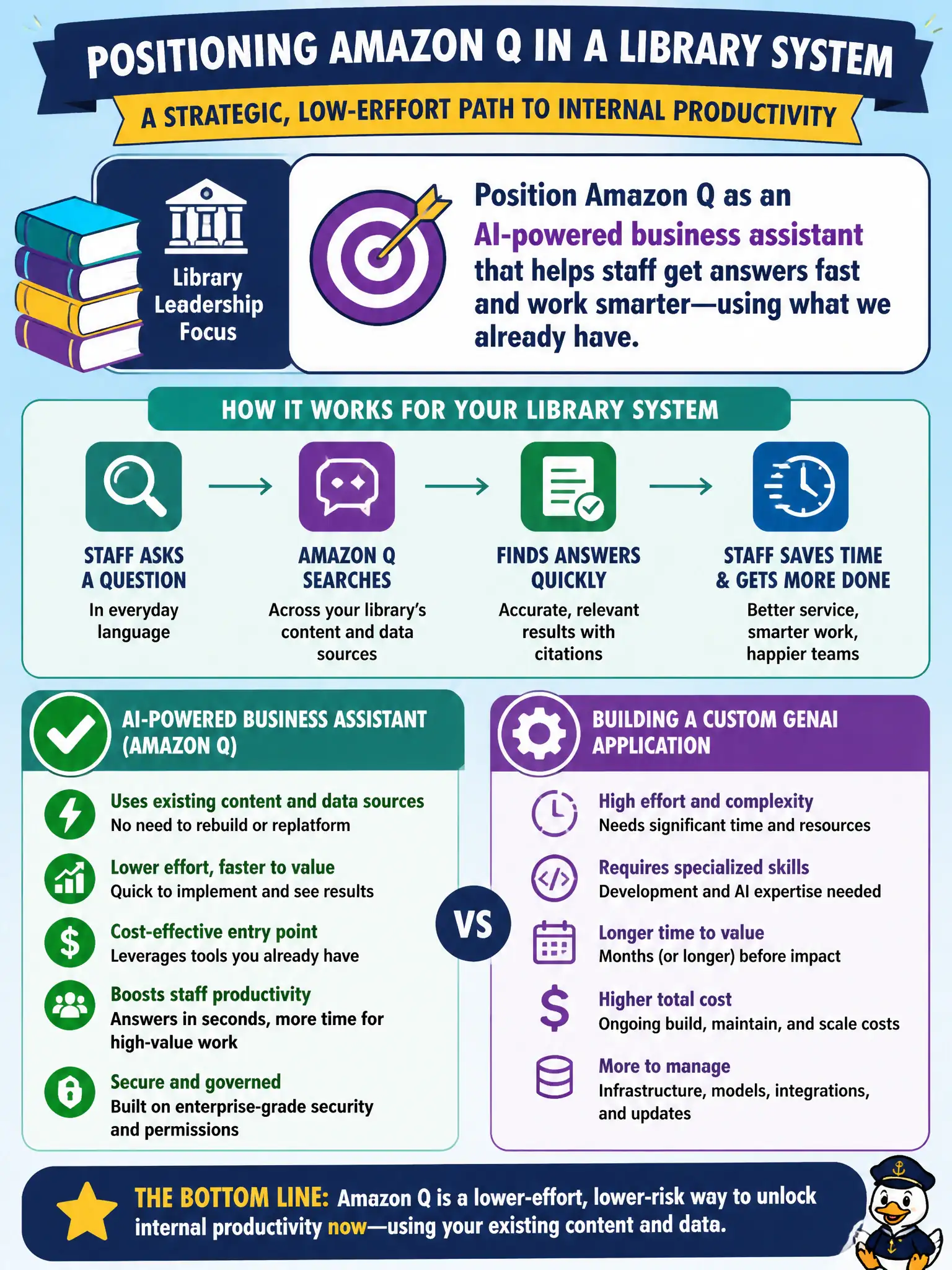
Think of it as handing every staff member a research assistant who already knows where everything in the building is filed, instead of asking the library to build that assistant from scratch. That's the strategic pitch for an AI-powered business assistant: quick internal wins, not a ground-up build.
Full Explanation
An AI-powered business assistant is positioned as a ready-made layer that lets staff query across the organization's own content and data without the library building custom retrieval or model infrastructure itself, which is why leadership should read it as a lower-effort entry point for internal productivity rather than a platform project. That framing matters for a business-case conversation, because it changes the comparison from 'build versus buy' engineering tradeoffs to 'how fast can staff get value.' Positioning it as a reference-desk replacement misapplies an internal staff-productivity tool to a public-facing service question, which is a different initiative with different risk and staffing implications entirely. Positioning it as a model-training platform confuses an assistant designed for staff to query existing content with the separate discipline of building and training predictive models, which is not what this category of tool is for. Claiming it needs the same infrastructure investment as a custom build erases the exact tradeoff that makes it strategically attractive — lower setup effort in exchange for less customization, similar to any managed-versus-custom decision elsewhere in the AI portfolio. A scope caveat: the tool's value depends on how well-organized the library's underlying content already is, since it surfaces existing information rather than generating new knowledge. As an operational check, leadership should pilot it against a handful of real staff questions before committing budget to a system-wide rollout.