
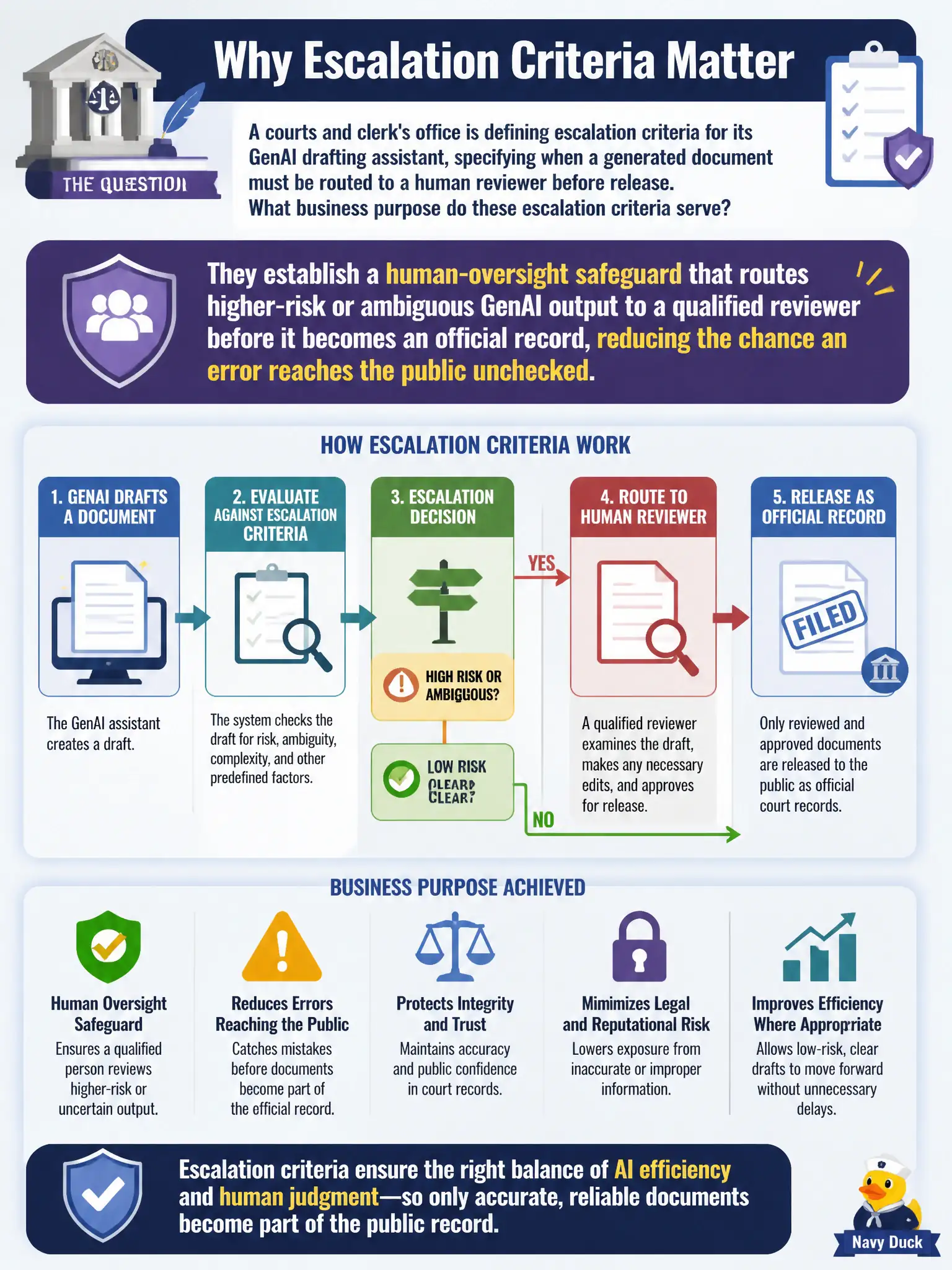
A courts and clerk's office is defining escalation criteria for its GenAI drafting assistant, specifying when a generated document must be routed to a human reviewer before release. What business purpose do these escalation criteria serve?
Select an answer to reveal the explanation.
Short Explanation
Think of escalation criteria like a tripwire for a second pair of eyes: routine drafts move along, but anything unusual gets pulled aside for someone to actually look at before it goes out the door. For a clerk's office, that tripwire is what keeps a GenAI drafting mistake from quietly becoming an official court record.
Full Explanation
Escalation criteria work by defining specific conditions under which a GenAI-generated document cannot proceed to release without a qualified human checking it first — flagging things like unusual case types, ambiguous source material, or high-consequence filings. That mechanism is a human-oversight safeguard: it accepts that GenAI output carries some error risk and inserts a deliberate checkpoint before that risk reaches an official record or the public. The workload-balancing framing misreads the purpose by concept — escalation rules are triggered by risk characteristics of the output, not by a goal of evening out who does the drafting, so treating it as staffing logistics misses why the rule exists. The usage-statistics framing confuses a safeguard with a reporting artifact; tracking how often escalation triggers fire can be a useful byproduct, but that is not why the criteria were defined in the first place. The vendor-benchmark framing misapplies an oversight mechanism to a procurement decision, conflating a document-level safety control with a contract-level performance evaluation. A scope caveat: escalation criteria only work if they are specific enough that staff can apply them consistently — vague thresholds like 'when it seems risky' invite inconsistent judgment calls. As an operational check, the office should be able to point to a written list of the exact conditions that trigger escalation, not a general expectation that staff will notice problems.