
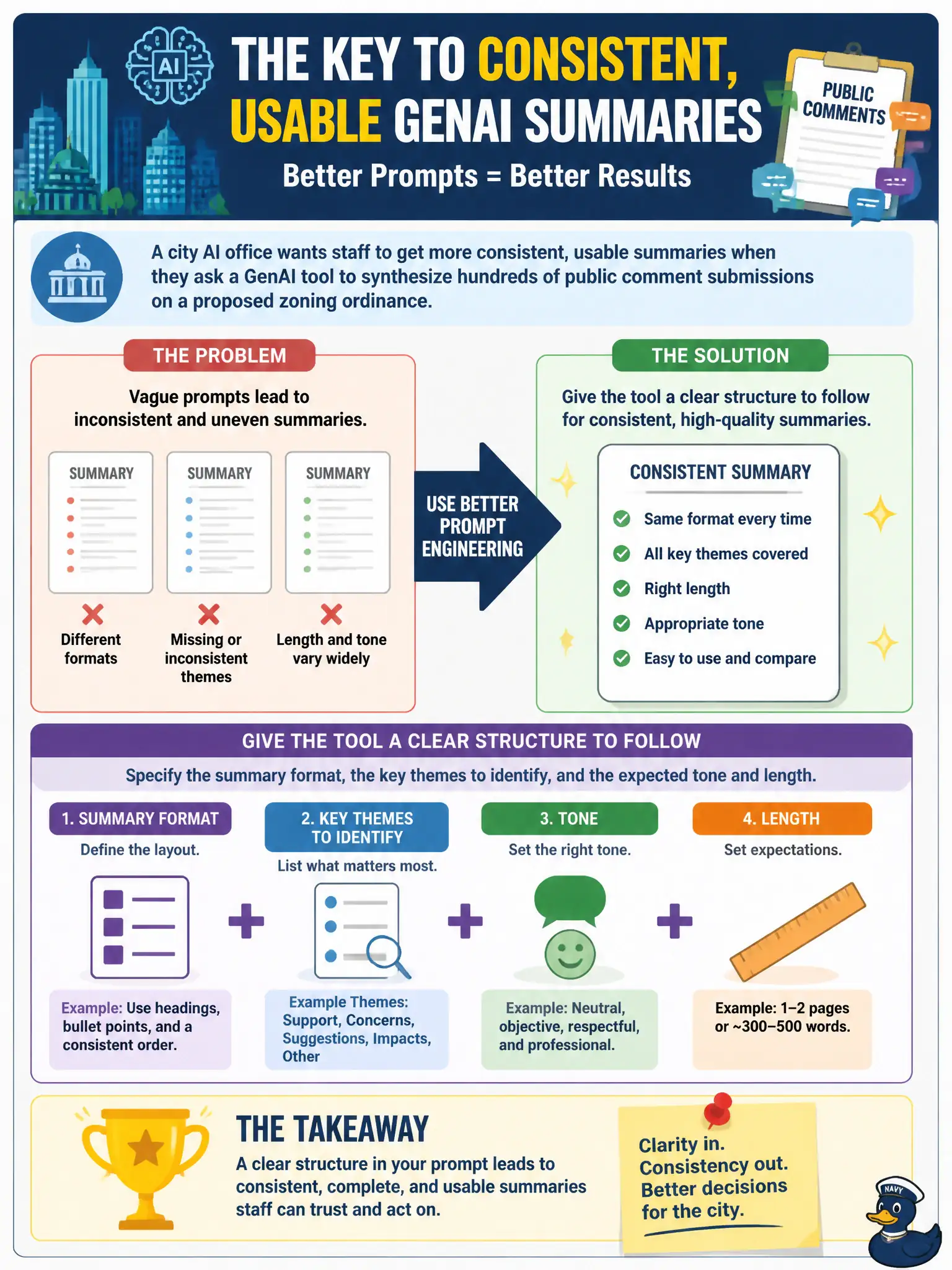
A city AI office wants staff to get more consistent, usable summaries when they ask a GenAI tool to synthesize hundreds of public comment submissions on a proposed zoning ordinance. Which prompt engineering practice would most reliably improve the consistency of the tool's summaries?
Select an answer to reveal the explanation.
Short Explanation
Think about asking a new intern to write a report versus handing them a template with clear headings and word limits, the template gets you something usable every time. That's structure: telling the GenAI tool exactly what format, themes, and tone you want turns a vague ask into a consistent one. Prompt engineering isn't magic, it's just giving clear instructions.
Full Explanation
Basic prompt engineering improves consistency by reducing the range of reasonable interpretations the model has to guess between, and specifying output structure, format, target themes, tone, and length, directly narrows that range so repeated runs converge on similar results. Here, telling the tool exactly what shape the summary should take gives it a concrete target to hit every time, which is the mechanism behind more predictable GenAI output. Manually averaging results from several repeated broad requests treats inconsistency as something to fix after the fact through extra staff labor, rather than addressing the actual cause, an underspecified prompt, at the source. Asking a short, minimal-detail question shifts the burden of structure onto the model's own guesswork, and different runs will reasonably guess differently, producing the inconsistency the office is trying to eliminate. Loading in as much raw comment text as possible confuses volume of input with clarity of instruction; more source text does not tell the model how to organize its output, and very large inputs risk running into the tool's context limits rather than improving structure. A scope caveat: structured prompting improves consistency but does not guarantee factual accuracy, so summaries should still be spot-checked against a sample of source comments. A concrete check: run the same structured prompt against two different comment batches and confirm the output format stays identical even though the content differs.