
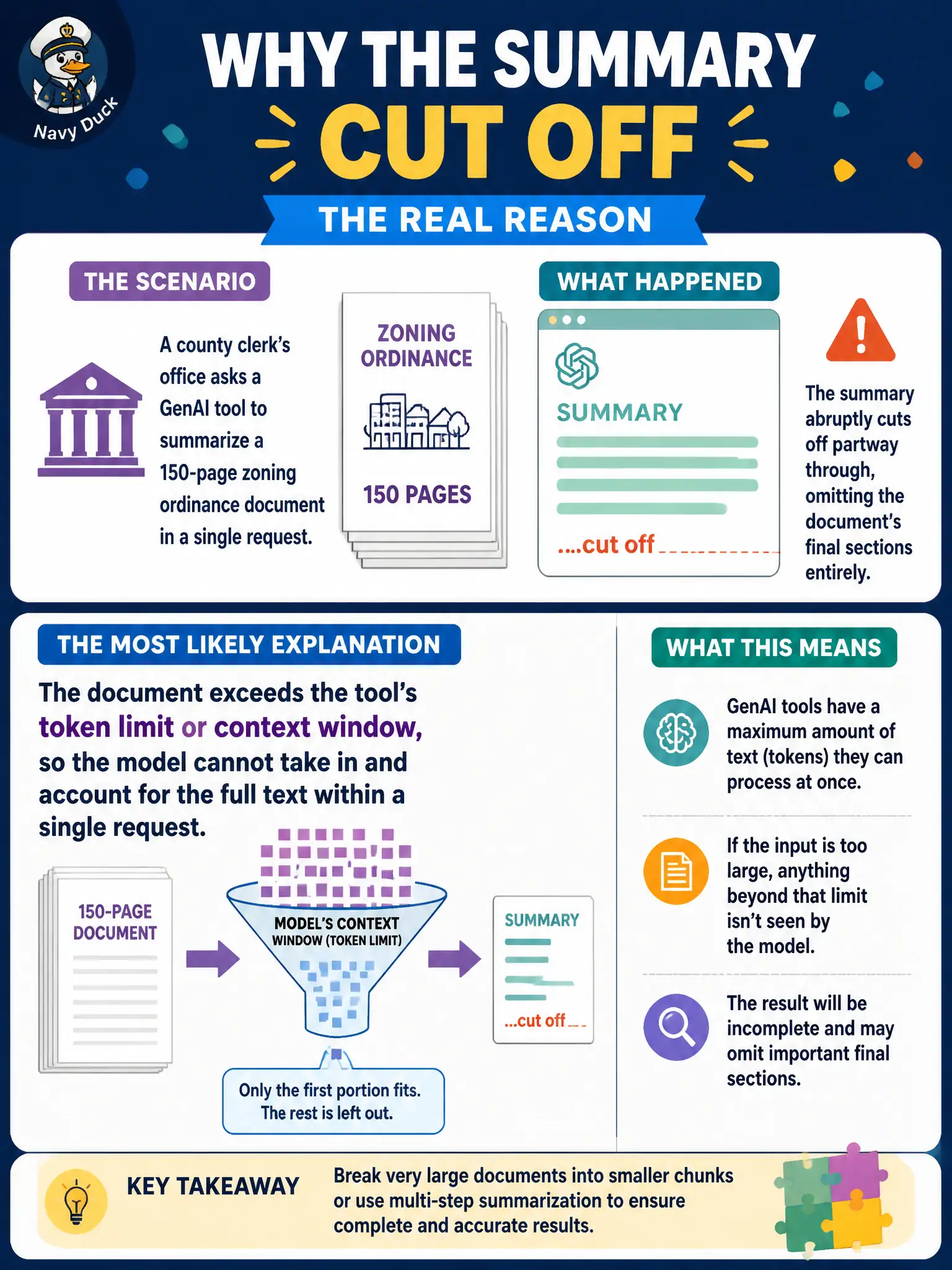
A county clerk's office asks a GenAI tool to summarize a 150-page zoning ordinance document in a single request, and the summary abruptly cuts off partway through, omitting the document's final sections entirely. What most likely explains this behavior?
Select an answer to reveal the explanation.
Short Explanation
Picture trying to read an entire 150-page report out loud in one breath, at some point you just run out of air. GenAI tools have the same kind of limit, a token limit, that caps how much text they can take in and produce at once. When a document that long gets cut off mid-summary, that ceiling is almost always the reason.
Full Explanation
Understanding token limits and context windows as a business concept means recognizing that every GenAI tool has a fixed ceiling on how much text, input plus output combined, it can process in a single request, and a document long enough to approach or exceed that ceiling gets truncated rather than fully summarized. Here a 150-page ordinance is a plausible candidate for exceeding that ceiling, and the abrupt mid-document cutoff, rather than a gradual loss of detail, is the telltale sign of hitting a hard limit rather than a quality problem. Attributing the cutoff to insufficient zoning-related training data confuses a knowledge gap, which would produce vague or generic content throughout, with a length constraint, which produces a document that stops cold partway through. Claiming the tool has a built-in compliance safeguard for legal documents invents a mechanism with no basis in how these tools actually work; nothing about summarizing regulatory text triggers deliberate truncation. Blaming prompt vagueness assumes the model chose to stop because it judged the summary complete, but a summary that cuts off mid-section and skips entire final chapters is not what a satisfied stopping decision looks like. A scope caveat: different GenAI tools have different limits, so the fix depends on the specific tool in use. A concrete operational check: split the ordinance into smaller sections and summarize each separately, then confirm the combined summaries now cover every section of the original document.