
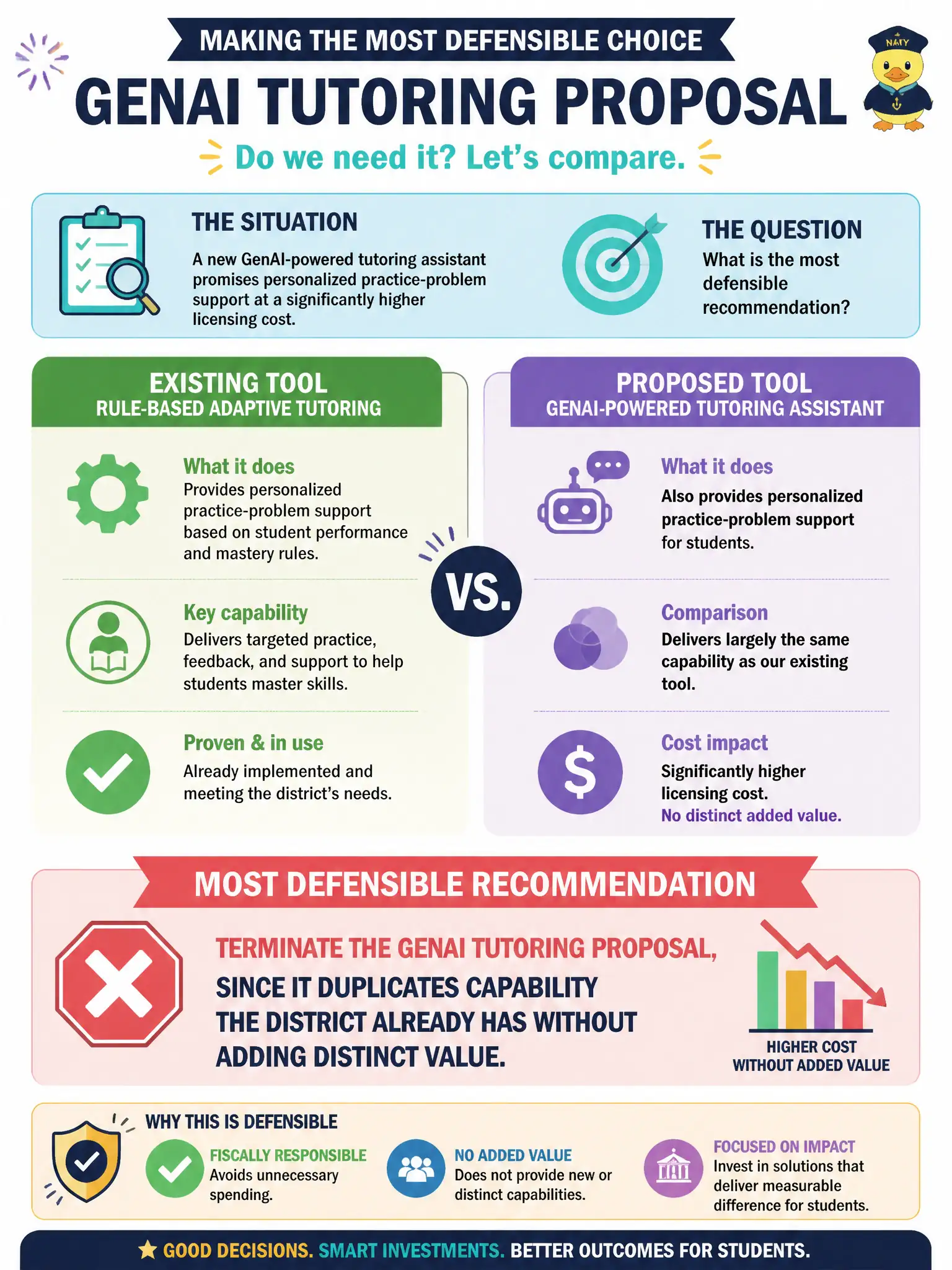
A school district's IT director reviews a proposal for a new GenAI-powered tutoring assistant and finds it would deliver largely the same personalized practice-problem support that the district's existing rule-based adaptive tutoring tool already provides, at significantly higher licensing cost. What is the most defensible recommendation?
Select an answer to reveal the explanation.
Short Explanation
If you already own a working toolbox, you don't buy a second one that has the same wrenches, just shinier. This GenAI proposal does the same job the district's existing tutoring tool already does, for a lot more money. When a new initiative just duplicates what's already there, terminating it is the responsible call, not price negotiation.
Full Explanation
Recognizing redundancy as grounds for terminating a proposal starts with comparing what the new initiative would actually deliver against what existing tools already provide, because paying more for the same outcome creates cost without added value regardless of how advanced the new technology sounds. Here the GenAI tutoring assistant covers functionally the same personalized practice-problem support the district's current rule-based tool already handles, so its added licensing cost has nothing distinct to justify it. Assuming generative AI is generally more advanced mistakes a technology's broader reputation for a specific finding about this comparison; the exam-relevant judgment is about the actual capability gap, or lack of one, not the technology's general sophistication. Piloting a scaled-down version without first identifying a unique gap skips the analysis step entirely, spending implementation effort to discover something a straightforward feature comparison could have answered up front. Postponing the decision for a lower price treats cost as the only issue, when the deeper problem is that the tool adds no distinct value at any price point until a real capability gap is identified. A scope caveat: this conclusion would change if the GenAI tool could be shown to handle a case the rule-based tool cannot, such as open-ended writing feedback. A concrete check: have the IT director request a side-by-side feature comparison, not a marketing summary, from the GenAI vendor before any further review.