
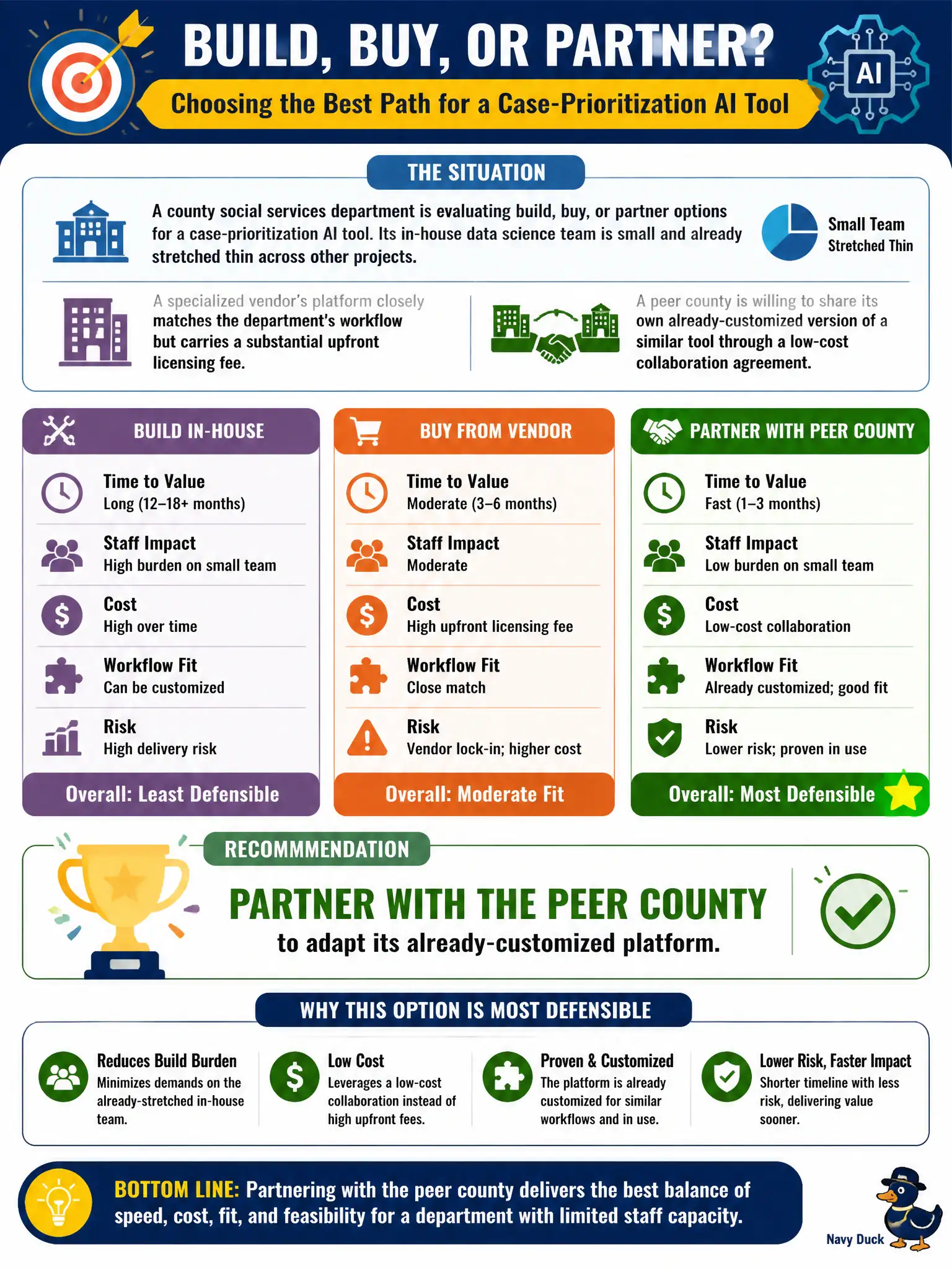
A county social services department is evaluating build, buy, or partner options for a case-prioritization AI tool. Its in-house data science team is small and already stretched thin across other projects. A specialized vendor's platform closely matches the department's workflow but carries a substantial upfront licensing fee, while a peer county is willing to share its own already-customized version of a similar tool through a low-cost collaboration agreement. Given the department's limited staff capacity, which option is most defensible?
Select an answer to reveal the explanation.
Short Explanation
When your own team is already stretched thin, the smartest move usually isn't building from scratch or writing a big check, it's borrowing something a neighbor already fixed up. That's the partner option here: a peer county's tool already fits the workflow, and grabbing it through a low-cost agreement takes the pressure off a data science team that doesn't have room to spare. It's not about which option looks most impressive, it's about which one your capacity can actually support.
Full Explanation
A build-buy-partner recommendation has to weigh workflow fit against what the organization can realistically execute given its current staffing, because even a perfect-fit option becomes a liability if the team lacks bandwidth to implement and maintain it. Here the partner option satisfies both constraints at once: it fits the department's workflow, since it is already adapted to a similar caseworker process, and it demands little of the strained internal team, since most of the customization work is already done. Building in-house ignores the stated staffing constraint entirely, treating customization control as more important than the team's actual capacity to deliver it. Buying the vendor platform addresses workflow fit but carries a cost burden the scenario flags as substantial, and licensing cost alone does not offset the fact that a lower-cost, comparably-fitting alternative exists. Pausing the initiative until more staff are hired treats capacity as fixed and unsolvable, when the partner option shows a capacity-appropriate path is available right now, making delay unnecessary. A scope caveat: this reasoning depends on the peer county's tool remaining a genuinely close workflow fit; if the case types diverge significantly, the calculus could shift back toward buy. A concrete check: before signing the collaboration agreement, confirm data-sharing and privacy terms are compatible with the department's own governance requirements.