
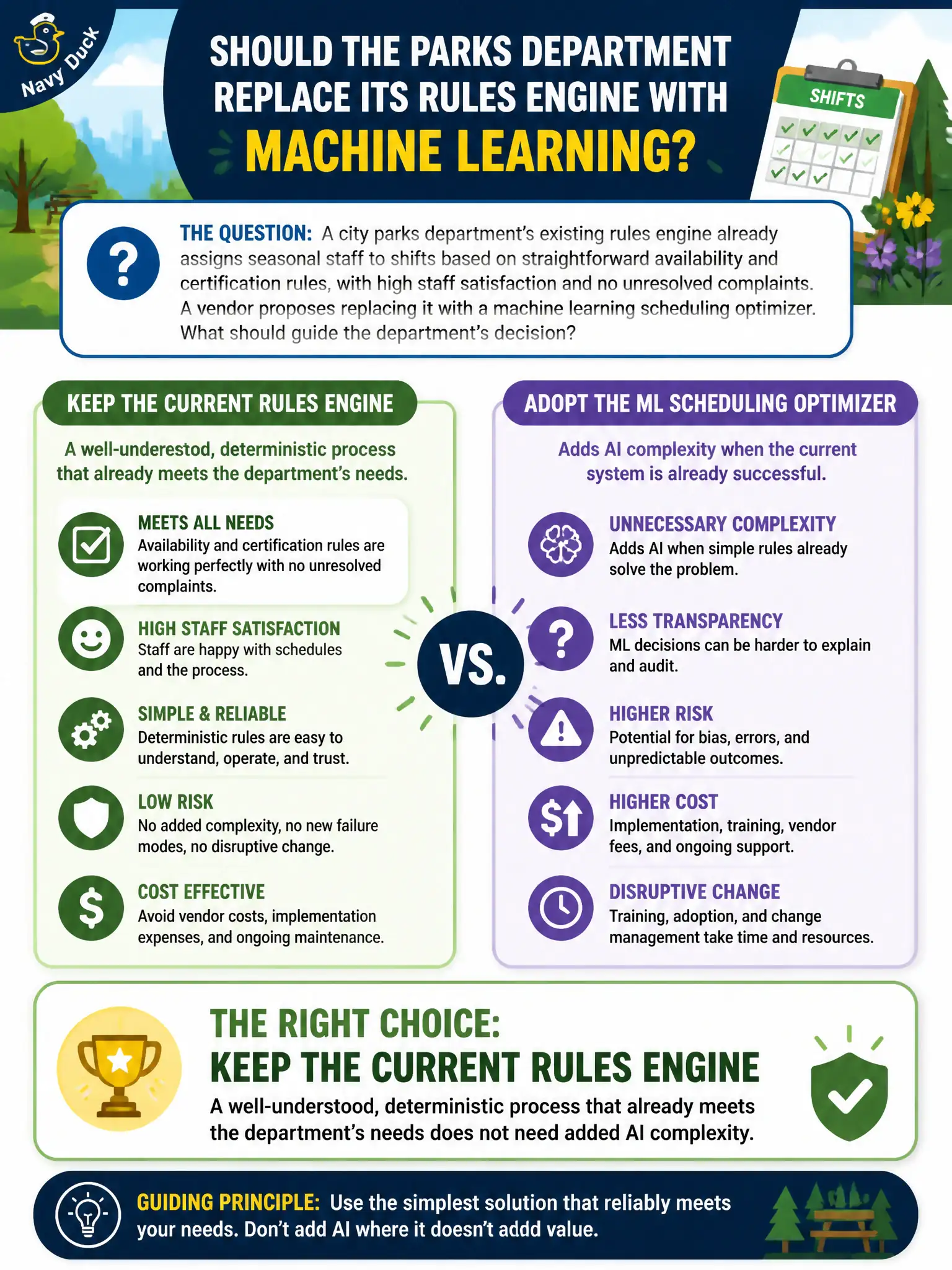
A city parks department's existing rules engine already assigns seasonal staff to shifts based on straightforward availability and certification rules, with high staff satisfaction and no unresolved complaints. A vendor proposes replacing it with a machine learning scheduling optimizer. What should guide the department's decision?
Select an answer to reveal the explanation.
Short Explanation
If your bike already gets you to work on time every day, you don't need to shop for an engine. That's this rules engine: it's simple, it's deterministic, and nobody's complaining. When a process this well-understood already meets the need, the smart call is to leave it alone and save the AI investment for a problem that actually has one.
Full Explanation
Recognizing when to keep AI out of a process starts with checking whether the existing solution already meets the business need reliably, because introducing machine-learning complexity into a well-functioning deterministic process adds risk, cost, and opacity without a corresponding gap to close. Here the rules engine handles a bounded, well-defined problem, availability and certification matching, with documented satisfaction and no outstanding complaints, which means there is no performance gap for a scheduling optimizer to fill. Assuming machine learning generally outperforms rules-based systems mistakes a general industry trend for evidence about this specific, already-solved problem; general superiority claims do not override a working solution. Piloting the optimizer only during peak season sounds cautious, but it still commits real implementation effort toward closing a gap that has not been shown to exist, since peak-season complaints were never part of the picture described. Running a shadow pilot before deciding treats every vendor proposal as deserving evaluation, but resources for that kind of evaluation are better spent on initiatives where an actual capability gap has first been identified. A scope caveat: this changes the moment scheduling complexity increases, such as multi-site cross-training constraints the rules engine cannot express. A concrete check: before entertaining any proposal, the department should confirm no recurring scheduling pain points exist in recent staff feedback logs.