
Six months into a permitting-assistance AI pilot, a county CIO finds the vendor's platform cannot reliably parse the county's multi-department permit forms, causing frequent manual overrides that erase the promised time savings, and the vendor has no near-term roadmap to fix the parsing limitation. Under these conditions, what is the most defensible justification for the CIO to transition to a different AI platform?
Select an answer to reveal the explanation.
Short Explanation
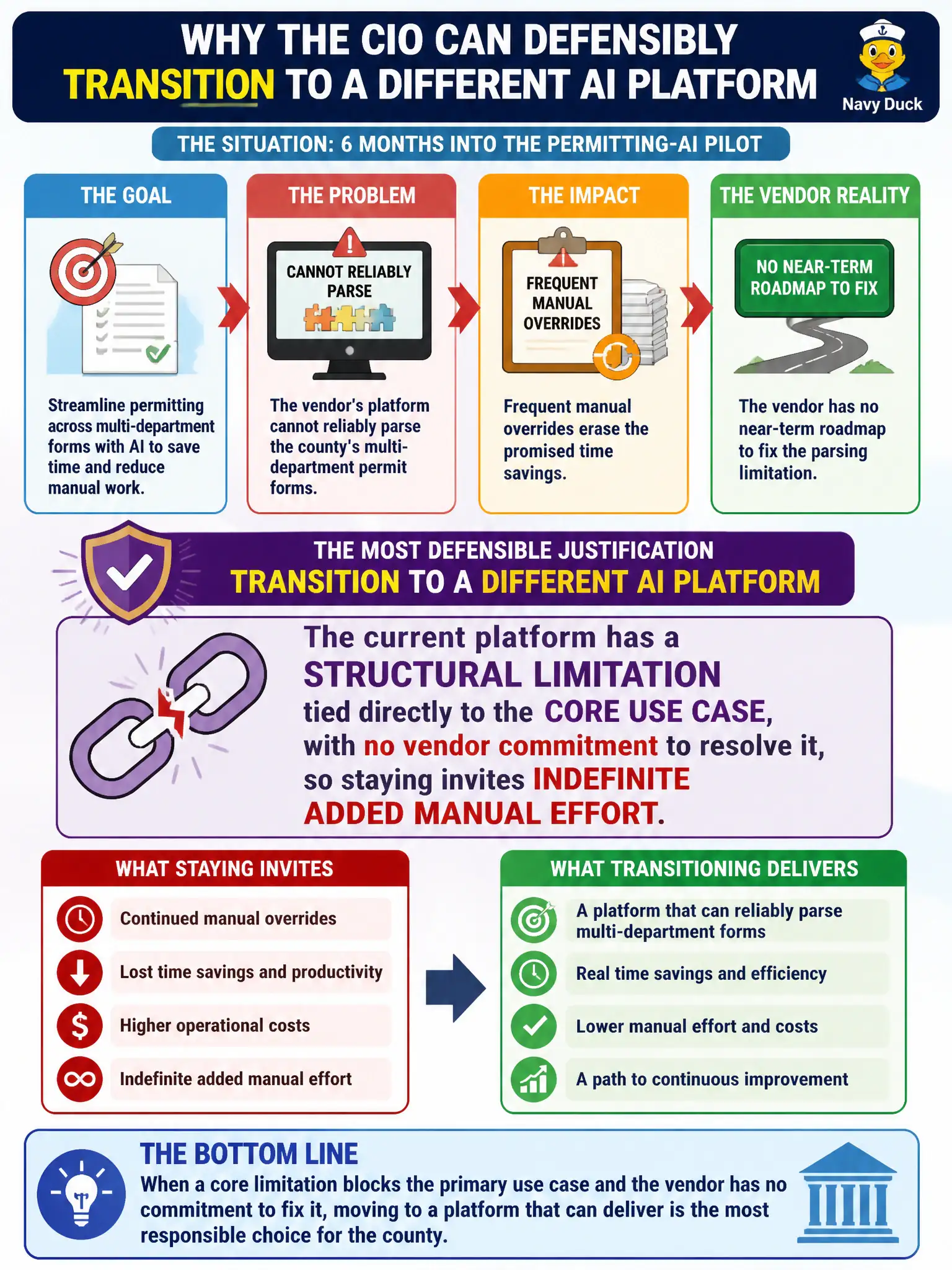
Switching platforms mid-program is a big call, so it needs a big reason, not just a shinier option down the street. Here the reason holds up: the tool can't do the one job it was bought for, and the vendor isn't fixing it, so every month spent waiting is a month of manual overrides piling up. That's a structural problem, and structural problems are what justify a switch.
Full Explanation
A platform transition mid-program is justified when the mismatch is structural and tied to the core use case rather than cosmetic or preferential, because structural gaps do not close on their own and keep generating cost indefinitely. Here the parsing failure directly undermines the pilot's core promise, faster permit processing, and the vendor's lack of a roadmap means the county has no credible path to resolution by staying put. Chasing a newer platform simply because it has more features conflates capability breadth with fit for this specific permitting workflow; extra features that do not address the parsing gap do not justify the switching cost. Staff interface preference is a real usability signal worth tracking, but it is subjective and does not establish that the current platform cannot do the job, which is the higher bar a mid-program switch requires. A peer county's early satisfaction with a different vendor is suggestive, not diagnostic, since it says nothing about whether that vendor actually solves this county's specific form-parsing problem. A scope caveat: this justification applies to the specific limitation described, not to switching vendors generally whenever friction appears. Before committing, the CIO should get a written, dated commitment from any replacement vendor demonstrating a successful parse of a representative sample of the county's actual multi-department forms.