
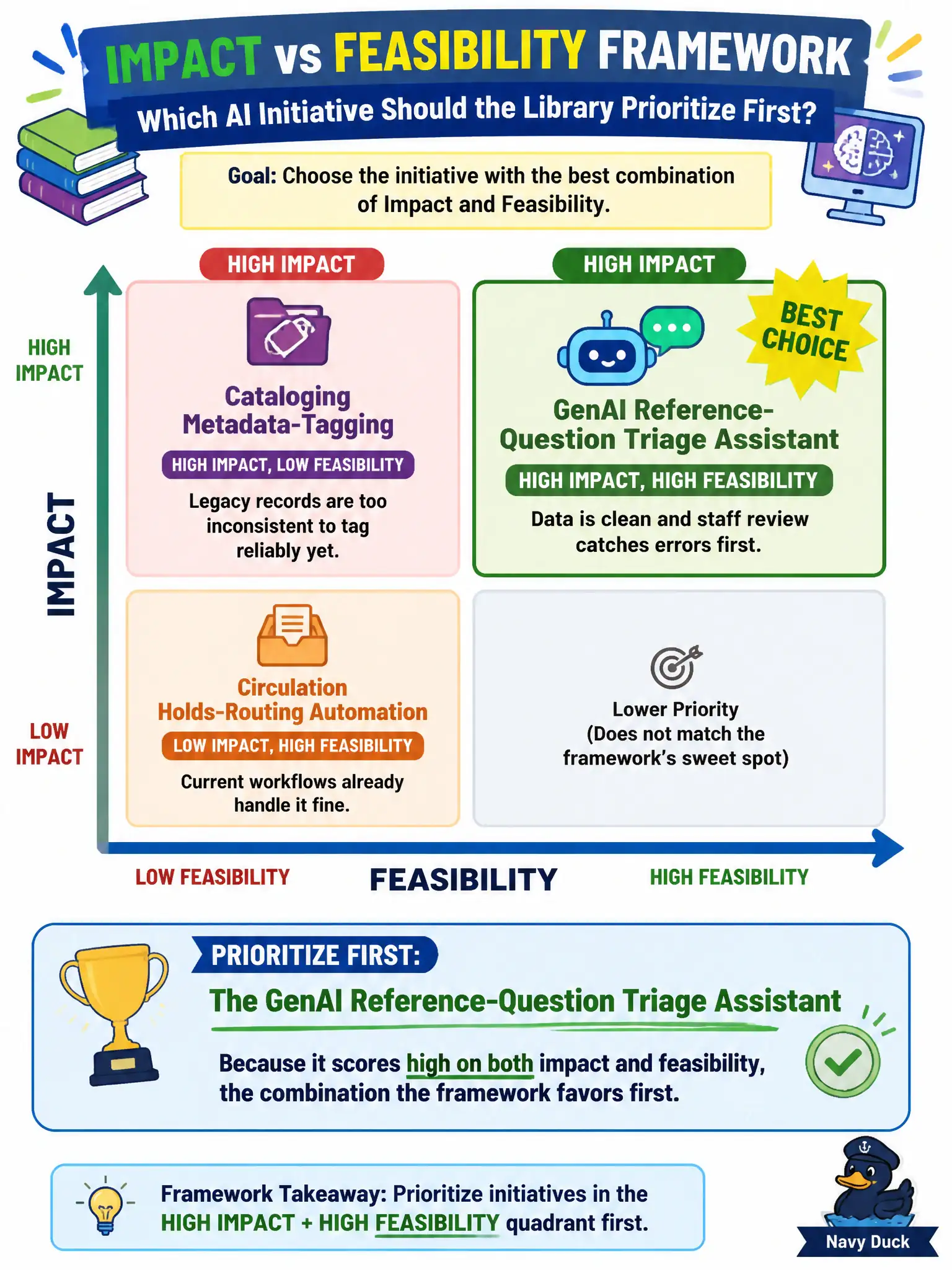
A library system scores three candidate AI initiatives with an impact-versus-feasibility framework. Circulation holds-routing automation: high feasibility, low impact, since current workflows already handle it fine. Cataloging metadata-tagging: high impact, low feasibility, since legacy records are too inconsistent to tag reliably yet. A GenAI reference-question triage assistant: high on both, since its data is clean and staff review catches errors first. Which initiative should the library prioritize first?
Select an answer to reveal the explanation.
Short Explanation
Think of impact and feasibility like two lanes on a highway on-ramp: you don't just want a project that's easy, and you don't just want one that matters, you want the one that clears both checks at once. That's the reference-triage assistant here, high value and low risk together, so it goes first. The other two ideas are still worth doing, just not first.
Full Explanation
An impact-versus-feasibility framework works by plotting each candidate on two axes and prioritizing whichever initiative lands furthest toward high on both, because that combination delivers meaningful value with the least execution risk. Here the reference-triage assistant is the only initiative scoring high on both dimensions, since its data is already clean and its errors are caught before reaching residents, which is exactly the quadrant the framework is designed to surface first. The circulation automation tool fails on impact even though it is easy to build; feasibility alone does not earn top priority when the underlying problem is already adequately solved. The cataloging tool fails on feasibility even though the backlog it would clear is large; high impact does not overcome a foundation of inconsistent legacy data that has to be cleaned up before an AI tool can tag it reliably. Treating all three as equal priority abandons the framework's whole purpose, which is to produce a sequence, not a flat list. A scope caveat worth noting: feasibility scores can shift once upstream work, like a metadata cleanup project, changes the picture, so the ranking should be revisited periodically rather than treated as permanent. A concrete check: before greenlighting the triage assistant, confirm the staff review step is actually staffed and funded, not just assumed.