
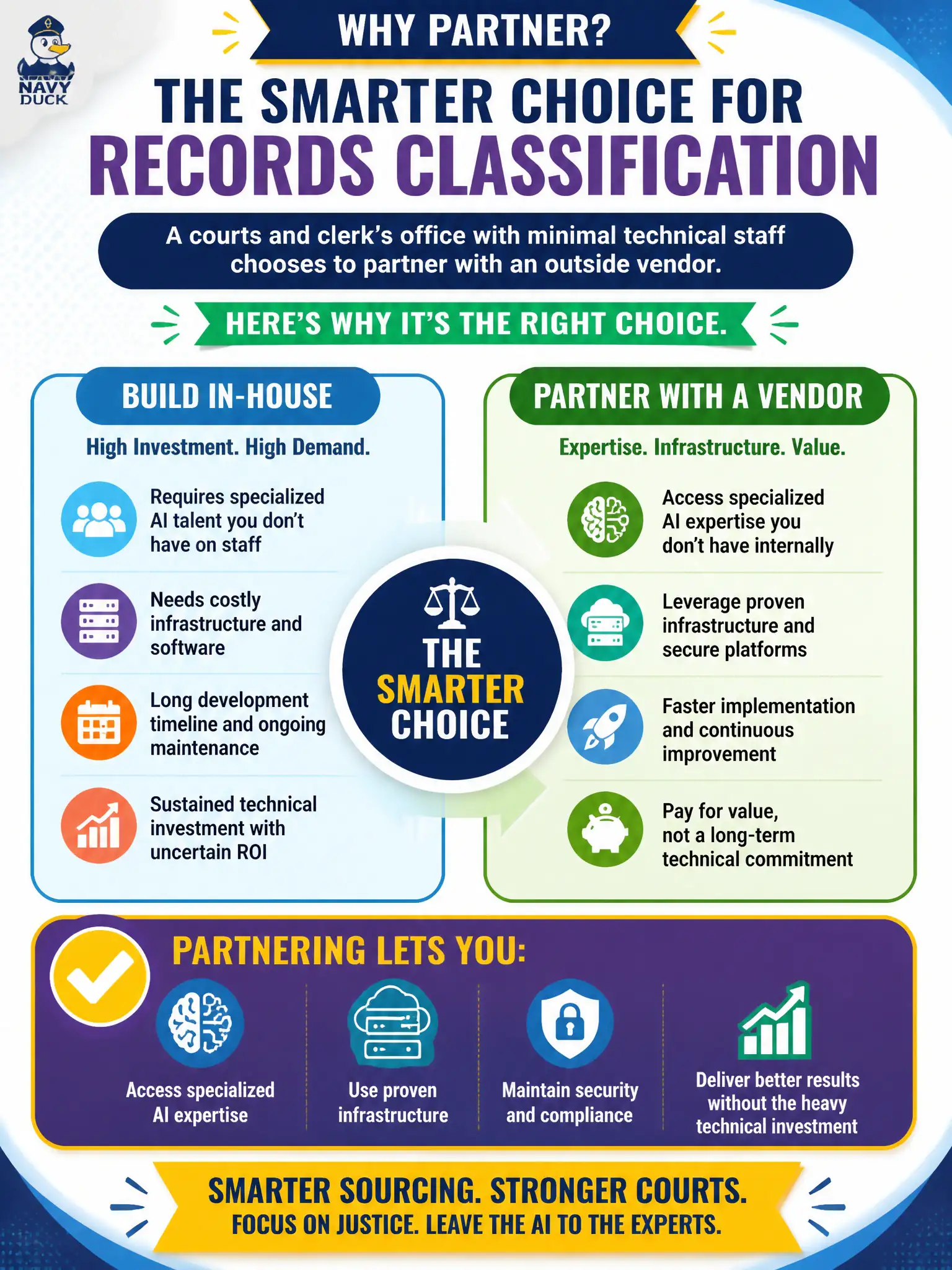
A courts and clerk's office with minimal technical staff decides to partner with an outside vendor rather than build an in-house AI tool for records classification. What makes this the appropriate sourcing choice?
Select an answer to reveal the explanation.
Short Explanation
With barely any technical staff on hand, building your own records-classification tool is like trying to fix your own plumbing with no tools in the garage. Partnering brings in someone who already has the expertise and the pipes on hand, without the office committing to build that capability from scratch.
Full Explanation
Partnering with a specialized vendor gives the office access to AI expertise, infrastructure, and ongoing technical support it doesn't have internally, without requiring the sustained staffing investment that building and maintaining a custom in-house tool would demand. For an office with minimal technical staff, that's precisely the constraint that makes partnering the sourcing option best matched to actual capacity, since building in-house would leave the tool under-resourced the moment initial development finished. Framing the choice purely around cost, claiming partnering is always cheaper regardless of staff capacity, misses that the real driver here is capability, not price; partnering can sometimes cost more than a DIY build, but it remains the right call because the office lacks the staff to sustain a build. Believing partnering removes any need for governance oversight is a dangerous assumption, since the office is still accountable for how the vendor's tool classifies sensitive court records, and oversight of the partnership itself remains necessary. Insisting offices with minimal technical staff should always build custom tools gets the readiness logic backwards; limited technical capacity is generally a reason to lean toward buying or partnering, not toward taking on a build. As an operational check, the office should confirm the partnership agreement specifies who is accountable for reviewing the vendor's classification accuracy over time, since a partnership without a defined oversight role can quietly become unmonitored regardless of who built the tool.